


Potential
developments such as these have been identified and assessed by the Millennium
Project of the American Council for the United Nations University.The
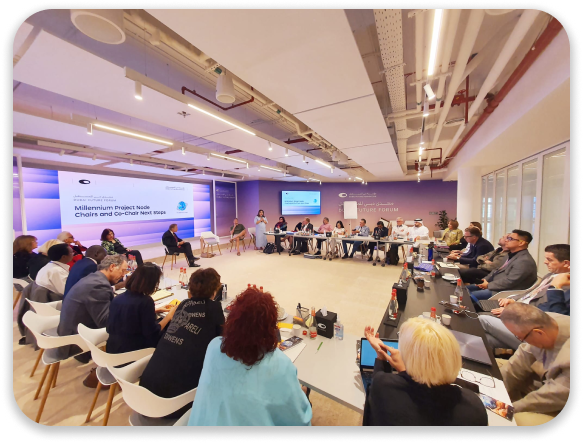
Project is a globally decentralized think tank of 550 futurists, business
planners, scholars, scientists, policy advisors, and decisionmakers who
work for international organizations, governments, corporations, universities,
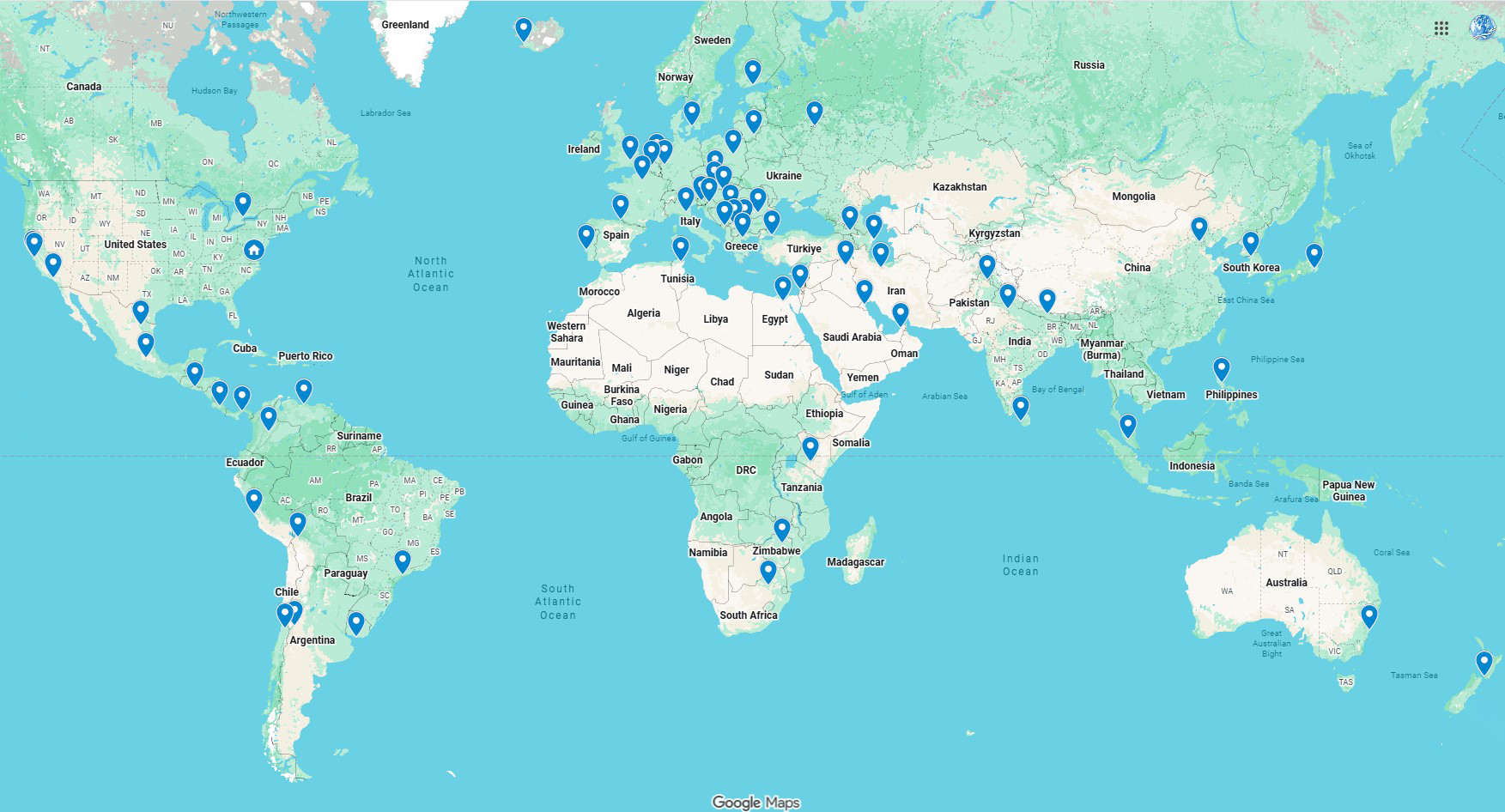
and NGOs in over 50 countries.“Nodes”
or groups of individuals and institutions in eleven locations around the
world interconnect local and global perspectives via translated questionnaires
and interviews.
Over
the last three years, the Millennium Project used this network to identify
and study issues, opportunities and actions.[1]
These have been further synthesized to 15 Global Challenges
humanity faces at the millennium.
1.How
can sustainable development be achieved for all ?
2.How
can everyone have sufficient clean water without conflict ?
3.How
can population growth and resources be brought into balance ?
4.How
can genuine democracy emerge from authoritarian regimes ?
5.How
can policy-making be made more sensitive to global long?term perspectives
?
6.How
can the globalization and convergence of information and communications
technologies
work
for everyone ?
7.How
can ethical market economies be encouraged to help reduce the gap between
the rich and
poor
?
8.How
can the threat of new and reemerging diseases, and immune micro organisms
be reduced?
9.How
can the capacity to decide be improved while the nature of work and institutions
is
changing?
10.How
can shared values and new security strategies reduce ethnic conflict, terrorism,
and the
use
of weapons of mass destruction ?
11.How
can the changing status of woman improve the human condition ?
12.How
can organized crime be stopped from becoming more powerful and sophisticated
global
enterprises
?
13.How
can the growing energy demand be safely and efficiently met ?
14.How
can scientific and technological breakthroughs be accelerated to improve
the human
condition
?
15.How
can ethical considerations become more routinely incorporated into global
decisions?
All
of these 15 Global Challenges involve social-technological dynamics.Most
of the following material in this paper is drawn from the 1999 State
of the Future’s[2]
discussion of Challenge 14 on science and technology; however, some material
is also drawn from the other challenges.
Globalization
of Science and Technology
A
fundamental trend affecting the world is the accelerating pace of scientific
progress and technological applications.This
trend shows no signs of slowing down. The synergies among the sciences
and confluence of technologies have been accelerated by the global convergence
of communications and information technology.This
convergence has led to a dramatic increase in cross?disciplinary invention,
geographically disbursed research collaboration, and rapid dissemination
of information. Boundaries between classic disciplines are disappearing.
The Genome Project, the Intergovernmental Panel on Climate Change (IPCC),
and the International Space Station are examples.
During
the Cold War, basic research was conducted in parallel in different countries
at the same time. Today basic scientific research is becoming more expensive,
specialized, and is being conducted in centers with international participation,
giving rise to the need for international principles of international specialization
and collaboration. What happens when one country within a large scale international
project -- such as the super collider or the international space station
-- does not meet its responsibilities ?
We
need to develop and accept an international convention for the regulation
of basic principles of collaboration, and develop principles for international
support of unique research centers. Since much basic research has become
international, it should be financed internationally.National
contributions should be proportional to GDP and should not depend on the
research location. The first principle of international collaboration should
be that the results of such collaboration are available to all. A second
principle should be the selection of unique facilities to prevent unnecessary
redundancy, such as particle accelerators and space stations. These facilities
should be supported not only by the governments, but also by corporations
and patrons of the arts and sciences.
Ultimately,
technology comes from basic research, which provides the growing pool of
knowledge from which applied science draws its insight. Since basic research
(as a percent of the global economy) is falling, the future of technology
is threatened. We should collect, discuss, and disseminate all the good
arguments for basic research. UNESCO, ICSU, and/or UNU could provide the
focus for such collection and distribution. Such a study should focus more
attention on the link between application and research. When inventions
are proprietary, technology dissemination may be slowed. Companies performing
the research deserve to get a return for their efforts.A
study might ask better ways to serve both patent rights and dissemination
speed.
According
to interviews conducted by the Millennium Project, multinational corporations
would like to produce technology through more environmentally friendly
means, but they want global rules applied equally with internationally
and scientifically defined measures of “environmentally friendly means”
before they commit to significant changes. UNEP, UNESCO, UNU, ICSU, and
possibly, IPCC and WTO should create international scientific boards to
define terms, standards, and measurements so that it might be possible
to commonly apply environmental policies such as tax incentives, labels,
full-cost accounting, trade and other policies to help achieve sustainable
development. In parallel, ECOSOC should lead the policy discussion for
binding sanctions and enforcement mechanisms for any agreements that flow
from this work.
National
development banks in poorer regions should increase R & D funding for
new competitive local production systems and new technological applications.
If the countries are members of WIPO, then they can register for patents
with WIPO (useful for countries that lack their own patent systems).The
Convention on Biodiversity calls for countries (which cannot develop their
own genetic resources) to receive benefit from those who patent such biological
sources.
One
suggestion made by participants in the Millennium Project was that UN organizations,
with some leadership by governments, should establish an international
technology bank, funded by country pledges, that could acquire the rights
to “green” technologies and make them available to less advantaged
countries. Some views on this suggestion were that...The bank should focus
first on the most ecologically dangerous regions.... Such a bank should
have direct links to corporations.... The first step has been taken with
the Global Environmental Facility.... The regional development banks
could open sections to address this issue.... Many in developing countries
think that the developed countries' objective in these kinds of issues
is to suppress the economic success of poorer countries. For this reason,
UN organizations are the best mechanisms to implement this.
International
cooperation has linked individual labs into collaboratories, which can
be thought of as labs “without walls in cyberspace” connected via video,
voice, graphics, data bases, and shared software. ICSU and UN organizations
like UNU could help connect individual scientists and labs in developing
countries and more advanced countries. The cost of transceivers is falling
and radio links from these transceivers to local computer terminals with
radio modems could create low cost rural access. Developing countries have
both a work force and a THINKING FORCE at reasonable prices. Better to
hire or contract than to subsidize them. India and China produce good science,
but received few subsidies.
Since
new technologies will help solve pressing issues and improve the lives
of most people, yethave dangers
and hidden consequences, technological forecasting and assessment should
be considered more seriously.An
international organization such as UNU/INTECH should be adequately financed
to anticipate and assess, to the extent possible, the consequences of scientific
breakthroughs and technological applications.For
example, if low?cost methods to determine the sex of a child are available
in China and India with 40 percent of the world's population and where
male children seem to be preferred, the demographics of humanity would
be drastically altered. Although biotechnology could feed the world, it
might also eliminate livelihoods for vast numbers of people and create
serious environmental problems. Scientists who have determined the minimum
number of genes to create life, believe they can create new organisms from
only chemical ingredients. Since new life forms could become biological
weapons as well as organisms to eat toxic wastes and produce fertilizer,
the scientists have called for a public assessment prior to creating new
life forms.
Space
Technology
The
synergies of advanced research in biology and physics necessary for human
space flight have generated an extraordinary number and range of inventions;
stimulated thought about the meaning of life, history, and our common future;
and created many opportunities for peaceful international cooperation.
Space?related inventions have created new industries, tax sources for social
programs, improved living standards, expanded access to tools by miniaturization,
and produced processes that have lowered the costs of many technologies
from satellite communications to medical diagnostic techniques. Some argue
that migration from earth is inevitable; it is in the myths of many cultures;
it is an exciting goal and could provide alternative habitats as an insurance
for the human species should an earthly catastrophe destroy life on earth.For
example, if the trajectory of the comet that crashed into Jupiter in 1994
had been slightly different, it would have destroyed life on the earth.
New
space projects could continue to improve our understanding of the nature
of the solar system and the universe; develop completely novel technologies
that could contribute to alleviation of some of the world's most vexing
problems (food, shelter, health, etc.); lower costs and increase efficiencies
in production processes; accelerate peaceful international collaboration;
provide virtually instant, ubiquitous multi-communications among both fixed
and mobile users; and possibly confirm extraterrestrial intelligence or
microbial life (a development that could revolutionize our sciences, values,
philosophies, and views of the universe). Public interest is high. For
example, the coverage of the 1997 July 4th Mars rover landing and surveying
was one of the biggest Internet events in history with 700 million hits
on NASA's web site over a 2?3 month period.
By
the year 2050, the energy demand of a larger and wealthier Third World
will require enormous amounts of energy that probably can be delivered
from solar power satellites without generating either greenhouse gases
or nuclear wastes.A solar power
satellite should be tested in orbit. This should be the next major goal
after the International Space Station (ISS). A study in the mid-1970s assumed
that all materials and components were manufactured on earth and then flown
to orbit by a large number of flights by the original space shuttle. The
approach preferred by leading advocates of solar satellites are more cost/effective.They
suggest the use of nearby asteroids and/or lunar material and manufacture
and assemble as much as possible in space.An
orbital “robot spider” could spin photovoltaic webs. The US has allocated
$25 million to update the previous research on solar power satellites.
The
graph from Fig. 1, Consumption of Fossil Fuels over time,
by Guy Pignolet, European Space Agency, illustrates that fossil fuel, like
the match, has a short life compared to the past and potential future of
humanity.
|
Fig.
1. Consumption of Fossil Fuels over time
|
NASA
is leading an international effort, Mission to Planet Earth, now called
Earth Science, to use satellites and ground sources to provide data to
create an integrated computer model of the earth from cloud tops to inside
the oceans within four years. Attention to global warming will help put
space on the political agenda by drawing attention to the role of monitoring
earth from space.As we realize
the fragility of life on earth, the need to have communities off earth
as insurance for the future of humanity will become more apparent.
1996
was the first year that private sector revenues from space activities exceeded
general government expenses for space activities. The NASA Space Shuttle
is semi?private now. As government budgets reduce, privatization will continue,
but governments still need to lead with the International Space Station
(ISS), though it too will move toward privatization. 17 nations are involved
in the construction of ISS. 45 space flights are planned from 4 launch
sites that will lift 100 pieces of equipment to assemble the ISS.
Space
industrialization should be seen by all nations as a shared project. It
was suggested that commercial ventures in orbit, on the moon or on Mars
should pay a fee to the UN. The UN should develop international law and
administer the collection of these fees. Another participant suggested
that if the Moon were made a UN Trusteeship, then earthlings would learn
how to work together as a species to manage a planetary body. The reverberations
for world peace and security from this experience could be enormous.
The
single most important goal for society to receive more benefits from space
programs is to lower the cost of transportation to earth orbit. This has
been a priority for the past 30 years, but the political decisions have
not matched this goal.It is seen
as infrastructure and not politically exciting technology.An
exciting spokesman and forum for launch costs research is needed.Maybe
the UN Millennium General Assembly is the right forum.
Nanotechnology
One
of the most important trends is the continuing microminiaturization of
technology increasingly being referred to as micro- and nanotechnology.
Green leaves of plants can be thought of nature’s nanotechnology for food
production. As scientists learn more about molecular chemistry, they will
be able to create similar nano-scale production processes for manufacturing
a vast array of products. Small devices could be produced by using photolithography
similar to the processes that produce computer chips today. President Clinton's
Science and Technology Advisor Neal Lane stated that nano-scale science
and engineering is the "most likely area of science and engineering to
produce the breakthroughs of tomorrow." Nano tubes could be used as nanometer?sized
probes for imaging in chemistry and biology or cables in miniaturized electronic
devices. Self?organizing machines could assemble themselves using forces
such as molecular recognition, hydrophobicity and hydrogen bonding.
"The
ultimate fantasy," says Jim Von Her, president of Zybex "is to have a machine
the size of a sugar cube that has a solar panel that sucks carbon dioxide
out of the air, strips the oxygen away and starts building," Bill Spence,
editor of NanoTechnology magazine, predicts micro?manufacturing
sites in private homes, where people build their own wristwatches and computers
as easily as they would print out an article. Spence suggests that one
day nanotechnology could prolong life by modifying human genetic and cellular
structure.
Dr.
Richard Smalley (Nobel Laureate in Chemistry 1996) testified 12 May 1999
before the US Congress that nanotechnology could make cables strong enough
to make an elevator to orbital space possible, and thus revolutionize space
transportation.
Biotechnology
Many
have called the next century the “Biological Century.” Gene technology
and clone technology can create new biological species, decrease the starvation
of the globe, and improve the condition of the developing countries. Between
1987 and 1996 there were 45,085 biotechnology patents registered in the
US.Usage of transgenic crops have
increased from 7 million acres in 1996 to 75 million in 1998. In addition
to making plants more productive on diminishing agricultural land, agricultural
genetics will also redefine what land is productive. As new plant strains
are developed that allow marginal lands to accommodate agriculture, the
land area in the world that is engaged in farming may grow.
In
addition to sources of food, biotechnology in animal husbandry will also
provide animals that serve as production factories for human pharmaceuticals.
Cows will be seen as bio?reactors, making valuable products. The human
gene for insulin or clotting factor, for example, can be inserted into
the germ plasma of cattle and sheep at a genetic location that leads to
easy harvesting of the desired human chemical in urine, blood or milk.
Cloning these animals then makes available large quantities of drugs that
today may be more valuable than platinum or gold. To over simplify, feed
the cow (bio?reactor) hay and water, and get pharmaceuticals.
Another
new approach to drug development called "combinatorial chemistry" uses,
say a million combinations of chemicals 1, 2, 3, ...nplaced
on a microchip in all permutations: 1 alone, 1+2, 2+3, 3+4, etc. The chip
is exposed to a disease marker and the top sets of combinations of molecules
that are likely to be effective against the disease are identified. This
screening approach speeds the development of more effective medicines.
Unfortunately,
biotechnology can have dangerous effects on the environment. Genetically-engineered
traits from one crop can move to it’s relative creating “super weeds” more
difficult to kill.The EU has proposed
that genetically modified (GM) foods receive a special label. Increasingly
foods are composed of ingredients which in turn have many sources making
it increasingly difficult to know if there are no GM sources in the final
food product. There are nine major food sources that have been genetically
engineered: soya, corn, canola, cotton, potatoes, tomatoes, squash, papaya,
rBGH dairy products. From these come all sorts of processed derivatives,
e.g., soy oil, corn starch, corn syrup, canola oil, lecithin, vitamin E,
etc.Because none of them are labeled,
and because the GM soy and corn crops, for example are not segregated from
the non?GM ones, when the processors go to make corn syrup, both the GM
and non?GM corn are mixed together and the entire batch is thus affected.
The cost implications for segregation and labeling are enormous; consider
what a non-GM food manufacturer would have to do to prove the absence of
GM sources.
Over
135 nations and public interest groups have supported a biosafety protocol
which would tighten regulations on genetically engineered seeds, grains,
and foods. So far the US, Canada, Australia, Argentina, Uruguay and Chile
-- the world’s major producers of GM commodities -- do not support it.
Increased
funding devoted to the study and discussion of ethical issues in biotechnology
including patents, royalties, and advanced informed consent is necessary.These
issues have to be debated among biologiests, legal scholars, politicians,
and citizens. Such discussion could be facilitated by UNESCO and documented
and analyzed by UNU/INTECH.
The
mapping of human and plant genomes will provide the means to eliminate
diseases that have genetic origins or which result from malfunctioning
of genetic material in the body. Genetic medicine concentrates on curing
of diseases from the inside, while conventional medicine administers therapies
from the outside in.
The
process of cloning was demonstrated in 1997 when a sheep, Dolly, was successfully
cloned in Scotland. Since then, mice have been cloned in Japan, calves
in New Zealand, and other organisms else where.The
possibility of human cloning has been seriously discussed, and the production
of organs from one's own genetic material seems at least plausible. Although
it has be noted that Dolly’s telemeters - the material at the ends of chromosomes
which are associated with aging - are shorter than one would expect, leading
some scientists to think that the sheep inherited some of its age as well
as its genetic make up from its six-year-old mother's cells.
Nevertheless,
it is likely that cloning will be used for growing of spare parts for one's
self, and as an alternative procreational technique. There's a technique
now coming into use in which a baby's umbilical cord cells are stored so
that these cells can be stimulated into development later on if replacement
cells are need by the adult, say cells for a bone marrow transplant or
brain repair. With this approach one’s umbilical cells, stored years earlier,
could be the source of new cells.
In
addition to using stem cells to produce human organ replacements, stem
cells from cows and fish could be used to grow muscle tissue in protein
factories reducing the need for cattle and fishing industries.
Information
Technology
Internet
is the greatest growth phenomena in history and has operationalized the
term “global.” Cyberspace could become an unprecedented medium for civilization.
Information technology (IT) has made new alliances unknown to traditional
power and promises to give equal access to rich and poor. The art of estimating
how many are online throughout the world is an inexact one at best. Surveys
abound, using all sorts of measurement parameters. As per Nua Internet
Surveys, at the end of February 2000, there were 275.5 million Internet
users: 136.06 in Canada and USA, 71.99 in Europe, 54.90 in Asia/Pacific;
8.79 in Latin America; 2.46 in Africa; and 1.29 in the Middle East.
Total
ecommerce market should grow from $2.9 trillion this year, to $9.5 trillion
by 2003 according to Computer Economics analysis. Durlachet estimates that
EU business-to-business (b2b) ecommerce will grow to $1.27 trillion by
2004, about 13 percent of the EU's GDP. In Asia-Pacific, total online retail
revenue was $2.8 billion in 1999, compared with $3.5 billion in Europe
and $36.6 billion in the US. Three countries account for 94% of the total
Asia-Pacific market: Japan, Korea, and Australia.
According
to a Computer Economics survey, only 6 percent of ecommerce will be transacted
in Africa, South America and parts of Asia this year, and to rise by only
one percent by 2003. However, they expect China to become the second largest
Internet user by 2005, behind the U.S.Forrester
Research expects internet advertising to grow to $15 billion by the year
2003.
According
to the National Center for Education Statistics in the U.S., 95 percent
of US schools are connected to the Internet.
Information
technology is a powerful mechanism of change to accelerate economic development,
augment hospital services by tele-medicine, access to the world’s knowledge,
increase participation in the world’s economy, and facilitate self-education
and employment. Ecommerce is helping to destroy the theory that economic
growth is inextricably linked to high energy consumption. One-way media
(radio, newspapers, television) held an audience by the drama of conflict,
while the new interactive media holds users by connecting needs and resources.
Speed, capacity, miniaturization, speech recognition and synthesis continue
to improve, leading to the integration of all artifacts augmenting human
thought and action.
Increasingly,
streaming video, voice and video email, radio mobile access will make us
“always on.”We will seek ways to
be accessed, as we used to just seek how to access. Manufactured
items will become intelligent and connected with humans to eventually form
a global “conscious-technology.”
Yet,
our increasing dependence creates new vulnerabilities such as, fraud, cyber
terrorism, information warfare, cultural threats, widening knowledge gaps,
making financial markets vulnerable to fast manipulations ($2 trillion/day
moves around the world which increases the likelihood of speculation and
money laundering widing the rich-poor gap), jobs moving to the lowest bidders
creates jobs in one area but eliminates them in other areas, efficiencies
which can lead to employmentless growth, loss of privacy and property rights,
and totally new problems with authenticity of information. Previous automation
replaced physical strength and labor, now automation is replacing knowledge
and judgments - the social consequences of which are not well understood.
Despite
the problems, information technology is creating a planetary “nervous system”
which canimprove the prospects for
humanity. Once we understand that this is truly a revolution - and not
merely a more efficient way to do what we did in the past - then even greater
progress could be made using this technology.
Some
suggestions of the Millennium Project participants to improve the use of
these new information technologies is to: make Internet access a right
of citizenship, end national telecommunication monopolies find incentives
for the private sector to provide education and training, accelerate international
development organizations’ efforts in training and applications, create
low-cost hand-held computers with direct satellite access for low income
regions to access educational software, provide free Internet access and
training to the public at public libraries and schools, regulate the content
and use of international networks as little as possible while promoting
the use of software that blocks reception via Internet of offensive materials,
strengthen intellectual property rights, anticipate and expand network
capabilities that tend to help avoid communications overload, study virtues
and consequences of the cyber cartels, closed-trading, and on-line cooperatives,
promote international electronic commerce through organizations such as
UN, WTO, and the World Bank, promote tele-citizens who volunteer to help
poorer regions via computer communications, create an ongoing forum to
freely explore the potentials of emerging world cyberspace, recognize potential
impacts and advantages of information technologies on employment, develop
computers and software adapted for Third World and non-Western cultures,
change medical and education laws to accommodate on-line consultation as
legitimate and covered by insurance, support efforts to create software
for compact multi-language translator, and develop content-related standards,
graphics, and objectives for Internet to make it less confusing for users,
the UN should consider cyber cities as a new kind of jurisdiction, support
efforts such as the “Open Source” movement of the software development
community and encourage policies to nurture them into global efforts, and
understand how to prevent "information warfare."
All
UN organizations which conduct research should encourage global collaboratories
as one of the most important ways to advance science, consider technological
applications, and assess impacts on society.Collaboratories
can have global, regional, and/or local foci. Internet II provides greater
bandwidth making this more attractive. Collaboratories are not simply email
exchanges, but allow for the full exchange and interactivity as if one
were in a common lab while actually being in different places.They
can be augmented by expert systems that could prompt the user to see potential
synergies of their work with research in other fields that they might not
have otherwise considered. UNU/IIST, UNESCO, and ICSU, for example, might
collaborate to get information from national Ministries of Science &
Technology to create such research data bases and expert systems. New forms
of smart group software could notify users when new items of interest are
entered in global discussions.
Memory
chips will soon reach above one giga-byte capacity, reducing costs further,
making them even more popular, and continuing to change communication patterns.
Soon we will see a complete computer on one chip.... Information-communication-decision-organization
should be considered as one large-scale complex social system that too
can have breakthroughs. Some areas to explore are "autopoiesis" or self-organization,
"transducers" between digital technology and social systems, and "mimes"
or units of information that can make change. Some speculate that the future
interplay of hardware, software, and communications may create cyber consciousness
and artificial “lifeforms” within twenty-five to fifty years.
Cognitive
Science and Educational Technology
Future
applications of cognitive science to enhance the brain's ability for complex
reasoning promises to improve education. It took many decades for new knowledge
from Newton to percolate through to common understanding, and find application
in everyday engineering. Likewise, it will take a long time to use new
knowledge about learning and intelligent systems into a variety of domains.
Early
attempts at "brain-based" individualized instruction have been criticized
as too simplistic; however, in the long term, it is essential that education
serves the off-center or those students not in the middle of the bell cure
- the students who could learn more and the students who need special help.
At a minimum, learning-based software informed by better models of human
learning could be useful in many core areas, building on and automating
some of the very special successful programs of the best researchers in
these areas.Possibly UNESCO could
provide a clearinghouse and assessment function for research results.
Dynamic
knowledge-based databases should be identified and connected to collaboratories
for virtual education systems. One Millennium Project participant counseled
that an Internet web site could be the global entry point where one can
find links to good quality data bases that would be identified by 200 or
more individuals who monitor Internet sites of their interests and provide
digests for the quality links. These individuals would have to be motivated
by improving the quality of science not money. UNU could initiate this
in collaboration with UNESCO, ICSU, and others. We can now be much more
systematic in pulling together data from across the world.
Seemingly
bizarre ideas and controversial technology
In addition
to change and accident, the exploration of new and sometimes counter-intuitive
ideas are the source of previous breakthroughs. Sailing around the world,
machine flight, electricity, germs causing disease, landing on the Moon,
and many other important ideas were ridiculed prior to their success. Today
ideas like interstellar travel, increasing human capacities by self?control
of inherent human healing power; cognition enhancing drugs, beneficial
uses of low level radiation, artificial reality, extraterrestrial contact,
and new sources of energy face the same skepticism and receive little support.
Increasing affluence and global communications systems allow for new ideas
to be rapidly assessed via widely different disciplines and epistemologies.
Common
data protocols for unconventional science for an international registry
of new and unconventional ideas could be created by UNU/IAS in cooperation
with UNESCO and ICSU with international copyright protections via WIPO.
Such a registry could be linked via Internet to registries and clearinghouses
in every country’s national research councils which could report their
success, failure, and inconclusive research and lean the same from others
around the world.
One
way to generate new ideas is to try to answer how future trends in one
area could affect the future of another area.For
example, one could take areas discussed in this paper and explore how they
might effect each other. In the table below, cell 2 would be filled in
by answering how globalization of science and technology might affect the
future of space technology; cell 2 would be filled in by answering how
globalization of science and technology might affect the future of nanotechnology.
Table
1. Cross-Impact Matrix to Explore Synergies among some areas of this paper
|
Row’s
affect on Columns?
|
Globalization
of Sci.&Tech
|
Space
Technology
|
Nano
Technology
|
Bio
Technology
|
Cognitive
Sci./EdTech
|
|
Globalization
of Sci.&Tech
|
xxxxxxxxxxxxxxxxxxxxxx
|
1
|
2
|
3
|
4
|
|
Space
Technology
|
5
|
xxxxxxxxxxxxxxxxxxxxxx
|
6
|
7
|
8
|
|
Nano
Technology
|
9
|
10
|
xxxxxxxxxxxxxxxxxxxxxx
|
11
|
12
|
|
Bio
Technology
|
13
|
14
|
15
|
xxxxxxxxxxxxxxxxxxxxxx
|
16
|
|
Cognitive
Sci & Educ Tech
|
17
|
18
|
19
|
20
|
xxxxxxxxxxxxxxxxxxxxxx
|
Conclusions
Although
only 6% of the Millennium Project participants work for the UN or related
international organizations, the participants concluded that the much of
the leadership necessary to address the challenges we face at the millennium
should come from multi-lateral institutions.[3]The
15 challenges identified by the Millennium Project cannot be addressed
by nation-states acting alone.
Throughout
this paper, a range of future technologies were briefly discussed in the
context of their capacity to affect society and how the UN and its related
international organizations might affect their application. The authors
selected several to highlight.