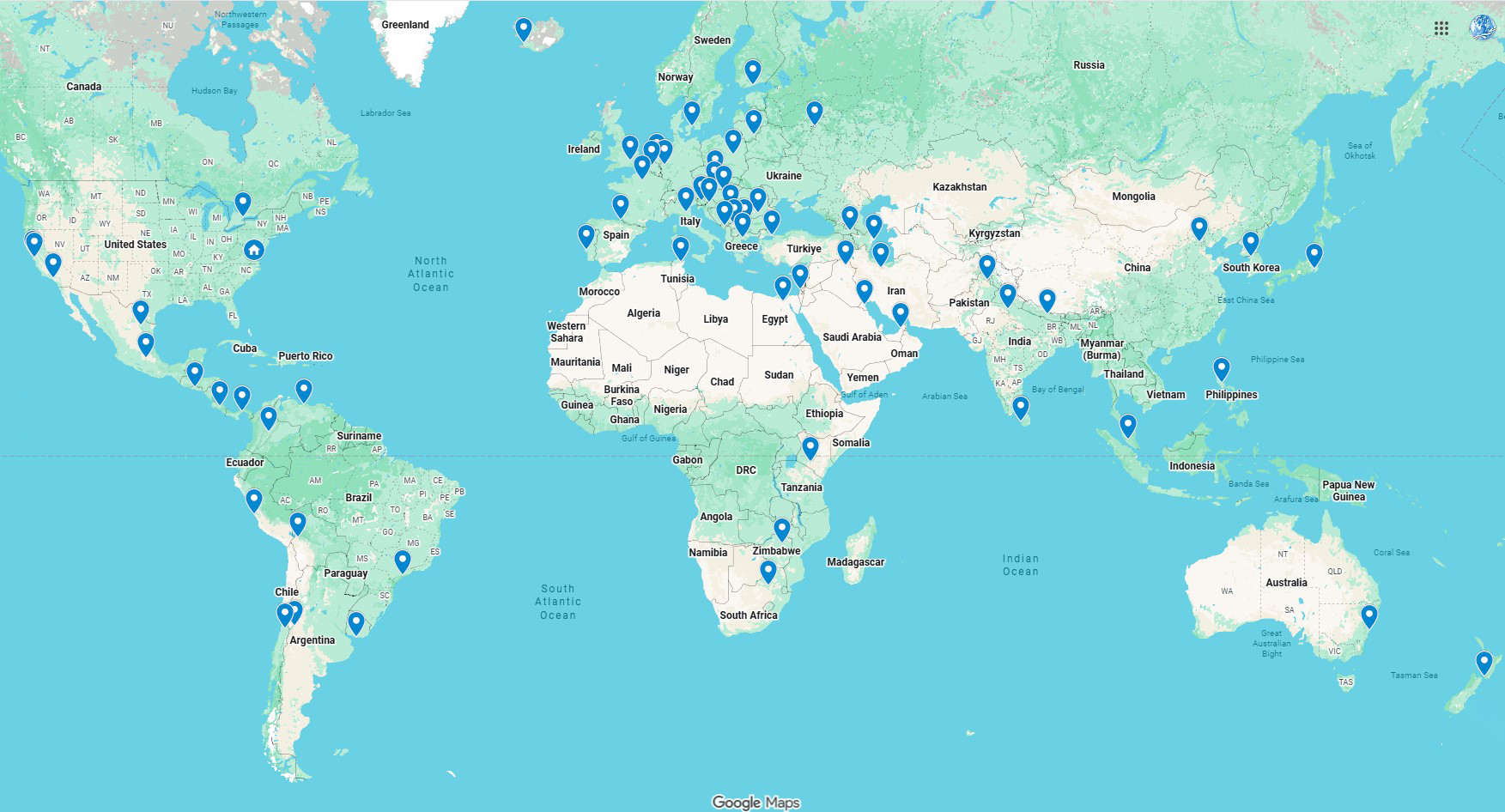
Regions and Nations

Annotated Scenarios Bibliography excerpt from the 2011 State of the Future reports


Top of the Page

America 2048: A Scenario. Harold Thomas. The T& D.com - The Times and Democrat Magazine. An internet magazine devoted to democracy, freedom, and human rights in the Western world countries. This article was posted on May 2, 2010. It received quite a number of view comments. ( Harold Thomas is a native of Orangeburg who writes periodically about local, state, national and international topics. )

This article provided an overview of trends involving Hispanic populations in America with a scenario about a hispanic as president of the United States.The Latino population reached 38.8 million, or 13.3 percent of the U.S. poulation in 2002, according to the new population estimates released by the Census Bureau.The Latino population experienced a 9.8 percent growth rate since 2000, compared with a national growth rate of 2.5 percent.Latinos were responsible for one half (3.5 million) of the U.S. population growth (6.9 million) between April 2000 and July 2002.

America 2048: A Scenario. [NOTE: This is an excerpt from the article.] Allow me to fast forward to Nov. 3, 2048. Roberto Emilio Desalva Sanchez becomes the third person of Hispanic ancestry to be elected as president of the United States. His constituency consists of every shade of color, racial classification, ethnicity, country of origin and socioeconomic class that is representative of this vast conglomeration of humanity that we call America. The victory by the president-elect has highlighted a trend that has become normal rather than a freak event that is unlikely to be repeated. The racial composition and the mindset of our country has evolved and our residents are more receptive to embrace changes that are necessary for the proliferation of our society. Race has become regarded as a reference rather than a classification and the nationalities of our ancestors are considered as welcomed assets rather than added liabilities. The United States has gradually transformed into a nation that truly guarantees that the principals, values and freedoms that have been outlined in our Constitution will be granted to each and every citizen. Our country's progression toward recognizing and accepting change did not occur naturally, but was a necessary reaction to battle internal and external forces that were intent on destroying everything associated with the American way of life. Indifference by our citizens allowed the cancers of hatred, preference and prejudice to create a weakness in our nation's patriotic structure that was taken advantage of by opportunists, patiently poised to capitalize on any segment of our society that was susceptible to being compromised. During the second and third decade of the 21st century, unrest, fueled by militias whose numbers had skyrocketed because of fears of a governmental takeover of essential functions, escalated to attacks on public buildings and infrastructure. America was under attack by its own citizens. Other domestic terrorists, who were dependent upon the support of those who were disillusioned with the federal government, eradicated any sense of security that was once taken for granted .. at one time Americans did not kill Americans .. especially for the perceived intent of changing the way that our society is governed. The bomb and the bullet replaced the ballot as the accepted means to effect change when we became dissatisfied with legislation that did not have universal approval. No one realized that the freedoms that every citizen enjoyed would become contributing factors to the unrest in the land. Al-Qaeda and other international terrorists took advantage of the civil strife in the country and brought the terror of the Middle East to the streets of America. Citizens experienced first-hand the horrors of war as they were forced to defend their communities against extremists. Neighbors allied with neighbors and put aside any differences that they had and fought for a common goal, the preservation of America. The survival of our country was worth fighting and dying for and the differences among people were dismissed as inconsequential.Regrettably, it took the threat of losing everything that we enjoyed as Americans to realize that life here was not so bad after all. While our system is not perfect, it is malleable and possesses the unique distinction as being the model for other countries that desire to become democracies. It serves as the envy of all the depressed people of the world who wish that they had just a small portion of the liberties that we have. [While this article is merely conjecture, the possibility of these catastrophic occurrences happening are alarmingly real and vividly evidenced by the unsettled state of affairs in our country and the world today. Perhaps it will take an extreme situation to motivate the country's residents to compromise on their differences and come to the realization that no matter how bad things seem, they could be exceedingly worse. Our citizens have to acknowledge that our enemies are aware of all the unrest and instability that comes from discord and will exploit any chance to take advantage of these opportune situations. Our future existence necessitates that we act rather than react to preserve the freedoms that we all cherish so dearly. Necessity is not only the mother of invention, but is also the catalyst that ignites the fires in the spirits of those who wish to perpetuate a way of life that they are accustomed to. It multiplies the capabilities of the weak to levels that were once unfathomable during times that were less demanding and also bridges the diverse philosophies between men that were thought to be non-negotiable. In addition, necessity is also the bond that unites those who have a common goal and leads to a mutual acceptance of the other man. It has and will forever be an incentive of those who seek a desired outcome, whether singularly or collectively. ]

China's New Demographic Challenge: From Unlimited Supply of Labour to Structural Lack of Labour Supply.Labor Market and Demographic Scenarios to 2048. Headed by Michele Bruni. Center for the Analysis of Public Policy (CAPP), Faculty of Economics, University of Modena and Reggio. February, 2011. (PDF of the full report can be found at http://www.capp.unimore.it/.)

China economic growth and its impact on the global economic and political arena areat the centre of increasing attention.In 2009 China's GDP growth has  ranked first in theworld and China has shown the capacity to deal with the global financial crisis better than anyother country.In 2010, the record growthof the first quarter indicated that China was going toreturn to a two digit rate of growth.In the longerterm China's GDP is projected to surpass the American GDP by 2020, after having becomethe second largest during the current year.This paper focuses on the demographic and labour market consequences of the dramatic decline in fertility that has characterized China starting at the beginning of the '50s. It is shared opinion that a sustained decline in fertility below replacement level will provoke a decline in Total population, an even more pronounced decline in Working age population and very relevant ageing phenomena. I have recently shown that, on the contrary and coherently with empirical evidence, a decline in fertility provokes a structural lack of labour supply that determines positive migration balances and, finally, positive demographic trends. The paper applies the same approach to China with similar results.Thescenarios  we have proposed should be sufficient to take intoconsideration the fact that China will have to face a serious, structural shortage of labour.it is reasonable to expect that inthe first case the shortage of labour will be a very visible and evident problem around 2015, inthe second around 2020.

[NOTE: See the full report for the quantiatative details, charts, and graphs of variant projections. ] Scenario 1)Medium Variant Projection and Scenario 2) LowVariant Projection:For what relates to China, the Population Division medium variant projection (the one that is normally used, being considered the most probable) assumes that the TFR will progressively increase fromthe 2005-2010 estimatedaverage value of 1.77 to 1.85 in the period between 2020 and 2025, and will then remain constant for the following 25 years. This assumption reflects the equilibrium hypothesisthat still underlinesdemographic transition theory that fertility will, sooner or later, converge toward the equilibrium level of 2.1. In the case of China this goal has not been judged realistic and a sub-equilibrium level of 1.85 has been preferred.The low variant projection assumes that the TFR will remain 0.5 children below the level  hypothesized by themedium variant. In this scenariotheTFR does, therefore, progressively decline from 2010 to 2025 when it will reach a minimum of 1.35 children perwoman and will then remain constant in the following 25 years.According to  the medium variant projection, Total population will increase up to1930, when it will reach a maximumof 1,462 million, to then decline to 1,417 million in 2050; in the low variant the maximum is reached in 2020, juts below 1.4 billion; total population then drops to 1,237 million in 2050; The number of young people steadily declines over the whole period, both in theoptimistic (high fertility) and pessimistic scenario. The decline is obviously more pronounced in the latter (-137 million, -19.7 per cent.) than in the former (-53 million, -51 per cent); The 40 years time interval is not sufficient for different fertility levels to affect the 65 and over age group; therefore, the number of elderly increases by 219 million (+197 per cent) in both scenarios; WAP reaches a maximum of 998 million in 2015, to then progressively decline in the following 35 years. The two variants start to differ in 2030 due to the fact that the fertility rate begins to impact on WAP entries in 2025; between 2025 and 2050, WAPwill decline by 126 million (-12.8 per cent), according to the medium variant projection, by 222 million (-22.4 million) according to the low variant; As a consequence of the previous trends, the population age structure will undergo major changes: in both variants the shares of the young and of WAPprogressively decline, while the shares of the elderly progressively increase. More specifically, inthe medium variant the percentage of young people drops from 19.9 per cent in 2010 to 15.3 per cent in 2050; the percentage of WAP from 71.9 per cent to 61.4 per cent, while the percentage of the elderly increases from 8.2 per cent to 23.3 per cent. In the low variant the decline in fertility determines an even more pronounced drop of the share of the young (to 10.7 per cent), a more pronounced increase of the share of the elderly (to 26.7 per cent), and therefore a lower decline of the share of WAP (to 62.6 per cent).

Four Scenarios for Alaska's Future to 2020Scott Goldsmith, Institute of Social and Economic Research, University of Alaska, Anchorage.This paper is part of ISER's "Investing for Alaska's Future" research initiative, funded by a grant from Northrim Bank. (May 2011) (PDF of the expanded scenarios are available on www.ISER.edu/.)

The Alaska economy is growing as high commodity prices (for oil and gold in particular) drive the private sector and oil revenue surpluses fuel the state budget. But as oil production continues to decline; the prospect for commercialization of North Slope gas in the near term fades; access to petroleum resources on federal lands remains stalled; and non-petroleum resource development moves forward only slowly, many Alaskans are concerned with what path the Alaska economy will take in the next decades. We could go in four possible directions. Here we offer a short description of each scenario— general enough to let each person fill in the blanks. Our objective is not to predict but rather to stimulate thought and discussion about what Alaskans can and should do to move the economy along the preferred path.

Scenario Summary 1) We Are the Chosen Ones or No Room at the Fishing Pole.Who think good luck will keep the good times coming can point to a number of times in the past when luck did save the day for Alaska—say, the Prudhoe Bay oil discovery, or the high oil prices that have spared us from most of the effects of the current national recession. So it's possible to be optimistic and believe the state's luck will hold, with rising oil prices driving future developments and keeping the economy healthy and the state treasury full. Scenario Summary 2) The Big Crash or I Can Handle the Handover because the Party was Awesome. Alaskans who know the state's history as a boom-and-bust economy—and especially the economic turmoil Alaska went through when oil prices crashed in the mid- 1980s—have reason to believe it could happen again. World oil markets are nothing if not volatile. So it's possible to be pessimistic and think plummeting oil prices could dry up investment in petroleum development and blindside Alaska's economy again. Scenario Summary 3) The Slow Squeeze or Up a Lazy River.The economy enjoyed moderate, steady growth in the 1990s. But at the same time flat oil prices and falling oil production were eating away the state's oil revenues. The state balanced the budget during most of the 2020s by using the Constitutional Budget Reserve—and if it hadn't been for that rainy-day account, the need for dramatic budget cuts and tax increases would have put the brakes on the economy. So it's not unreasonable to think that if future oil prices flattened and there was little new exploration and development, both state spending and the economy could dwindle. Scenario Summary 4) Strategic Planning or Socialist Takeover. Alaska does have a record of actively managing its publicly owned resources for the maximum benefit of residents (as the state constitution requires). One of the first acts of the new state legislature was banning fish traps and breaking the hold of outside interests on Alaska's salmon fisheries. A more recent example is creation of the Permanent Fund, which Alaskans approved as a way to save part of oil revenues, in anticipation of a time when those revenues would be gone. So looking ahead, there is precedent for the state to actively manage its petroleum resource—through strategic planning— instead of letting world oil.

Four Scenarios for Europe.  United Nation's Environmental Program's Third Global Environmental Outlook Series.UNEP and RIVM - RIVM, the National Institute of Public Health and the Environment in Bilthoven, The Netherlands, is a supporting scientific organisation for the ministries in the Netherlands who deal with public health, the environment and nature. With contributions from: Analytical Centre on Science and Industrial Policy Russian Academy of Sciences, Russian Federation, Central European University, Hungary, Center for Environmental Systems Research, University of Kassel, Germany.2003.

This paper presents the pan-European elaboration of the four GEO-3 scenarios. It focusses on

the scenarios proper and their impacts in environmental terms. Unlike a GEO report, it does not

assess the findings in the light of policy questions. Much of what will happen over the next 30 years has already been set in motion by policy decisions and actions taken in past decades. However, the policies emanating from new decision-making processes will also have a vital role to play in the process of shaping the future. By exploring different future scenarios, today's decision-makers can get a clearer picture of what tomorrow might bring in terms of human and environmental health, and what the impact of their decisions is likely to be. They can determine more accurately what they can do to create a more desirable future. Scenarios do not predict, rather they paint pictures of possible futures and explore the outcomes that might result if basic assumptions are changed. As a way of exploring the unknown, scenario analysis can result in surprising and innovative insights.A set of four scenarios were developed.

Scenario 1) Markets First. This scenario envisages a world in which market-driven developments converge on the currently prevailing values and expectations in industrialized countries. Most of the world adopts the values and expectations prevailing in today's industrialized countries. The wealth of nations and the optimal play of market forces dominate social and political agendas. Trust is placed in further globalization and liberalization to increase corporate wealth, create new enterprises and livelihoods. In doing so, people and communities can be supported in paying for and insuring themselves against - or pay to fix - social and environmental problems. Ethical investors, citizens and consumer groups try to exercise growing corrective influence but are undermined by economic imperatives. The powers of state officials, planners and lawmakers to regulate society, the economy and the environment continue to beoverwhelmed by increasing demands. By 2032, many of the same questions that were posed at the turn of the 21st century remain unanswered. Scenario 2) Policy First. In this world, world, strong actions are undertaken by governments in an attempt to achieve specific social and environmental goals.Firm decisions are taken by governments in an attempt to attain specific social and environmental goals. A co-ordinated pro-environment and anti-poverty drive balances the momentum for economic development at any cost. Environmental and social costs, and gains, are factored into policy measures, regulatory frameworks and planning processes. All of these are reinforced by fiscal levers or incentives such as carbon taxes and tax breaks. International "soft law" treaties and binding instruments affecting the environment and development are integrated into unified blueprints and their status in law is upgraded, while provision is made for open consultation processes to allow for regional and local variants. By 2032, the current forces driving the world in unsustainable directions appear to be coming under control. However, improvements have often been very expensive and improving lifestyles continues to intensify demands for water, food, forest resources and space. Scenario 3) Security First.This scenario assumes a world full of large disparities, where inequality and conflict, brought about by socio-economic and environmental stresses, prevail. This scenario assumes a world of striking disparities, where inequality and conflict prevail. Socio-economic and environmental stresses give rise to waves of protest and counteraction. The more powerful and wealthy groups focus on self-protection, creating enclaves akin to the present day "gated communities". Such islands of advantage provide a degree of enhanced security and economic benefits for dependent communities in their immediate surrounding but exclude the disadvantaged mass of outsiders. Welfare and regulatory services fall into disuse, but market forces continue to operate outside the walls. In an atmosphere of rising social, environmental and economic tension, violence is endemic, leading, among other things, to massive movements of refugees. By 2032, an air of uneasy stability has begun to settle, but forces for further breakdown are ever present. Nonetheless, a better world for all might yet emerge.Scenario 4) Sustainability First. This is a world in which a new development paradigm emerges in response to the challenge of sustainability supported by new, more equitable values and institutions.A new environment and development paradigm emerges in response to the challenge of sustainability, supported by new, more equitable values and institutions. A more visionary state of affairs prevails, with radical shifts in the way people interact with one another and with the world around them. This stimulates and supports sustainable policy measures and accountable corporate behaviour. There is much fuller collaboration between governments, citizens and other stakeholder groups in decision-making on issues of close common concern. A consensus is reached on what needs to be done to satisfy basic needs and realize personal goals without beggaring others or spoiling the outlook for future generations. By 2032, sustainability has not yet been achieved, but the world is moving in the right direction and there is no turning back.

Vulnerability 2030: Scenarios on Vulnerability in the United States. Institute for Alternative Futures in collaboration with the Robert Wood Johnson Foundation. (2011) (PDF of the full report is available on www.ifaf.org/) In April 2010, the Robert Wood Johnson Foundation's (RWJF) Vulnerable Populations Portfolio awarded a grant to the Institute for Alternative Futures (IAF) to develop scenarios describing the alternative futures of vulnerability and vulnerable populations in the United States in the year 2030. The Vulnerable Populations Portfolio addresses the critical connections between health and social circumstances.

The Great Recession of 2008–2010 has expanded the ranks and deepened the suffering of vulnerable populations. Prior to this recession there were mixed signals—some populations were doing better, while others remained marginal in their income and in their access to employment, food, effective education and health care. So much change in just a few years is a reminder that there is no single, certain future to plan for. There are many plausible alternative futures, and planning for just one set of assumed future circumstances is likely to miss the mark. We need to think about the forces that will shape the future of vulnerability, the different ways that future might unfold, and the kind of actions today that would be most effective across a variety of different future conditions. This report sets out alternative scenarios of how our society and the vulnerable populations within it could change over the next two decades. We believe these alternatives are all possible, but they range well beyond what people usually allow themselves to consider. They explore four different pathways: an expectable or "most likely" future, a challenging or "hard times" future, and two different paths to surprising success in reducing vulnerability, or "visionary" scenarios.

Scenario Overview 1) Comeback?The economy rebounds after the Great Recession. Education improves and works for most families. But automation and offshoring prevent many jobs from ever coming back. Governments are constrained by their debts. Despite some improvements, the ranks of the vulnerable expand. Scenario Overview 2) Dark Decades.The double-dip recession is followed by Peak Oil in 2016. Prices for energy and food rise rapidly while low- and middle-income jobs continue to disappear. Government services and payments are cut severely, while vulnerability rises significantly. Scenario Overview 3) Equitable Economy.A Depression follows the Great Recession. Massive unemployment and hardship prompt a shift in values that leads to an economy that is fair and works for all. Governments are forced to be effective and education works for all. Vulnerability is reduced.Scenario Overview 4) Creative Communities. The economy recovers. High debt levels limit what federal and state governments can do. Families and communities become more self-reliant and creative in finding solutions to their problems, creating local currencies, barter services, supports for local innovation, and invigorated processes for community engagement. Technology yields low-cost energy and food, as well as a capacity for localized manufacturing of many daily necessities. Vulnerability is reduced.


Governmental Corruption and Social Change in New Zealand: Using Scenarios to 2020. Robert Gregory. Routledge Taylor & Francis Group.Asian Journal of Political Science, Vol. 14, No 2, December 2006. (PDF of full article and scenarios are available on www.ajps.org/.)

New Zealand has long enjoyed a reputation as a country with a corruption-free state sector, and ranks very highly on the Transparency International's Corruption Perceptions Index (meaning its corruption levels are perceived to be extremely low). However, there is prima facie evidence to suggest that this situation may be changing, not dramatically but significantly. While the state sector changes of the 1980s and early 1990s may be having some impact on this shift, it also has to be understood in the context of wider societal changes, which are probably more decisive. After some brief conceptual clarification, the article presents three scenarios sketching past (1950s/1960s), present (1990s_2006) and future (2006_2020) social and governmental conditions thought to be relevant to corruption levels. [NOTE: These scenarios are excerpts from the report.]

Scenario Overview) New Zealand, Towards 2020 (see article for past and present scenarios: The following summary embodies factors that seem likely to shape, directly or indirectly, the future profile of governmental corruption in New Zealand. New Zealand will become an increasingly inegalitarian society, in which materialist values of wealth acquisition will dominate and in which economic growth will be uneven and unspectacular. The 'vertical decompression' of remuneration between lower level government workers and top executives will increase markedly, as will the gap between the remuneration for top executives in the public and private sectors. Crime rates will continue to increase, not necessarily in any regular pattern but consistently over time, and public officials will be increasingly susceptible to pressures from organised crime operating in a 'globalised' marketplace. Any continued and increasing attenuation of the old 'Public Service ethos' will weaken barriers against the incidence of governmental corruption. Because the 'old' ethos sits uneasily with the public choice zeitgeist underpinning the reforms, which views bureaucrats and politicians as being motivated primarily by egoistic self-interest, and because the delivery of public services will continue to be driven in large part by devolved quasimarket models in an increasingly consumerist society, these sorts of assumptions will tend to become self-fulfilling. New Zealand society will be characterised more by the converse side of the concept of social capital as outlined above. That is, because New Zealand society will be much less egalitarian, politically and economically, even though democratic norms and values will remain strongly institutionalised, bonding rather than bridging social capital will predominate, generalised trust will be low(er) and more groups (especially organised crime) will be able to engage in covert and illegitimate activities. New Zealand society, in other words, will be more atomised, diverse and fragmented, more market-driven and competitive and much less altruistic. Racial tension that was largely latent during the 1950s and 1960s became far more expressive from the mid-1970s, and in turn political angst surrounding attempts to redress Maori grievances over historic settler and governmental injustices grew in later decades.It is projected that New Zealand's growth rate will slow down steadily in the coming few decades, giving the country a population of about 4.5 million around 2020. This will be an increasingly ageing population, which may have implications for crime rates and perhaps governmental corruption on the broad assumption that much offending is carried out by younger people, although not necessarily in the case of 'white-collar' crime which is more likely to encompass governmental corruption. Maori, Asian and Pacific Islands subpopulations are all expected to increase in proportion to the total population. Race relations will bestrained rather than harmonious, and these divisions will be strongly manifest in Parliamentary politics. Constitutionally and administratively, by 2020 New Zealand may have thrown off its constitutional ties to Britain, become a republic and further evolved its ownpeculiar form of 'Wellminster' (Wellington) government. There will be increasing flexibility in careers paths as people move in and out of the private, public and notfor- profit sectors. Most governmental officials will work on fixed-term and relatively short contracts. Corrupt behaviour and declining standards of ethical probity probably tend to be self-reinforcing. As corruption and sleaze become more commonplace so levels of tolerance and social complacency also tend to increase. Intolerance of corruption is increasingly replaced by fatalist and cynical attitudes. In the early 2000s there were several much-publicised cases involving allegations of improper or dishonest behaviour on the part of some politicians and public sector executives, which together raise questions about changing standards of ethical probity. These tendencies will be greatly enhanced by the growing imbalance between investigative journalism dedicated to the public interest 'watchdog' role, and the increasingly sophisticated and effective use of techniques of political 'spin' to fudge issues when they do attract public attention. They will also be reinforced by the fact that the Parliamentary opposition will not be assiduous in calling government politicians to account, because they will run the risk that their own behaviour will attract return scrutiny and will also be found wanting. Maor (2004) reminds us that governmental corruption is not just a crime problem; it is*primarily?*a political problem. So the political willand resolve to fight increasing levels of corruption will tend to weaken to the extent that politicians and bureaucrats are themselves part of the problem rather than part of the solution. Developments in electronic transactions within government and between government agencies and citizens may work as much to enhance the possibility of corruption as to diminish and control it.


Russia 2020 – Alternative Scenarios and Public Preferences. Andrei Melville, Doctor of Philosophy and Ivan Timofeev.Russian Social Science Review, Vol 51 no. 2, March –April 2010, p 72-98. (The author is vice-rector of the Moscow State institute of International Relations (MGIMO) attached to the Russian Ministry of Foreign Affairs and an Honored Scholar of Russia.)

The authors describe four idealized alternative scenarios for Russia in 2020 and analyze the views of focus-group participants concerning their probability and desirability.A research project initiated in 2006 at the Moscow State Institute of International Relations (MGIMO) in collaboration with the public education foundation INO Center (Information, Science, Education), which currently continues under the aegis of the Innovational Education Program of MGIMO, has developed four alternative scenarios for Russia's future in 2020.    There were five key areas the group examined before developing the scenarios: 1) first, the influence exerted on Russia by its external environment . The foreign policy agenda has often if not determined then at least greatly influenced the domestic priorities of Russian development; 2) Second, socioeconomic and political modernization has traditionally been a challenge for Russia. The range of possibilities here is determined in significant measure by the priorities of national development and by its agents, methods, resources, and so on; 3) Third, another important problem or challenge is the quality and characteristics of Russia's political regime, including the traditional opposition between authoritarianism and democracy; 4) Russia's  territorial structure, including the level of centralization and the logic governing relations between the center and the regions and 5) to insert the above variables into the live context of the current Russian and international situation, including world market trends, various kinds of globalization, conflict potential and factors of controllability in the international environment. [NOTE: These scenarios are partial excerpts from the report.]

Scenario 1) Kremlin Gambit.In 2020 world economic growth continues; oil prices remain high. The G7 countries are still among the world's leading economies. Dynamic growth characterizes Brazil, Russia, India, and—especially—China. Their share of world gross domestic product (GDP) has increased sharply. Globalization continues, but there is also a growing diversity of economic and political arrangements and systems. The division between rich and poor countries deepens. The potential for conflict in the world remains substantial—the struggle for access to energy resources, a "black hole" in Afghanistan and Iraq, conflicts in the Middle East, impasses with regard to Iran and North Korea, new conflicts in the Transcaucasus and Central Asia, Islamist radicalism, international terrorism, the narcotics mafia, and so on. There is no progress in arms control. But the likelihood of conflicts on a global scale is minimal: key world players compete with one another but avoid ratcheting up tension. The cooling in relations between the United States and Russia and between the European Union and Russia has not led to a new cold war, although there is continuing criticism of Russia's domestic and foreign policy, of its strategy as an "energy superpower." Russia is an independent center of power in the world. Russian international influence is based on the export of energy resources and armaments, the modernization of its armed forces, and pragmatic diplomacy, with the stress on Russia's own national interests. The country has been integrated into international institutions (above all, the World Trade Organization) on favorable terms. Russia has been able to achieve this thanks to a political strategy that maintains continuity in the economy and in domestic and foreign policy and that rests on the support of society. In economic policy, the state determines key developmental strategies and allocates investment. The foundation of continuing economic growth is the energy sector. In relations between the state and business, the state occupies the dominant position. It controls the energy sector and high-priority branches of the economy—the military–industrial complex, machine building, transportation. In domestic policy, too, the state sets the "rules of the game." In the system of "sovereign democracy," the executive branch of government dominates. The political opposition has neither resources nor public support. Society is satisfied with economic growth and the rising standard of living; interest in politics is minimal. In practical terms, the federal center has complete control over the situation in the regions. The chief priorities of the state are accelerated modernization ofthe strategic branches of the economy, a rising standard of living, and the strengthening of Russia's positions in the world. In the language of chess, this is a sort of "gambit"—that is, the restriction of political and economic competition in the country to serve the strategic goal of modernizing Russia.Scenario 2) Fortress Russia. The situation in the world in 2020 is highly unstable and tense. International law and international organizations are greatly weakened. The deciding factor in international relations is force. A new arms race is in progress. Weapons of mass destruction are proliferating. Russia finds itself trapped inside a hostile encirclement. An "arc" of real, smoldering, and potential armed conflicts has formed along its borders. The United States and the European Union have decided that "Russia is lost," given up hope of influencing Russia to develop in the direction they need, and returned to a policy of "cold war" and "deterrence." They raise every conceivable barrier against Russian business; a harsh struggle is under way over fuel and routes for its delivery. Oil prices fluctuate wildly, which puts Russia in a disadvantageous position. There are many other conflicts in the world. A struggle over energy and other resources is under way between "old" (the United States, the European Union, Japan) and "new" (China, India, etc.) centers of economic power. Besides the Middle East, centers of global instability have appeared in the left-leaning sections of Latin America, in Indonesia, and in Pakistan. Russia does not take an active part in these conflicts but strives to exploit them in its own interests. The West's hostility toward Russia has drawn away capital and curtailed foreign investment. Defense expenditures have risen sharply. It is necessary to "tighten belts": the consumer sector contracts, incomes fall, taxes rise. All this, together with unstable oil prices and active opposition to Russian energy policy, has greatly impeded efforts to achieve modernization. The state has been compelled to mobilize all resources to ward off foreign challenges and threats, for the sake of preserving the country's sovereignty, independence, and territorial integrity. A bloc of politicians from the security and defense agencies [siloviki] also sets the "rules of the game" in domestic politics. Political opposition does not exist. Companies in key branches of the economy—the fuel–energy complex, machine building, transportation—have been nationalized. The military–industrial complex is expanding rapidly, but there is also rising inflation. The federal center completely dominates in relations with the regions. Scenario 3) Russian Mosaic.  By 2020 globalization "according to the Western model" is developing in the world. The "leading countries" (the United States, the European Union, Japan) set economic, technological, and sociopolitical standards that all other countries strive to meet.8 China, India, and such "new giants" as Brazil, South Africa, South Korea, Indonesia, Turkey, and Thailand retain specific national characteristics but on the whole follow the example of the West. There is stable growth in the world economy. Oil prices are relatively low thanks to new technologies. International institutions and organizations (from the World Trade Organization to NATO, the Parliamentary Assembly of the Council of Europe, and the Organization for Security and Cooperation in Europe) set the "rules" for the world. International conflicts have not disappeared but are mostly under control. "Rogue states" and "antisystemic forces" such as international terrorism, Islamist radicalism, the narcotics mafia, and international crime have been marginalized. In the new international system, Russia plays "by the rules," which it has been forced to accept. It has been integrated into international institutions and has become a member of the Western community—though not always on advantageous terms. But Russia has become an open country: there is a massive influx of foreign investment and credit, while the most active part of the population and the regions that have been most integrated into the international division of labor enjoy rising standards of living. There is also, however, an outflow of capital and a brain drain. State power is becoming more decentralized and the Russian regions are acquiring a measure of sovereignty. The regions increasingly determine their own policies and developmental strategies, the rules by which they live. Some—primarily those dependent on federal subsidies—retain an orientation toward the center, whereas others rely on their own resources or on the support of external partners. Competition among regions intensifies; Moscow does not interfere. The state is no longer dominant: both individuals and regions have a chance to live as best they can. Corruption is growing and the income gap widening, but greater opportunities have opened up for the active and successful. The state sector and state regulation in the economy are insignificant. There has been a large-scale program to privatize and reprivatize sectors that were nationalized during the first decade of the twenty-first century (energy, transportation, etc.). The two capitals [Moscow and St. Petersburg], port cities, resource-rich regions, and certain border regions are best placed for accelerated development. Scenario 4) New Dream.In 2020 stable growth of the world economy is based, above all, on high technology. Demand for energy is high, but oil prices are gradually falling. The gap between "North" and "South" remains, but the world community, acting through the United Nations and other international organizations, strives to ensure stable development, reduce inequality, regulate conflicts, and maintain peace. Successful reform of the United Nations (UN) has strengthened international law. Force is not the decisive factor in international relations. International police forces under the UN's aegis control the most dangerous regional conflicts (in the Middle East, Central Asia, the Transcaucasus, etc.). New centers of economic power (especially China, but also India, Brazil, South Africa, and others) have been integrated into the international division of labor. Stable development, ecology, health care, and education have become recognized international priorities. Russia is a full-fledged member of the contemporary world community. The UN—not NATO—sets the "rules" for the world. Russia's border conflicts have been settled one way or another, but the country has to share its influence in the post-Soviet space with other "players." Russia finally has the opportunity to concentrate on internal modernization. Declining oil prices compel Russia to pursue intensive forms of development, increase labor productivity, and invest in high technology and in human capital. The "Russian Breakthrough" is the slogan of the country's new generation of politicians. A new political coalition, supported by the young and the most active part of the population, has come to power. It does not remember the Soviet period and did not take part in the "carve-up" and corruption of the 1990s. The new coalition brings together young technocrats with experience in private business, entrepreneurs from high-tech branches and the service sector, representatives of civil society, and young and successful politicians and business people from the Russian regions—all willing and prepared to "live in a new way." Order has been established in the state administration; law is no longer a "dictatorship" but a rule of life, for which not everyone is ready. All taxes have to be paid. Superfluous bureaucratic obstacles to entrepreneurial activity have been eliminated. For the first time in its history, Russia has an influential middle class. But the gap between rich and poor remains. People have to pay for their own health care, education, and housing, although there is a system of social insurance and credit is readily available. Individuals' success lies in their own hands.

Two Scenarios for the Future of Houston: Long Boom or Soft Path? Andy Hines, lecturer in futures research,Graduate Program in Futures Studies, University of Houston. Derived from material developed for Innovaro.(Complete report and all four scenarios available on www.ug.edu.) (February 2011)

Houston is the fourth-largest city in the United States and the largest city in the state of Texas.  With a population of 2.1 million, Houston is rated as a global city.Houston's economy has a broad industrial base in energy, manufacturing, aeronautics, and transportaiton. Houston is also leading in health care sectors and building oilfield equipment. Two archetypes for the future of Houston are presented: A Long Boom and the Future is More and More of the Sae.In the Long Boom World, Houston is in the midst of 25 years of prosperity, freedom, and a better environment; the current recession just a speed bump; and Houston was driven by five waves of technology: 1) personal computers; 2) telecommunications; 3) biotechnology; 4) nanotechnology and 5) alternative energy.In the archetype The Future if More and More of the Same, there is 1) continued emphasis on economic growth and globalization; 2) greater reliance on technical solutions; 3) a rising tide that lifts all boats (even if unequally); and 4) sustainability is important, but secondary to growth.

Scenario Overview 1) Sprawlville.The city is dominated by fossil fuel-powered cars. The elite still gets around, but most urban dwellers face poor transport infrastructure.  URBAN FORM - The city is a great fragmented sprawl. There are huge, low-density suburbs, freeways to connect them, and commuter jams. In the periphery of the city there are numerous "failed" developments, built too far from public transport and therefore unaffordable to urban commuters now that oil prices are high.They either become ghetto areas for poorer people or are reborn as local communities trying to provide their own services.MOBILITY - In urban areas, the car-dominant model persists, although the average personal vehicle is now an ultra-efficient hybrid or diesel car.As the poor are increasing unable to afford the daily car commute, urban ghetto areas spread in the city core and informal paragransit services spring up to serve commuity needs.People begin to alter their commute to address daily needs: nomad businessmen sit in traffic. In armoured vehicles, working while moving slowly from meeting to meetingl many of the cars bought by the emerging global middles classes become driveway trophies rather than a practical means of transport, as people return to buses and bicycles.ENERGY  - Oil production peeled around 2030 but transport still uses fossil fuel - particularly gas - and focuses on efficiency;  RESOURCES- Resource scarcity has lowered the quality of life for the urban masses in this elite-controlled world.  ECONOMY - The global economy is stagnant, susceptible to protectionism and shrinking supply chains. CLIMATE CHANGE - Short term thinking rules as people focus on adapting and protecting their property.GOVERNANCE - Cities are governed by and for the elites - they maintain just enough of the basic infrastructure to minimise public disorder. Social structures - Its a less equal world where the informal economy prospers. VALUES- Tension is growing as people lose faith in consumerism and the world is increasingly polarised into religious and ethnic extremes.BUSINESS - Business is powerful - with an expanded role in society as a result of less public service provision - but it is less accountable.  Technology - There are efficiency gains but few major breakthroughs. Scenario Overview 2) Communi-City. The world has turned to alternative energy, and transport is highly personalised with a huge variety of transport modes competing for road space.URBAN FORM - Power has devolved to individuals and communities; cities have become more informed and sometimes chaotic centres of creativity. For example, community-organised vertical and small-scale hoticulture has florished, with balconies, roofs and the sides of buildings given over to growing food.MOBILITY - Personal and individualized mobility is important. Modes of transport proliferate and people move about in a range of small electrical vehicles - souped-up bikes, covered scooters, od-cars and so on. Customisation is rife. Some people even build their vehicles locally from kits, using open-source designs, local materials and home-brewed biofuels. The roads look chaotic with so many vehicle types and so much personalised transport - but somehow it all works, through smart use of information technology to avoid collisions and optimise routes.ENERGY - Local renewable energy generation and decentralised grids have superseded coal, gas and oil.RESOURCES - Cities have transformed to produce more of their own food and deal localy with waste and water. Economy - Grassroots business and new technology compensate for protectionist trade and slow global growth.  CLIMATE CHANGE - People and communities adapt to climate change and reduce carbon, despite weak global policy.  GOVERNANCE - Central coordination is weak and more power resides at the community level using computer-based collaborative tools.SOCIAL STRUCTURES - Its a more unequal world, but full of opportunities if you're able to grab them.VALUES - People are less consumerist and less status - driven; they look more to religion and community.Business - Business is more local and decentralised, and many global brands are now extinct. Technology - Rapid breakthroughs make technology an exciting area of change, and many people are involved through grassroots innovation and research.

Scenario Building for IranMichael M.J. Fischer (professor of Anthropology at MIT).Tehran Bureau – An Independent Source of News on Iran and the Iranian Diaspora.January, 2010.Shown on PBS/www.pbs.org. This article is a good analysis of four possible short-term (5 year) outcomes after the political crisis in Tehran.As a result of the fraudulent June 2009 re-election of  President Ahmadinejad, the country reached a level of serious hostility and near revolution or civil war.Issues in these scenarios are explored and include visions of what a new constitutional order might look like.   These possible outcomes are examined in a classic scenario matrix: the Green Movement becomes sufficiently strong to sweep away the current government and establish a secular constitutional democracy (call this the secular republic); the Green Movement in combination with pragmatic and technocratic factions of the Revolutionary Guard creates a new constitutional order (call this a tutelary republic); a military figure takes over à la Reza Khan in the 1920s, Attaturk in Turkey, or Mobarak in Egypt (call this a dictatorship which could be more secular, or more religious as Zia ul-Haq was in Pakistan); or the Revolutionary Guard could install Mesbah Yazdi as the new Supreme Leader (a theocratic dictatorship).[The following is an excerpt from the report:]Scenario 1) The Direct to Secular Republic Scenario. In an ideal outcome for the Green Movement, the IRI state apparatus will collapse allowing a purely civilian leadership to guide the control of events. This will require the clerics and Revolutionary Guard currently in control to turn on their closest allies and thereby undermine their own power that they cannot continue. Both security forces and clerical legitimation will shift to the side of the Green Movement. In classic revolutions, this has happened when the state, needing money, turns on its primary supporters to extract the most immediately available sources of wealth, as when royalty taxes the aristocracy or the finance bourgeoisie, thereby losing their support.In Iran this happened under the shah when severe bottlenecks developed in the wake of the inflationary expansion of construction after the 1973 price increases, and the regime first tried to scapegoat the bazaars for rising prices, then squeezed other sectors. Today, the potential parallels lie in the underemployment of the educated classes, the pressure of rising prices for the working classes, and the increasing demands to know where billions of petrodollars have gone in a corrupt system. Indeed this last was perhaps one of the most damaging charges fired during the 2009 televised presidential debates, one of the places where cleavages within the elites began to be exposed.Should there be this kind of collapse, then perhaps there would be time and space for a transition to allow a new constitutional convention that would create a framework for checks and balances and accountability in the structures of governance. The transition requires a coalition of leaders of constituencies, leaders who can speak to religious and security constituencies, to civil rights issues, to economic planning, as well as some guidelines for how to deal with the past. Musicians and media creators, including comedy, might well be important in this transition to model the ability of different people to interact,women unveiled, for instance.So will leaders who can make the distinction between secularism in governance (that religion, Islam, has been and is inevitably corrupted by involvement and attempts to control daily politics) and secularism in belief (a secular republic does not require giving up of faith or belief, only not forcing it violently on others). After all, the high road of Islam, particularly in Iranian poetry, parables, and epics, has always been internal purity and faith while living in a corrupt world.Scenario 2) Tutelary Republic Scenario: Focus on the Transition. The transition period may not be so smooth as in the "direct to secular republic" scenario. In the 1979 revolution although there was a period of euphoria and coalition, and although the security apparatus was neutralized, the transition over the course of the year, and through the process of writing a new constitution, turned into a struggle for power and control, and as in so many revolutions an authoritarian outcome emerged followed as well by a terror and violent retribution against members of the old regime, which turned also against coalition partners. In Iran's 1979 revolution, it took the form of the velayat-e faqih bolstered by a series of cleric-dominated control bodies (the Assembly of Experts, the Council of Guardians).  In addition, as in many revolutions, a dual power structure was established which became first the defenders of the revolution and then the enforcers of state ideology: the Revolutionary Guards were unified into a military parallel to the army and eventually grew stronger than it; there were revolutionary courts, revolutionary councils in factories, bureaucracies and universities. Rather than being transitioned out, these grew over time, a process reinforced by the emergency of the war with Iraq. In the aftermath of the war, children of those killed as well as veterans, were given various kinds of compensatory access to higher education and jobs, again establishing a dual structure, in which ideological commitment was credited over expertise. Ideological exams were part of entrance to universities, and separate funds were made available to the ideological cadres. On the streets, as well, veterans guarded their legacies and trained a new generation of militias (Basijis), some of whom ritually engaged in attacks on more affluent youth in north and west Tehran.To guard against a repeat of this, quite regular, process might require the hand of a strongman, and the problem always is how to ensure that the tutelary structure so imposed does not become permanent. The primary function of such a strongman, presumably coming with backing from pragmatic factions of the IRGC, is to prevent bloodshed and mayhem by stirred-up Basijis, families supported by the IRI's patronage system, and former officials and enforcers fearing retribution by a new order of affairs.Indeed one line of speculation is that Khamenei would prefer, or has so acted to make more likely, such a succession to a more unpredictable cleric succeeding him, who might find it politically expedient to purge Khamenei's family and holdings as part of a corrupt past that needs purification and correction (see scenario four below). He, like Khomeini, might distrust Ayatollah Mesbah Yazdi and his allies, and, despite the latter's ties to Ahmadinejad and key figures in the Revolutionary Guard, be cannily playing to out maneuver them within the IRGC ranks.The three closest examples are Attaturk, Reza Khan (who thanks to the clerical opposition to a republic crowned himself shah), and Mohammad Reza Shah (who was restored to power not only with American and British help, but with the support of Ayatollah Kashani who divorced himself from supporting Mohammad Mossadegh). All three committed themselves to modernizing their societies, and arguably did far better than their counterparts in Pakistan. One could conceive of a new Reza Khan who would build upon those efforts and those successes of the IRI such as expanding university education both demographically and to the Ph.D. level, and the expanding experience with the idea of elections, who would also learn to allow democratic institutions to be built. Ideally, this again would be a defender of a secular constitutional structure, with well run, transparent and accountable elections. And it would be a defender of a transparent judiciary that did not rely upon the national security state of the secret police (SAVAK and SAVAMA) or extrajudical killings and disappearances approved by clerical or political authorities.  Free and popular elections are not sufficient. Plebiscitary elections by themselves are subject to wild emotional swings of mood, and are unstable means for policy-making. A true democratic structure is one with various institutional checks and balances to channel and regulate the competing interests and power formations in a society. This was the point of the arguments in the Federalist Papers of the period leading up to the American Constitution, and recall that the Americans did not get it right the first time, and required important amendments the second time around. One can argue that the American Constitution as a model had various flaws, quite apart from initially and for many decades, not counting all human beings as voting citizens. It could be argued, and has been, that it favored too much one or another form of political economy.Here some of the goals of the democratic coalition of 1978 in Iran might be recalled: to diversify the economy away from an oil rentier state, to diversity trade relations, to institute a free press and civil rights, to build a democratic political structure. These need to be thought through again, and not allow the Plan and Budget Organization, for instance, to be a place of just making up numbers, or slogans of social justice to be unproductive distributions of money that tie people to patrons.Arguably a mixed tutelary republic would, in foreign affairs, engage in regional and global diplomacy that would build upon Iran's strategic interests to stabilize the region, expand the diversity and robustness of its global trade and technical links, and in that context strengthen its position in the nuclear arena by helping to pioneer a new age of international controls over the nuclear fuel cycle for energy, and give up its nuclear weapons programs (as Brazil did in an earlier decade) in exchange for becoming a robust economic power.Scenario 3) Civilian-Led, IRGC-Backed Mixed Republic. One of the foundational problems of the tutelary (Attaturk) republic scenario is legitimacy, and this would be even more the case if Britain and the U.S. had a hand in helping it to come about, however grateful segments of the population might be. This, despite the aid of Ayatollah Kashani, was the problem of Mohammad Reza Shah's restoration. It is a moot point now whether if he had democratized and diversified the economy, gradually empowering the growing middle classes, the outcome might have been different.The better alternative then would be a Mandela-like scenario. In South Africa (to simplify greatly), Mandela, with the restraining and backing of the armed African National Congress, was able to lead a negotiated civilian transition from the old Afrikaaner security state, one that also, with the help of Bishop Tutu, was able to provide an imperfect, but still politically effective, public peace and reconciliation process. Whether or not a Mandela figure emerges in Iran (alternatives to a singular figure can be imagined in the range of potential coalition figures), it might be possible for a strongman or faction of the IRGC leaders to back such a civilian-led transition and the process of establishing a new secular constitution. The role of senior clerics such as Ayatollahs Sistani, Sanei, Dastgheib, and others could be helpful in maintaining a strong sense of the moral authority of Islam. Again: a secular state does not require an anti-religious population. In many societies, class structures contain popular religious enthusiasms, and can again in Iran, in the sense that religious hayats (ritual and mutual help organizations) need not be abandoned, but they need to be integrated into productive economic networks (as they were once through the bazaar economies) rather than being greased with state ideology-tied funds. The tariqat (Sufi organizations), often tied to middle class teachers and bureaucrats with their mystical understandings of Islam, need no longer be suppressed as they have been by the IRI.It is possible to imagine a vigorous democratic debate leading to a robust constitutional republic supported and made accountable by the rich press and Internet activity of the past decades, and aided by the talents of lawyers, economists, engineers, social scientists, polling professionals, and others whose talents have been underutilized, coming together from both inside Iran and the diaspora. Most of the more hopeful elements of the previous scenario could then apply here.Scenario 4) Reinforced Theocratic Scenario. Finally there is the scenario of either an IRGC coup installing Ayatollah Mesbah Yazdi or one of his allies as Khamenei's successor, or without a coup the successful maneuvering by Mesbah Yazdi, as he has been doing, to have this done by a vote of the Assembly of Experts, or even of a repeat of 1979 through an out-maneuvering of an initial more liberal coalition transitional government. There are more than one logics along which this could occur. One logic includes the fear among groups of the IRI elites of retribution from any new constitutional order. It has been speculated that unlike the affluent classes of the 1970s, these elites might find it less easy to leave Iran having considerably less experience and comfort outside the country. It has been speculated by many commentators that Khamenei and other IRI leaders are stiffened in their resistance to compromise by their memories of 1978, that any sign of weakness or compromise will only engender further demands.A second logic is the rationale of so-called "hardliners" since the taking of the American Embassy hostages in 1979, that Iran needs protection from domination by the corrosive capitalist Western and global economy, which distorts the ability of Iran to pursue its own independent course. The heightened emotional populism of the embassy takeover helped pass the Constitution that had seemed defeatable, and institutionalize the multiple institutions of clerical "supervision" of, and final word over the government. Arguably one of the successes of the IRI has been to diversity its trade relations and global political alliances, initially a third-worldist approach, but more importantly building up relations with India, Turkey, both Koreas, and perhaps China. In any case, this second logic is one reason that such a scenario would likely imply intransigence on the nuclear weapons front. It, together with the third logic, is also the source of the language of infection and contamination used to fend off the commoditization and lifestyles of the West, and effect a "criminalization of youth culture" as Shahram Khosravi puts it in his 2007 book, "Young and Defiant In Tehran." A third logic is ideological, the claim that an Islamic state can be created with will and discipline, force and executions if necessary, and that the result will be one of a good society sustained by faith. In this logic, faith is protection against mental illness and depression, homosexuality and social deviance. It has authoritarian hard edges, apocalyptic messianism, and a kind of Heideggerian care of the soul, of authenticity, and of Being, the knowledge of which last, and thus of the divine intent and ordering of the world, is revealed to the true faqih. It also can be expressed in a language of intimate family-like paternalism, which followers can find comforting.Even if this scenario were a temporary outcome, the danger is of a renewed major Terror, with executions of opponents justified in the ideological terms that have already labeled leaders of the Green Movement 'corrupters of the earth' and similar terms which carry the death penalty. It is likely that there would be, as is already being called for, another "cultural revolution" as when the universities were shut down for three years in the early 1980s with purges of students and professors. Marx might speculate that such a scenario stage might have to be undergone in order to finally isolate and destroy this faction of the ideological state. One hopes not.  Mesbah Yazdi and his prominent allies among the clerics cannot act alone. This is a reason, as argued from the beginning, that one of the most important tactics, certainly not the only one, in the short term is to track and make visible the networks of influence in the institutional structure that this faction is building and to redirect or block them.


Ethnographic Futures Research of Democracy in Ukraine: Democracy in Ukraine. Vitaliy Shyyaan, PhD.Ukraine Center for Independent Political Research. 2010/PDF/26pps./www.ucipr.org. As Ukraine balances between the West and Russia, consequences of the Orange Revolution and prospects for democracy remain unclear in the country, exacerbated by the 2008 military conflict between Russia and Georgia, and the current global economic crisis."Ukraine, as one of the largest countries in the region, was no exception to these processes, undergoing two major liberalization processes—its break-off from the Soviet empire in 1991 and its nonviolent democratic Orange Revolution in 2004. Over the last two decades, a wave of drastic changes has swept East-Central Europe, liberalizing and decentralizing political regimes and ending five decades of the Cold War.Even though some democratic changes have been reinforced in Ukraine, and the country became a member of the World Trade Organization and gained a market economy status, such Orange Revolution goals as joining the European Union and NATO remain unaccomplished due to internal and external geopolitical processes.  Longterm outcomes of the Orange Revolution remain to be seen, and its short-term impacts are the subjects of lively debate among politicians, journalists, and researchers."[The following is an excerpt from the article:]  Scenario 1) Optimistic Future. It is 2015. Ukraine has a well-established civil society and strong democratic system. The country is a member of the harmonious European community with transparent and prosperous economic practices. Ukraine itself has developed an economic system based on knowledge development and application as well as sustained innovative thinking. People live affordable lives. Health care, education, and other human necessities are available free of charge. Pluralistic mass media report unbiased information openly. Most democratic practices and institutions (elections, freedoms, governmental and nongovernmental organizations, etc.) are well developed in Ukraine and protect its citizens' rights. Young people are socially and politically active and the authorities are responsive to their needs. Additionally, young people (i.e., those under 30 years of age ) are represented in the government. Scenario 2) Pessimistic Future. It is 2015. Ukraine is divided into several states after a civil war and a war with Russia. Several parts of Ukraine have been turned into satellites of neighboring countries, and their citizens are treated as second-rate people. The failed infrastructure has caused economic and political crises with high levels of corruption. The gap between the rich and the poor is increasing and no strong middle class is established. People's human rights are constantly violated, media are not free, and human trafficking and torture are common practices. There are continual threats of terrorist acts and the outbreak of another war. The environmental situation is critical because of explosions at atomic power stations and industrial negligence. Several attempted youth movements have been violently suppressed by the authorities. Many youth activists are missing and many more are in prison for opposing the regimes. Scenario 3) Most Probable Future. It is 2015. Ukraine is struggling to establish a democratic system. The country cannot delineate its international position in Europe. On the one hand, Ukraine has been granted an association of limited membership in the European Union. On the other, Ukraine has joined the currency zone and military alliance with Russia and several other post-Soviet states. Ukraine's economy is still in a "catching up" mode and is infested with corruption. Democratic values are promoted in the relatively free media, but, in reality, there are frequent violations of human rights. Ukraine's reforms are stagnating due to disagreements within the government and a lack of visionary strategies for development. Youth activist groups remain divided in their ideologies and activities—some support Ukraine's Westernization, others side with pro-Russian forces; some prefer to remain purely civic organizations, others have joined the political system.


The Road to 2020: Future Explained: The Long View to 2030.  Hossam Badrawi (Head of the ruling NDP's Education Committee and member of the National Council for Human Rights) , Al Ahram weekly newspaper for Egypt. New Decade's Special Edition. The author believes a paradigm shift is needed towards real leadership in Egypt.The realization of afuture vision that energizes the process of growth and development across Egyptian society is very much needed.."Eight pillars of a vision of Egypt 2030" were inspired, according ot the author, by the 2005 Egypt Human Development Report that explored five directions of change for Egypt: 1)a new 'social contract' whereby the state reduces central control and promotes greater political, social and economic participation from civil society, with strict implementation of the rule of law. Restricting the number of presidential terms to two comes on top of all political reforms; 2) cultural and behavioral change through an education system that promotes participation, entrepreneurship, innovation and transparency within an enabling environment; 3) the clear and credible implementation of human rights, as stated in the constitution and contained in the international agreements to which Egypt is a signatory; 4)structural change within the economy capable of driving sustained growth and employment; 5)  a radical shift away from the intensive concentration of Egypt's population along a narrow strip and the redrawing of the Egyptian map to save scarce agricultural land. [The following is an excerpt from the report:]A Normative Scenario of Egypt to 2030:   By 2030 Egypt becomes, similar to Europe of 2010, a welfare state.Legitimizing the welfare state is achieved through the provision of higher quality public goods and services that were targeted to ensure equity and efficiency. In this world,seven deliverables meet the constitutional right of individuals to equal opportunity which has an enormous impact on the quality of their lives. They are: 1) quality education for all; 2) quality health care provision for all; 3) state contributions to social security for new and young SME employees to encourage formalization and job creation; 4) an integrated package of income transfer and service access for families in extreme poverty; 5) support for the rapid introduction of clean water and sanitation projects; 6) provision of effective public transport; and 7)  progress towards the Millennium Development Goals.Growth happened with solid employment by 2030. The reallocation of budget resources to prioritize disadvantaged segments of the population, within a consistent fiscal framework, becomes possible when average economic growth of 10 per cent annum is achieved. Domestic savings climbs from a low of 20 per cent of GDP to an impressive 30 per cent by 2015 to 35+ percent by 2030, driven by a large injection of medium and long- term finance. This promotes credit and social insurance for workers, health insurance, and housing mortgages. The aim becomes a virtuous circle -- major boosts in finance triggering increased aggregate investment and incomes as well as a decline in population growth. The new social contract of Egyptencourages an end to apathy by providing a democratic and decentralized environment where choices are possible. Accountability and transparency are instilled through clear legal frameworks and citizen charters.Pride in work is encouraged through market-based salary scales and incentives. The realignment of job descriptions in the public domain matches real needs which require retraining of available staff rather than the creation of new jobs. NGOs, and a growing private sector, encourages corporate responsibility, and the partnership with the state is energized by a new legal framework.Entrepreneurship is promoted. Reforms in education and training systems, coupled with the spread of ICT and increased expenditure on research, become a necessary first step in overcoming the prevailing culture of mediocrity. Empowering the poor with information and technical knowledge through extension services raises productivity across two thirds of the private sector, allowing for a successful economic take-off. The accent is on institutional reforms. Civil servicereforms in the public service sector comes about because the causes of laxity and corruption are addressed. The civil service system is perceived as an honorable occupation, offering a competitive salary scale and incentives system that discourages dishonesty. Employment and promotion are merit based.Under the heading of conserving the environment, the best case scenario urgently requires that Egypt develops and implements an integrated plan and program, articulating the goals to the public and such measures to improve efficiency and reduce waste. The full range of policy instruments are employed, including regulation, monitoring, voluntary measures, market and information-based tools, land-use management and cost recovery, without cost recovery objectives becoming a barrier to access by poor people. This is an Egypt with no less than 150 universities, divided between the public and private sectors, the majority of them public private partnerships. All of Egypt's education institutions gain international recognition, and at least five Egyptian universities are included among the world's top 100. I see average per capita income of US$20,000. Vibrant DFI investment supplements local investment so that it reached $50 billion a year. Every Egyptian citizen carrys a health insurance card that grants access to appropriate medical care regardless of his of her financial status. Young Egyptians take up service and logistic jobs in European countries. By 2030, 30 million tourists visiting Egypt every year. Egypt is green and environmental-friendly and becomes a country that produces 70 per cent of its energy needs through solar and wind power.

The Future of Manufacturing in Europe 2015-2020: Four ScenariosBert Maes (HTEC coordinator at Haas Europe) February, 2010.Report commissioned by the European Commission.This report covers future trends of manufacturing in Europe.An overview of world regions, according to this report, reveal that the US is most heavily involved in materials and processes; Japan is focused on applications that incorporate EBM into their business strategies, introducing  new products primarily to gain market share and resource conservation; and the European Union is concerned primarily with product end-of-life, infrastructure, supply chain and reverse logistics, elimination of materials of concern, and systems level modeling.In general, the report reveals more eventual collaborative relationships between government, industry, and universities in the European countries.These scenarios discuss manufacturing options that are driven by certainties, predetermined elements, and driving forces described in the report..[The following is an excerpt from the report:] Scenario 1) The European Union doesn't get stronger.Large multinationals shape international trade, consumers don't care much about environmental impacts of production and consumption. Energy efficiency in production improves only because of strategies of company cost reduction. There are no incentives for radical changes . In education, due to the lack of government commitment, more and more private initiatives will pop up, focusing on excellence in education. Author's reflection:The European Union is weak and will probably always be weak. The creation of the EU presidency post following the Lisbon Treaty was great. But Europe will never be unified as a transnational entity: too many cultural and historical differences, too many national minorities, all protecting their own interests. Guy Verhofstadt, president of the European Liberals recently wrote that the future of Europe doesn't lie in the juxtaposition of national identities. "That would be a Europe that is incapable of solving problems," Verhofstadt says,  "that would be a Europe that can't play a significant role in the multi-polar world of the 21st century." This means that private initiatives in education will be crucial to raise the quality and attractiveness of manufacturing education. Scenario 2)Regional governments take over and determine policy priorities. Strict environmental regulations lead to a concentration of manufacturing activities in creative regional clusters that work with radical new manufacturing approaches and alternative energy systems for cleaner production. But there is little trans-regional coordination of policies. In education, regional government bodies will work closely with industry and associations in training initiatives. Author's reflection: Building regional innovative clusters is probably the right way forward . Economic growth and economic business is generated by autonomous regions, not by nations. In my view, the source of prosperity is always regional, e.g. Hong Kong/Shenzhen, Singapore/Johore/Batam, Taiwan/Fujian, South China, South India (Bangalore), Northern Mexico, North West coast of US (Silicon Valley), Eindhoven Netherlands for the ICT industry, North Rhine-Westphalia & Bavaria Germany for chips, Cambridge UK for Mechanical engineering.But the weakness of the whole system is education, i.e. the supply of human resources. You can have the right ideas, work hard, take initiatives, bring together governments, professors, companies, students & financiers to make new companies happen, you can have lots of money, but without the right people with the right skills and with the right tools you will not make it. A strong economy is routed in a strong educational system . Scenario 3)  Global governance emerges, that promotes sustainability. The European Union defines and implements clear sustainability policies , with energy taxes, emission charges, strict regulations and financial incentives. Governments watch the designing and implementing of new technologies closely. Major technological breakthroughs result in more environmental production with renewable materials.In education governments retain the lead role, emphasizing interdisciplinary training , soft skills and problem solving capabilities. This scenario requires a highly qualified labor force with new skills to operate and manage sustainable production systems.Author's reflection: The global governance is the ideal scenario for sustainability of our planet . But as said in Scenario 1: I doubt if Europe will ever speak with a unified voice. Moreover, the Copenhagen Climate Conference in December 2009 has shown us how difficult it is to unlock a global collective action. On the other hand, training in interdisciplinary skills will become more important as the manufacturing industry will be completely reinvented by online communities, asking for highly customized products and smart, creative, innovative thinkers that will set up completely new client-centered business models to better meet the needs of increasingly demanding customers.  Scenario 4) Europe establishes a strong industrial policy, but there is little willingness of China and India to include environmental and social concerns in their production. There are incentives for industry to invest in sustainable manufacturing solutions, but they run along existing application trajectories. In educationthere will be a EU-wide training certification system, coordinating public and private training schemes focusing in excellence in education. Author's reflection:Europe that is focused on itself is probably what is happening now.East Asia is a huge competitive problem. So Europe will try to push innovation in high quality technologies that use new eco-friendly materials and product designs. That will create new export opportunities for companies. But unfortunatelyI don't expect radical shifts in European manufacturing. Although in education, a EU-wide training certification system is a very interesting track to bring together all public and private education initiatives and could set the world-wide standard for manufacturing training.

America: Three Alternative Futures for 2030. Professor Dan Lewis, director of International Economy Program, University of Colorado. 2010/PDF/21pps/www.uc.org. In preparation for a course in global governance and the future at the University of Colorado, Professor Dan Lewis reviewed the major driving forces that could affect life in the United States by the year 2030.These forces included: the increasing threat of the 2008 Financial collapse to the stability of the global economy; increasing threat of global economic meltdown caused by uncontrolled globalization and the 2008 Financial Collapse; increasing globalization; increasing population growth; increasing demand for fossil fuels; increasing divisions between the First and Third Worlds; increasing immigration from the Third World to the First World; increasing collapse of global ecosystems;increasing global warming and climate change; increasing growth of failed states; increasing threat of terrorism; increasing growth of the internet and instantaneous global communications; increasingly development of renewable energy; increasing outsourcing of jobs from the First World to the Third World;increasing threat of global pandemics caused by the growth of anti-biotic resistant viruses in the Third World;increasing division between the Globalized World and the Islamic World;increasing threat of bankruptcy by the United States; increasing threat that OPEC will switch the global reserve currency from Dollars to Euros; increasing concern about the rising number of immigrants in the First World; increasing scarcity of natural resources; increasing costs of scarce natural resources and fossil fuels; increasing growth of a global consumer culture; increasing threat of WMDs threatening global society and economic stability; increasing threat of war and violence in the declining Third World countries; increasing threat to societal stability caused by economic insecurity and the growing division between the very wealthy and the vast majority, who are desperately poor; increasing threat of global environmental collapse caused by Global Warming and the destruction of Global ecosystem;increasing global insecurity caused by the interaction of environmental collapse and economic insecurity; increasing fear of economic and societal breakdown; increasing distrust of political and economic leaders; increasing fear that our political and social institutions aren't working; increasing fear that the future will be worse than the past. [The following is an excerpt from the report:]  Scenario 1) America as the leader of a Globalized World.  This is the future according to Thomas Friedman.The U.S. is the leader of a Globalized economy and world. Wealth and the standard if living for the top 20 percent of the world (the First World) has increased. The environment is cleaner in these wealthy nations. This globalized economy is still based on fossil fuels, nuclear energy, and some renewable energy. Computer technology connects this world into a global marketplace and a global village. The First World still consumed 70 to 80 percent of global natural resources, and doing so maintains a high quality of life.In the Third World, wealth and the standard of living are declining. Overpopulation, crowded urban megacities filled with slums and refugees, increasing threats from pollution to the rural and urban poor, declining environmental quality, scarce natural resources, and the increasing inability of Third World governments to govern and manage their economies and societies have caused the quality of life in most of these Third World nations to decline. In this Globalized world there is an increasing division between the wealthy First World and the declining Third World.The economic, social, and cultural decline that began in the poor African nations in the 1990s has spread to Latin America, India, China, the Middle East, and to Southeast Asia. Global Corporations dominate the economy and politics of the First World. There is increasing tension between the declining Third World and the wealthy First World. This tension leads to increasing numbers of U.S.-led military expeditions to put down local and regional rebellions in the Third World.Even  more so than in the 1990s and early 2000s, Third World peoples see their only hope for a decent life is to escape to the wealthy First World. Because of the threat posed by these Third World refugees, First World nations are spending billions of dollars and using high technology to prevent these refugees from entering prosperous First World megacities. Global Warming, declining soil fertility, declining fisheries, dwindling supplies of clear fresh water, increasing air and water pollution, and declining global forests threaten to undermine this increasingly divided world. Scenario 2) America as the leader of a Global Sustainable World. This is the future world of David Korten and John Cavanaugh and the anti-globalization critics.The U.S. leads the world in the creation of local and regional sustainable economies that are based on the principles of a "restorative economy." Instead of being a part of a Globalized economy, the U.S. tries to produce and consume products that are made in North America.Green taxes, strict environmental laws, polluter pay laws, and an emphasis on "reducing, reusing, and recycling" has improved the quality of local and regional environments.This economy is based on using renewable energy such as solar, wind, water, geothermal, and hydrogen fuel cells.This restorative economy emphasizes reducing material consumption and increasing consumption of services produced by local companies and cooperatives. The U.S. is leading the way to reduce the power of global corporations to dominate local and regional sustainable economies. Led by the United States, both the First and Third Worlds focus on creating sustainable local and regional economies. The standard of living, the quality of life, and the quality of the environment are slowly improving in both First World and Third World nations. Because the U.S. and other First World nations aren't supporting their economies and way of life by appropriating the natural resources, fossil fuels, and destroying the environments of Third World nations, global environmental quality and the air, water, soil, forests, and fisheries are all improving. Most of the resources needed to create this global sustainable economy came from high taxes and controls on the behavior of global corporations and the shift away from high military spending by first and Third nations. Instead of fighting over scarce resources and a declining global environment, First and Third World nations are cooperating to reduce their populations, restore their local and regional environments, and reduce their total impact on the Earth's ecosystems. The larger goal of this U.S.-led global sustainable society is to create healthy societies with sustainable standards of living in a healthy and clean global environment that will be better able to support future generations. Scenario 3) Americ as a Fortress Nation in a Troubled , Declining World. This is the future world of Robert Kaplan and Chris Lewis. In this world the political, cultural, and environmental collapse that spread throughout Africa in the 1990s and early 2000s is spreading to the rest of the world.We witness an increasing Third Worldization of the First World.There is increasing inequality between the top one to five percent of the Global elite and the bottom 95 percent of the people in the First and Third Worlds.This economy is based on extended use of fossil and nuclear fuels, whose use is accelerating global warming and nuclear catastrophes such as Cherynobl. This is a Fortress World where the global elite who run giant global corporations and dominate First and Third World governments have to protect themselves from the majority of the population, whose quality of life and standard of living is declining. Increasing economic, cultural, and political dysfunction and anarchy spread from the Third to the First World. In such a Fortress World, the global environment is declining, damaged by global warming, destruction of forests, fisheries, and farmland, and pollution and the destruction of natural resources. With this declining global environment deadly diseases such as AIDS and super-resistant strains of the Flu, Tuberculosis, Cholera, and Malaria are devastating the populations of the First and Third World. With increasing threats posed by war, environmental destruction, massive refugee flows from impoverished areas to the wealthy First World enclaves, and global epidemics, First World elites increasingly rely on military and police forces to protect their Fortress communities and their privileged ways of life. In this world, a new and even more powerful form of Social Darwinism is used to justify the increasing concentration of wealth and privileges in a tiny global elite. Threatened by increasingly anarchy and disorder, this Fortress World faces a global political, economic, and environmental collapse.With this global collapse, much like with the collapse of Rome, billions of people will face increasing wars and brutal conflicts over declining global resources and the declining ability of the global environment to support massive populations. With the collapse of this Fortress World, it will take thousands of years for local and regional communities to recover from this global catastrophe. The only model for this pos-collapse world is the nightmare world of "the Road Warrior" movies.


South Africa Scenarios: 2025 – The Future We Choose?Policy Coordination and Advisory Services for South Africa (PCAS). Pub. September, 2008. This project involved in-depth scanning of relevant trends, driving forces, and65 interviews with well-placed South Africans and a series of working sessions with a core group of about 40 people, drawn from academia, business, unions, political parties, and think tanks.The goal of this project was to stimulate discussion about some of the challenges South Africa may face after 30 years of democracy.This research looks 'back' at three paths that the country may have traversed by 2025.As a result, key 'variables' and key driving forces (KDF) were identified that form the foundation for the scenario storylines.According to PCAS, Key Driving Forces most likely to shape South Africa to 2025 include:  1) shifts in global economic power - rapid industrialization; 2) shifts in global political power ;3) resource constraints - an energy gap between the age of fossil fuels, particularly oil, and the slow development of the coming age of alternative fuel sources; 4) South Africa's economic growth - how competitive and productive does it become?; 5) governance - how legitimate is government going to be in 2025?; 6) social fabric - the state has the resources to fashion a basic sense of nationhood and a sense of human solidarity.By 2025, billions of people will have access to always-on, high bandwidth communication devices, which will allow users to network and connect in dynamic new ways.These forces cut across all the scenarios. [NOTE: The complete scenario narratives, key driving forces, and quantitative analysis are available on the PCAS website.]  Scenario 1) Not Yet Uhuru."A Government strongly committed to accelerating economic growth struggles in the face of deteriorating global conditions and severe ecological challenges.  In a world of "me first, you later," the g overnment strives to deliver on its commitment to the poor, but ideological divisions and a 'me-first' spirit of rank materialism within the political leadership compromised its good intentions.The poor made up a slightly smaller demographic in 2025, but their disenchantment with the system soared to volatile new levels, as the gap between the 'have-lots' and the 'have-nothings' grew wider than ever. This acute sense of relative deprivation, in the context of a world obsessed by brands and 'getting and spending', made South Africa more combustible than ever.Senior management in Government was almost exclusively black in 2025, but the nation's wealth still lay overwhelmingly in white hands. The economy remained divided along racial lines, with white management occupying more than 60% of the boardroom seats of power. For the first time in history, as the natural environment buckled under the strain of more than 200 years of rampant industrialization, the doomsday nightmare of an environmental cataclysm appeared to be on the verge of coming true."Scenario 2) Nkalakatha."Determined to play a more central role in the economy, Government prioritizes poverty reduction and skills enhancement by articulating a national vision and fostering partnerships.    Narrowing the gap between vision and delivery, Government set the pace for a new era of action and application. Gradually, the notion of the developmental state edged towards everyday reality. While there were significant trade-offs to be made in the pursuit of a Better Life For All, Government succeeded in reducing the once-widespread sense of social alienation, by clearly articulating its vision and placing a deep emphasis on. The environment matters too. Although growth and redistribution remained on top of the national agenda, Government began to take a more proactive stance on matters of environmental change and sustainability, with mixed results. It was time to bite the bullet. In the aftershock of a global economic collapse, Government cut spending and introduced tough austerity measures. But the nation bit the bullet and worked together to weather the crisis." Scenario 3) Muvhango."Despite an initial resurgence of the economy and positive world conditions the government battles to govern well.In the slipstream of the 2009 elections and a successful 2010 World Cup, the economy boomed, and the growth rate breached 5.5%.But the euphoria was short-lived, as poor planning and coordination, exacerbated by political in-fighting, started taking their toll on the economy. Service delivery suffered, and corruption increased, as animosity among politicians reached startling new levels. Efficiency levels declined, as measured by unqualified audits, proportion of budgets spent and citizen satisfaction surveys. The Champ Slips Up. The economy, after a few good years, was on the skids. Foreign multinationals and private equity funds began cherry-picking key South African assets. South Africa's proportion of continental GDP declined to such an extent, that by 2025, the country lost its unrivalled pre-eminence on the continent. Standing at the edge of a cliff, a new ANC went back to the nation, humbly, and demonstrated signs of a revival of idealism."


Pakistan's Alternative Futures – Beyond the Pendulum of the Military General and the Politician. Sohail Inayatullah (professor, Tamkang University, Taiwan and adjunct professor, the University of the Sunshine Coast, Australia). Metafuture Journal, 2009. In this essay, Inayatullah outlines five futures for Pakistan. With the rise of the Islamic Taliban, Pakistan's future appears bleak.Can a secular democratic Pakistan ever flourish?Or, will the politics of Jihadism continue, with Kashmir returning as the battlefront?"Pakistan swings back and forth between military and civilian rule and between feudal and capitalist economies."The author warns that if an alternative future for Pakistan is not created, the pendulum will continue with collapse always being in the background. In today's world, everything is interconnected. "A weakness or pathology in any part of the planetary system threatens everyone.  Pakistan's futures are part of the planet's futures – we all need to transform." (Inayatullah) What then are Pakistan's alternative futures?   Scenario 1) The Pendulum Continues Forever. "After this particular civilian cycle, there would be another military coup in 7-10 years. Politicians will have some luck in ridding Pakistan of extremist fundamentalists, but old scores between the PPP and the Pakistan Muslim League or between the PPP and the military will still need to be settled. Issues of justice and revenge will continue and just as Pakistan's economy is about to take off, another crisis will set in. Citizens will rally but then when they see no real change will become despondent. "Nothing is possible here," or a similar catch phrase will be the inner story. Globalization will not go away but the politics will swing between growth and equity." Scenario 2) Collapse. "This is the most feared scenario for all, particularly in the West. Civil war in Pakistan (the provinces going their own way), the inability to stop jihadism, Al Qa'ida or their friends finding some nukes, not to mention the global challenges of climate change, all lead to a slow decline destined for collapse. And if the challenge from the Pakistani and Afghani Taliban is resolved, the frontline will switch to half-century old war in Kashmir. Capital flies away, economic development slows down and Pakistan becomes a nation of competing tribes. Women in this future are particularly vulnerable as the battle between religious and secularists throughout the Islamic (Arab influenced world) is fought over the "body" of the female. Is she a person unto herself or does the strong male (feudal lord, ruler, mullah) need to protect and control? In the collapse, chaos would reign. Over time, and perhaps even quite quickly, a strong military leader is likely to rise (the Napoleon scenario), but can the great leader unite all the tribes (the challenge facing Afghanistan today)?" Scenario 3) Joining Chindia. "With India likely to move into the ranks of the G-8 by 2020, gaining a permanent UN Security Council Position, Pakistan's only hope in this scenario is to link in every possible way with India and China – or Chindia. Certainly Pakistan will favor the China part of the amazing rise, but in any case, in this future, economic growth is far more important than ideological struggles. To move in this direction, the Singapore or Malaysian model may be adopted. This model is characterized by a clear vision of the future, transparency; breakup of the feudal system, limited democracy (one party rule), and creatively finding a niche role in the global economy, and then using that as a springboard to becoming a global player. However, the India example shows that economic rise is possible outside the East Asian model. In any case, this future is hopeful but requires investment in infrastructure and a favoring of globalized capitalism. Instead of lamenting the colonial past in this Chindia future, Pakistan creates its own transnational corporations. Politics moves from focusing on old wrongs (Kashmir, for example) to desired futures. Instead of Chindia, Chindistan is created."Scenario 4) The Great Game."Pakistan remains a pawn, moved around for the strategic and ideological purposes of the great powers. Whether in proxy wars against the Russians or against 9/11 jihadis or whoever may be next, Pakistan's capacity to influence its future is low or non-existent. At best, it can only rent out its military, or territory, for others' battles. In this future (as in the current present), the rental receipts do not lead to even development –they merely enrich those getting the rent, generally the military. The national game becomes not how to transform the great game but how to get a piece of the action, legitimately or illegitimately. Those not part of the money game sing songs of grand conspiracies. These songs take away agency. While Pakistan has a dependency relationship with the rest of the world, citizens have a dependency – that is, child/adult – relationship with the government, expecting it to solve each and every problem, without taking responsibility for their own actions and blaming the government when it fails. At the collective level, Pakistan remains rudderless, evoking the words of the founder, but unable to follow through with action." Scenario 5) A Wiser South-Asian Confederation. "The challenges Pakistan faces are similar to what other countries in the region face – religious extremism, climate change, poverty, corruption, deep inequity, stale futures, and less than helpful archetypes. In this future, the only way forward is towards an EU model of slow but inevitable integration. While this may seem too positive and far away, it is not impossible. Each country needs the help of others to solve their problems. None can go it alone, and each can learn from the other. This requires learning, peace and mediation skills in all schools; moving toward the sustainability development agenda; developing agreements in security, water, and energy to begin with; and a focus on the desired future and not on past injustices. Gender equity and systemic and deep cultural levels are foundational for this future. This future also requires an archetype that is neither the male general nor feudal lord nor the rebellious teenager, but the wise person, perhaps the Globo sapiens. Fortunately, the south Asian tradition is steeped with wisdom. Can this imagination be drawn on to create a different future? Already in Pakistan, there are hundreds of groups and thousands of individuals working on this vision. What is needed is systemic support for this future, and a move away from focusing on past injustices. Moreover, can the mullah who is focused on religion for tribal power become the wise sage, the Sufi or pir focused on transformative power? Can other roles as well be transformed? For example, can the consumer become the producer, the client the citizen, the child the adult? And perhaps, as in East Asia, can new myths be created through grounded realities such as the economic miracle, which has now created new stories of social capacity and new identities? Pakistan was on the verge of this future in the early 1960s, and it is possible to rediscover this pathway."

After America: Narratives for the Next Global Age by Paul Starobin.Pub. by Penguin Press, with permission of Viking, a division of Penguin Group (USA) Inc. Foreign Policy Journal Book Review, March, 2009. In this book Paul Starobin examines scenarios of a "post-America" world.According to Starobin's perspective, trends reveal that America is on the decline, especially after the anticipated long-term effects of a lingering global financial crisis.It is no longer a world in which countries look toward America for global leadership. There is a new order of things.America is lagging behind the "standard barometers of modernity:" healthcare, financial regulation, and education.The gold standards of global excellence are no longer US-centric (Harvard, Hollywood, Whitehouse, MIT); rather, they are scattered around the planet.As America fades into the background, what will it become?The author examines four scenarios of a post-American stronghold. [NOTE: This book can be previewed on the Google Books website.]Scenario 1) A Multipolar World."In a multipolar world of nation-states, the biggest winners will be those states that can succeed in establishing regional hegemonies in their neighborhoods. The world's regional policemen might include the United States in North America; Brazil in South America; India and China in Asia; Russia in its "near abroad"; possibly Iran in the Middle East (with Israel fending for itself); and South Africa in sub-Saharan Africa. Europe can be a winner if it finds the will to assert itself in this order. If not, Europe can expect to find itself increasingly encroached upon by other powers, like Russia. The losers will include weak small states -- the Georgias of the world -- that bank on protection against the local neighborhood bully -- in Georgia's case, Russia -- from an America no longer up to the task. The grimmest fate will await those peoples who feel themselves as a nation but are bereft a viable state. These are the Palestinians of the world, the many millions who live in what seem to be permanently failed states -- states in name only. The multipolar world will likely be democratic in some regions and autocratic in others, according to the traditions of the neighborhoods -- and in that sense, this world will represent a defeat for champions of liberal Western values as a universal standard. The multipolar world will be peaceful to the degree that the big players can arrive at satisfactory terms for coexistence."Scenario 2) A Happy Chaos. "A happy chaos will reward those who are able to unbutton their collars and find their innermost Merry Prankster. Victory goes to those who can think and act laterally, defeat to those who can operate only in a world of hierarchies. Perhaps the patches of the planet that in the past have spawned interludes or at least ideologies of happy chaos -- like Dada Zu rich and Berlin after the First World War and Grateful Dead California of the 1960s -- will prove especially fertile ground for a 21st-century variation of this type. Perhaps a happy chaos will flourish in Eastern societies, like India, with an ingrained skepticism of a world defined by power relations. More than anything else, winning in happy chaos will require a certain philosophical preparedness."Scenario 3. China Wins in a Chinese Century."China wins in a Chinese Century, but who else? Asian societies with a history of tense relations with the Chinese, including the Japanese and the Vietnamese, may be losers. India fears being a loser but may not be, given the protection afforded by its sheer size and the ways in which its economy complements China's. Distance may prove a blessing for the economies that succeed in developing profitable trade relationships with China -- from the Pacific Coast of America to continental Europe. For resource-rich lands that China aims to exploit, like Chile with its copper treasure, much depends on whether China is disposed to be a benign or a cruel imperial ruler."Scenario 4) An Age of Global City-States. "An age of global city-states as well as a universal civilization offers a chance for Europe to matter again, in a large way, because Europe is a font of the cosmopolitan values that would be ascendant in these worlds. But North Americans, South Americans, and Asians are by no means dealt out. There would be tremendous opportunities for global elites -- for architects, artists, business executives, university presidents, political leaders, global-health specialists, and others who tend to live in big cities and who already are starting to think of themselves as a superclass. The multilingual person stands to do better than the monolingual one. Woe to those in the provinces, on the margin of things, and unable to think or operate in a global way."

AIDS in Africa: Three Scenarios to 2025.UNAIDS and the African Union. Sponsored by multi-corporate and multi-governmental organizations.Pub. by the Joint United Nations Program, 2005. The three scenarios illustrate three possible ways in which Africa and the rest of the world may respond to the epidemic of AIDs.Some of the challenges include the anticipated doubling of the population over the next 25 years, which means that the number of deaths will continue to rise.However, the steepness of the curve on a graph in 2025 is not predetermined. The key to minimizing this curve is recognizing the complexity of AIDs.  Complex approaches are required to mitigate this disease on a medical, governmental, economic, social, and cultural level.There is no one silver bullet and in an age of dwindling resources and the global financial crisis, it is unlikely there will be any one silver lining. The scenarios in this report set out to answer one central question: "Over the next 20 years, what factors will drive Africa's and the world's responses to the AIDS epidemic, and what kind of future will there be for the next generation?" In answering this question, the scenarios pose two related questions: "How is the crisis perceived and by whom?" and "Will there be both the incentive and capacity to deal with it?" The responses to these questions led to three scenarios. The first scenario, 'Traps and Legacies' extrapolates current trends until 2025.  The second scenario, 'Tough Choices' applies the trajectory of the most successful response to date (Uganda), adjusted for respective national levels of the epidemic. The third scenario, 'Times of Transition' illustrates what might occur if a comprehensive prevention and treatment response were rolled out across Africa as quickly as possible. [NOTE: The complete scenario narratives and analysis are available on the UNAIDS website.]Scenario 1) Traps and Legacies: The Whirlpool. "The essential message of 'Traps and legacies' is that it will be difficult to make a difference to the AIDS epidemic if HIV is viewed in isolation from its root social, economic, and political context; or if it is seen only as a medical problem or as an issue of individual behavioural change, addressed via programmes that only consider the symptoms. The scenario deliberately does not play out a worsening epidemiological situation—population growth is enough to translate existing rates of incidence and prevalence into a doubling of the numbers of people living with HIV and AIDS by 2025. 'Traps and legacies' is a story of good intentions thwarted by an underlying development malaise, which remains unchanged in the quest for swift dividends. The AIDS epidemic does catalyse people and institutions into responding, but they cannot make sufficient headway in the face of depleted capacity and the spillover impacts from high-prevalence to low-prevalence countries. In this scenario, the continent is gripped in a downward spiral of disunity, denial and stigma, contested knowledge, wasted resources, and competing sources of power and authority. The capacity of systems, people, and institutions to respond to the crises of AIDS and underdevelopment are systematically diminished. At the start of the 'Traps and legacies' scenario there is a huge emphasis on HIV and AIDS, but the fractured, short-term nature of the response and the failure to make long-term, long-cycle investments result in a failure to deliver a lasting solution. Obviously, there are some winners: enclave economies, based on Africa's mineral wealth, and an élite who continue to live an international lifestyle. However, for the majority at the end of the scenario, demographic, social, and economic impacts have gradually eroded the capacity of high HIV prevalence societies, leading to a collapse in memory, transmission of culture, values, and social meanings, with profound effects. Times of transition: Africa overcomes 'Times of transition' describes a series of transitions in the way in which Africa and the rest of the world approaches health, development, trade, security, and international relations. The prospect of the collapse of world trade regulation, the failure to meet the Millennium Development Goals, and another century of war leads the continent to draw back from the brink of disaster. The AIDS epidemic mirrors and magnifies a wider crisis and so acts as a catalyst for action—by civil society as much as states. The transitions require sustained social investment and fundamental changes in the way in which donors provide aid and governments deal with it—so that it promotes sovereignty, but does not undermine national autonomy, is not inflationary, and does not promote dependency."  Scenario 2) Tough Choices: Africa Takes a Stand.  "The key message of 'Tough choices' is that, while there are enormous odds to overcome, there is much that countries in Africa can do with their own strength—and particularly with their collective strength—to grow their economies, to prioritise developmental objectives, to lay the foundation for future growth and development, and to reduce the incidence and prevalence of HIV. This scenario suggests that it is unlikely that the attitudes of the rest of the world to Africa or the provision they make for Africa will change—but it describes African countries nurturing their domestic resources, including cultural strengths, to find their own way forward. It shows that, with leadership and community mobilization, effective HIV and AIDS responses are possible without huge outlays of resources on stand-alone programming. This scenario ends with declining HIV incidence as the long-term investments in social, economic, and human capital over two decades begin to pay dividends. This scenario is about identifying the tough choices that state leaders and their people have to make. Leaders make their own priorities for their countries—rather than avoiding or displacing them with externally imposed or suggested priorities, disguised through large amounts of HIV- and AIDS-specific funding and programming. 'Tough choices' demonstrates that it is possible, although not easy, to make tough decisions. Not everything can be done at once, so choices must be made between competing priorities. It may require the sacrifice of more immediate economic comforts for a longer-term sustainable national development. 'Tough choices' includes a stark message that deaths from AIDS will continue to rise. At the end of the period, despite discipline and effort, the number of people dying each year and the number of people living with HIV and AIDS remain the same as at the beginning of the scenario because of population momentum. Admittedly, this is a much better future to be in than the one described in 'Traps and legacies', but nonetheless, it is not a pleasant or comfortable world for the near future.However, the foundations are laid for a future that is no longer blighted by AIDS."Scenario 3) In 'Times of Transition.'"Attitudes to Africa are transformed in an increasingly interconnected world and, within Africa, Afro-pessimism, Afro-scepticism, and Afro-exaggeration are replaced by a new understanding of solidarity and citizenship. On the international stage, this requires what has been called a new global covenant, involving security and human rights agendas brought together in coherent

international frameworks that encompass economics, trade, social justice, and political equality. These changing international norms are shaped by, and are more responsive to, African needs and perspectives. Within Africa, this scenario requires pan-African solidarity and high levels of regional cooperation. It will need governments that put public good before private office; that direct the benefits of Africa's vast mineral wealth to becoming an engine for pan-African good; and that ensure that the state is a resource for all, rather than a prize to be captured. In terms of interpersonal behaviour, this scenario requires that gender relations be transformed, so that women throughout society are able to determine when, where, how, and with whom they have sex. This scenario suggests that, if these transitions could be made within a generation, they could dramatically reduce the number of people infected with HIV and fundamentally alter the future course of Africa—and the world—in the twenty-first century."

The Future of the Middle East to 2025.World Economic Forum (WEF).Pub. 2009. The challenges currently facing the Middle East region are well recorded, but less well known are the alternative futures for the region under various scenarios, and what they mean for policy makers.

The World Economic Forum's (WEF)programme and workshops set out to link the Middle East with the latest thinking on broader global issues. Against a backdrop of enourmous forces that are changing the security landscape and shifting political realities, the  Middle East and North Africa (MENA) region is rapidly becoming a high-growth region, opening up many new opportunities for investment and partnerships. The increased global demand for oil has made this region more affluent, but only for a small group. The have have-not gap has brought great wealth to the few, and the question becomes how to more equitably spread this wealth and liquidity  to the benefit of the region's education, health, and innovation potential."With huge wealth comes huge responsibility and the countries of the Gulf Cooperation Council (GCC) are striving to put their affluence to good use." (WEF)Two key themes consistently emerged as being crucial to the future of the GCC countries: education/innovation and leadership and governance. Three different scenario paths for the GCC countries through 2025 are presented.[NOTE: The complete scenario narratives are available on the WEF website.]Scenario 1) Oasis."This is a story where a focus on technocratic governance and top-down institutional reforms pays off in the form of a well-organised, cohesive and prosperous regional grouping. The region's economic growth, however, remains partially constrained by over-regulation and less-inclusive globalisation. Will GCC governments allow regional tensions to spill over and affect their internal security, resulting in a focus on short-term solutions at the expense of tough reforms? This is a scenario where regional stability continues to be a challenge for the GCC countries, which are nevertheless able to achieve substantial institutional reforms. The GCC countries develop strong identities and work together to coordinate diplomatic and economic policies through technocratic governance and a strong internal market. Over-regulation slows the process of globalisation, impacting the GCC countries; nonetheless, they are an oasis of stability and prosperity in an otherwise troubled region. The story is written as a press conference by a member of the Kuwaiti leadership and a Saudi technocrat delivered in Kazakhstan in December 2025. Globalisation continues despite regional conflict throughout the world, but friction in global markets caused by security concerns means that global growth averages around 3-3.5% throughout the period."Scenario 2) Sandstorm. "Is a scenario in which dramatic regional events and domestic unrest contribute to the GCC countries failing to maintain their momentum of reforms, with negative consequences for the region's economic and social development. Will GCC governments succeed in taking advantage of globalisation in a more stable regional environment through bold reforms at the institutional and political levels? This is a future where regional instability is a defining factor, affecting the ability of GCC countries to effectively carry out much-needed institutional reforms. In a depressed global environment, reforms deflate or collapse due to a lack of attention to the root cause of internal issues and a tendency for governments to focus on short-term stability at the expense of long-term solutions. Caught in a shifting, violent environment, the GCC countries are blinded, unable to navigate their way out of the sandstorm and identify opportunities for prosperity for their populations. This scenario is written as a transcript of a televised debate on Arab satellite television, discussing the progress the GCC countries have made from the vantage point of 2025. Oil shocks and a lack of trust undermine international cooperation and trade integration, causing a global recession in 2010-2012, followed by slower growth thereafter."Scenario 3) The Fertile Gulf."Is a future where GCC governments invest heavily in education and innovation in order to create a healthy private sector while encouraging reforms through a bottom-up process. This results in a more socially integrated and economically diversified region that occupies an increasingly relevant position in the international scene. This describes a future of the rise of the GCC countries as innovation hubs in a global environment characterised by strong demand for energy and increasing globalisation. Regional stability gives the GCC countries the opportunity to focus on enhancing their human capital at all levels, investing heavily in education while proceeding carefully with political and institutional reforms to support their growing economies and societies. In this way, a fertile garden of prosperity is established along the Persian Gulf. Written as a business magazine interview, "The Fertile Gulf" is an account of the experiences of a successful young entrepreneur from the GCC region, who has taken advantage of the changes between 2007 and 2025 to develop a range of global enterprises.The global economy benefits from increasing globalisation and trade in a harmonious global environment and reaches growth rates of over 4%."


Jamaica 2015 – A Discussion of Possibilities, Policies, and Strategies.Jerome C. Glenn for USAID/Jamaica. August, 1995.This report describes four interconnected strategies that emerged through futures research utilizing methodologies such as a snowball Delphi, a series of in-depth interviews, group discussions, media analysis, examination of published and unpublished documents, and scenarios derived from trend analysis. This report also includes a chart that maps the distillation of thoughts from reknown futurists on the general direction of Jamaica. After the scenario narratives, Glenn presents a number of conclusions and implications for USAID/Jamaica in terms of the future of Jamaica's telecommunications infrastructures, overseas trade, agricultural sector, research labs, food processing, and use of the Internet.

Jamaica in 1995 was on the brink of deteriorating economic growth due mainly to poor management of large amounts of foreign aid that was driving a culture of dependency.Financial and economic reform and structural adjustment programs appeared to be loosing ground while a popular perception caught-on to the idea that the best way to build wealth was through marijuana trade, organized crime, and showcasing popular music like reggae.The "brain drain" was worsening as smart young people and professionals were leaving the country, depeting Jamaica of a competent pool of expertise and management on all levels.Disrespect for authority and moral decay was rampant and there was a decline of the nuclear family, which was becoming virtually non-existent.A small number ofrich families ruled and true political power wasn't divested to the many.  All of this contributed to cynicism and destructive attitudes. Global trends were a powerful influence in Jamaica, as this country was caught in a world of increasing complexity, economic globalization, global population growth (5.5 billion in 1995 forecast to 8 billion by 2015), increased travel that spawned competition from neighboring countries for tourist dollars, and the increasing spread of information innovations and diffusion of communication technology ("smart objects" – artificial intelligence,computer intelligence, nano-technology, genetic engineering, the Internet, voice recognition & synthesis).These trends  impacted developing countries such as Jamaica in positive ways, but they were also forces to contendwith, such as, for example, the more illustrious jobs overseas contributing to the brain drain.The key question Glenn posed in his report was, "How are these forces likely to change Jamaica over the next 20 years?"The following scenarios are a composite of views among participants & futurists, which, according to Glenn, are not predictions of what will happen, but plausible sets of paths into an uncertain future that may allow Jamacian leaders to test policy options to eventually shape the future environment. The goal was to stimulate fresh thinking about development policies and programs to more strategically assist the Jamaican development process. [NOTE: The complete report, including scenario narratives, analysis, snowball delphi, "bite-sized factors to consider," conclusions, and implications for USAID and Jamaica are available through the Millennium Project.]  Scenario 1) Business-as-Usual: 2015.In this scenario, basic global trends continue on a trajectory and impact Jamaica, creating new trends and future conditions of society and technology.  Globalization of the world economy and advances in shipping technology and communications impact the growing value of Kingston's geographic location and harbor.This drives investment for the development of Port Royal and related systems as a major contributor to Jamaica's economic growth in the early 21st century. The market for tourism continues to expand with increased travel from regions experiencing the benefits of new growth that rise out of the ashes of aging  industrial economies, especially in the neighboring regions of Asia and Latin America.The demographic transition in Japan cripples it's inability to meet retirement pensions for the rapidly aging populations, thus creating markets for overseas retirement centers, some of which came to Jamaica. Continued advances in telecommunications reduces the negative effects of the brain drain.On the economic front, completion of structural adjustment programs re-focuses policy on more stable, strategic grounds so management in a more liberalized economy expands trade relations.The Jamaican economy improves incrementally due to better economic reporting, policy coherence, and more trade with other countries in the region. Normal maturation of society has put Jamaica as a reasonably successful participant in the Western Hemispheric Trade Group.    The educational performance improved and by 2015 nearly all children have progressed from primary school to secondary school for the first time in history.  Participation in policy dialog increased and was enhanced through talk shows, discussions on re-writing the constitution, and "hands across Jamaica" campaigns.On a social and cultural level, cohesion in Jamaica has not improved as much as one might expect. The vast majority of those born in the late 20th century had no biological father to look to as a role model or authority figure.Socially positive heroes were few-and-far between, which kept the moral fiber of the country weak.Scenario 2) Tele-Jamaica: 2015.In this scenario Jamaica takes a broad leap into the the world of information technology.The country's leaders determine a national goal of having all Jamaicans connected to global multimedia networks via hand held computer communications devices for voice, video, data, and other forms of graphics. Incentives were offered for foreign investors to provide in-country Internet access and related equipment support. Much of the success of Jamaica's emergence into the international information age was spurred-on by what became known as the "Watering Hole," a strategic action center focused on selling the advantages of scientific thinking, advanced technologies, and the whole concept of a new and innovative "Tele-Jamaica."  Although initiatives were mainly from the private sector, the "New Jamaicans" were also a cadre of entrepreneurs working hand-in-hand with the international donor community (as opposed to just receiving foreign aid as in the past). One of the boldest moves was organizing Jamaica's economic information into a transparent national balance sheet that was continually updated for public viewing.Networked just-in-time inventories helped establish Jamaica's position as the central trading area of the entire Caribbean region. "Tele-Jamaica" eventually became a real-time model for a "Tele-Nigeria,"and a "Tele-China."Under the heading of growth, Jamaica was heralded as one of the fastest growing economies in history.[NOTE: Glenn provides two adjunct scenarios that describe two seperate initiatives that positively impact a Tele-Jamaica world in 2015.]The first adjunct scenario is titled, "Future Attitudes for a New Jamaica Movement." In this world, the UNDP collaborates with USAID to enlist a committee of "Untouchables" (in the positive sense), comprised of  very select,prestigeous Jamacian citizens who work togetherto come up with innovative ways to educate Jamacians about a future Tele-Jamaica. Collateral social and cultural effects improve the overall attitude of Jamacians. The second adjunct scenario is "The New Jamacia Movement." This is a world where a national participatory process is instigated after a public debate about changing the constitution. Creating a vision of a "New Jamaica" becomes an ongoing participatory process known as the "NJs" (New Jamacians), a movement that pushes analytics out the think-tank doors and into public conversation so more people have a better sense of normative thinking.Scenario 3) The Pits. This is a world of the unwise and unlucky.Jamaican debt increases. Deep cleavages exist between political approaches to development andtelecommunications with lots of political disagreement. A lack of improved education and other long-term policies create multiple set-backs as polarization of visions of Jamaica's long term future and political cynicism accelerate.   Political parties are ridiculed in the press.Secondary schools became recruitment and training centers for organized crime. National healthcare systems take a backseat. Mass migration out of the country continues and Cuba wins the tourism trade.Jamaica becomes the center for crime and hedonistic immigration & trade in the hemisphere. A great health crisis breaks out in the region by 2015, with Cuba taking the lead in directing the International Red Cross, WHO, and health care efforts because Jamaica is so riddled with crime cartels and it's governance so incompetent,it is unable to maintain a stable health monitoring system.


Future of Demographics in China to 2030.World Economic Forum (WEF).World Economic Forum Scenario Series pub. 2009.The World Economic Forum is committed to improving the state of the world.  As a result of a series of scenario workshops,hundreds of participants from around the world contributed to a throughtful analysis of key forces driving the future of China's demographics, aging population,pension, and healthcare system.   

China faces considerable pressure from the aging of its population and low fertility rates due to a strict planned birth policy that was implemented 30 years ago. While other advanced countries undergo the demographic transition, China will feel the effects more dramatically as a smaller workforce shoulders a vastly increased dependency ratio.With better health care, life expectancy has risen to approximately 73 years of age, but existing pension programs assume a payout period of only 11 years.In the future, China will face severe pressures on whether it will be able to finance pensions and healthcare.Key driving forces include the unequal distribution of pensions,inhibitive approaches to reform, urbanization,internal migration, changing patterns of chronic and infectious diseases, forms of traditional family support systems gradually changing; and China's economic development fueled by impressive growth of 8-11% per annum that could be challenged by global systemic risks.  In this report, the World Economic Forum proposes three scenarios of the future demographics in China. [NOTE: The complete scenario narratives, demographic trends, key driving forces, and quantitative analysis are available on the WEF website.]Scenario 1) The Winners and the Rest. "In a world where the Chinese economy chases rapid growth at the expense of fundamental structural adjustments for sustainability, will the Chinese government be able to improve public and corporate governance to secure adequate pension and healthcare systems that benefit the population at large? China chases rapid growth at the expense of fundamental structural adjustments for sustainability. Wealthy elites benefit, but the middle class emerges only slowly. Few of the benefits of growth trickle down to the poor. Attempts to improve public and corporate governance are only partially successful and structural problems come to the surface as the boom finally slows."Scenario 2) We Are in This Together."In a future where China reaps the rewards of bold and visionary leadership in improving and streamlining its governance for pensions and healthcare provision, will stakeholders collaborate to deliver standardized basic care and pension systems equitably across the entire country? In this scenario, China reaps the rewards of bold and visionary leadership in improving and streamlining its governance. The government sets out to manage risks at the national level while devolving implementation to individuals and communities, strengthening family structures. It has considerable success delivering standardized basic care and pension systems equitably across the entire country." Scenario 3) You Are on Your Own.  "In a world of low economic growth, internal unrest spreading to new sectors of the population and a changing family-support system, will the government be able to tackle bureaucratic bottlenecks and collaborate with the private sector and emerging entrepreneurs to provide minimum social security? China sees internal unrest spread to new sectors of the population, and government attempts to reform the bureaucracy and tackle corruption are ineffective. Migrants and the rural poor are especially hard hit by inadequate social security, Many young Chinese, who are in any case struggling to find employment, have come under intense pressure to support their parents and grandparents. But some hopeful signs emerge in micro-insurance and mobile financial security."

Who Shapes Kenya's Future? Kenya to the Year 2020. The Society for International Development (SID) and the Institute of Economic Affairs (IEA). Pub. April 2009. A group of over 80 Kenyans representing different generations and backgrounds met to reflect on the future of Kenya to the year 2020. The group tallied alternative futures that could evolve and presented what they would mean for the country.

According to the SID, Kenya has reached the limits of its current economic and institutional models and foundations."Radical changes will be needed to revive the economy of Kenya as well as a comprehensive reorganization of Kenya's primary institutions, models of governance, and relationships between citizenry and the government." (SID)Trends signal the necessityfor Kenya to undertake fundamental reform. If this is done quickly, it may be possible for this country to prosper in the long term.However, change will not come without pain and at no cost. The scenario team foresaw four possible outcomes to the future of Kenya.[NOTE: The complete scenario narratives and analysis are available on the SID website.]Scenario 1) El Nino."This is a world of no political reforms and no economic reforms. It is a world of decline and disintegration. Will the confusion and inertia of recent times thwart efforts to transform both the economic models and reorganizethe politics and institutions of governance in Kenya? If so, the status quo is maintained, tension is heightened and Kenya will fracture into regional and ethnic enclaves with new systems of government within them. This scenario explores the possible outcomes of a situation in which there is total indifference to reforming the politics and the economics of the nation. In this scenario, we visualize a process of slow implosion of the country as there is a continued retreat from formal institutions (political and economic) into informal and mainly ethnic-aligned institutions. This scenario has various flashpoints within it which could lead to this implosion -- key amongst these are the continued economic decline, increased militarization (both by opportunistic criminals and by 'leaders' organizing along ethnic lines) and the failure of the succession."  Scenario 2) Maendeleo.  "This is a world of economic reforms with minimal political reforms. It is a world of initial rapid gains but full of inequalities and instability.Will the transformation concentrate on reordering the economy alone and postpone agreements on needed changes in the political structures and environment?  If so, the gains of the economic transformation will not last for a long time as political tensions will re-emerge after a while and will require sorting out if the gains are not to be lost. This scenario explores a technocratic attempt to reform the economy with a view to using economic gains as a means of pre-empting or forestalling demands for political reform. The major assumption in this scenarios is that if the economy is growing steadily, there will be little or reduced demand for political reform. This scenario sees the government put in place a team of technocrats who then undertake to shift the economy to a high-value economic model focussing on knowledge-based service industries, high-value agriculture and tourism. In order to put this model in place, there is a shift in terms of the clients of the system -- i.e. the system chooses new champions who are able to deliver the required economic growth. Whilst this model is initially successful, as the limits of the system are reached and economic growth slows down, the demands for political reform pick up once again and the system is faced with two basic choices: to be repressive (and perpetuate the economic decline) or negotiate political reforms (and kick-start the economy again). This stage can however be forestalled if the system, at the appropriate time, has the vision and the courage to begin to implement the necessary political reforms."   Scenario 3) Katiba. "This is a world of politcal reforms with minimal economic reforms. It is a world of institutional reorganization.Will the transformation be long drawn, lasting for most of the next decade and focussing on institutional reorganization and the creation of democratic and locally accountable institutions? If so, though responsive institutions will emerge, Kenya will not achieve far-reaching economic transformation and poverty might actually increase -- a powerful ingredient for instability. The Katiba scenario presupposes a successful political negotiation that sees the country adopt a new constitution which recognizes the diversity of the peoples of Kenya and puts in place a mechanism of checks and balances which ensure that the centre is not in a position to dominate over any of the regions of the country. One of the key facets of this scenario is the devolution of power from the centre to the regions and the creation of commissions to deal with thorny issues such as land and transitional justice. In this scenario, economic growth is elusive and the economy remains largely informal, with the only growth arising from the ingenuity and efforts of Kenyans who take advantage of reduced government involvement and interference at various levels of the economic process."Scenario 4) Flying Geese."This is a world of simultaneous economic and political reforms.It is a world of silmultaneous and inclusive reforms of both the economy and major institutions.Will there be a definite departure from destructive politics? Will the incumbency realize that its position is untenable and will it reach a political settlement with key adversaries? Will a reorganization of institutions improve representation and participation that reflects the diversity of Kenya's people? Will this be accompanied by radical transformation of the economy to spur growth and distribution? If all major actors engage in this transformation, Kenya can achieve inclusive democracy and growth. This is a scenario of inclusive growth and fundamental institutional reorganization. The team is persuaded that with decisive action and a keen interest in redressing the past and capturing the future, sufficient resolve could be brought to bear and this scenario launched. For simultaneous reforms on both the economic and political fronts to succeed, a huge reservoir of goodwill is required. There is also a need to for there to be a body (or bodies) that can act as guarantors to the process. There are some interesting lessons to be learnt from exploring this option. The name flying geese is an apt metaphor for what the scenario team considered Kenya needs to become. Geese in flight normally fly in a 'V' formation, slowing down for those in the flock unable to keep the pace of flight (thereby maintaining the formation at all times). A bird always leads the formation from the flock, with leadership rotating frequently. By flying in 'V' formation, the whole flock adds substantially greater flying range than if the bird flew alone. The geese at the back honk to encourage those upfront to keep up their speed."


Floods and 40C - Britain's Climate of the Future – Medium Forecast to 2080.UK Climate Projections, pub. June, 2009. Report produced by the Hadley Center for Climate Change at the Met Office, funded by the Department for Environment, Food and Rural Affairs. This report involved studies of the change in Summer Mean Temperature for the 2080s Under Medium Emissions Scenarios.

This new report is the most authoritative assessment yet of the threat of climate change for the UK. It represents the result of 12 years of research by Met Office scientists and renews an urgent "call to action" for government, businesses and ordinary citizens. The study sets out a range of changes based on three greenhouse gas emission projections — low, medium and high. "Under the medium forecast, by the 2080s, average summer temperatures in the South East of Britain will rise by 2C-6C, while sea levels will increase by 36cm.Also, there will be a decrease in average summer rainfall of 22 per cent in Yorkshire and Humber and in the South East — which is already short of water — while the North West would experience an increase of 16 per cent in average winter rainfall." (Hadley Center)This report warned that drier, hotter summers could trigger water shortages and Mediterranean-style wildfires, especially in heath and moorland areas such as parts of the Peak District. "These results are sobering and we know that these changes will affect every aspect of our daily lives," said Mr Benn, head of UK Climate Projections.Scenario) Medium Range  Greenhouse Gas Projection to 2080.  Britainfaces a future of wildfires, storm surges and crop failures during blisteringly hot summers. In 2070 the Thames Barrier undergoes a major replacement project to cope with increased risk of flooding in the Thames Estuary and sea levels rise up to 68cm (26in) higher than 2009.By 2080, the summer temperatures in London regularly exceed 40C.The build-up of stocks of carbon dioxide already present in the atmosphere in 2009 takes 30 years or more to be worked out of the climate system, but by 2050 cap and trade laws did little to mitigate the eventual atmospheric tsunami.Changing patterns in farming are widespread throughout Britain with some crops unable to survive and cows and sheep dying from heat stress.More crop damage from storms, pests, and diseases spread new insects from Southern Europe.Winters are characterised by more frequent and intense rainfall with flooding more likely in cities such as Gloucester and Sheffield as well as in coastal areas, where tidal erosion increases. Higher temperatures translates to a boost in tourism in some northern areas and the introduction of new crops and higher yields from others.A successful global deal at Copenhagen in 2009 reduces emissions so the worst outcomes in the projections are avoided. However, strong mitigations were 'too little too late,' unable to make a real difference by 2050, which led to the medium scenario outcome by 2080.

The Kingdom of Saudi Arabia: Scenarios to 2025.World Economic Forum (WEF) Scenario Series.Pub. 2007. The scenarios are written as a consulting report from 2025, reviewing the results of institutional and economic reform policies in the KSA between 2009 and 2025.

The Kingdom of Saudi Arabia (KSA) has benefited from being a major OPEC nation because of it's vast oil and gas reserves which generates huge amounts of money for this country, and will continue to do so in the future ."This is a contiuing vast financial liquidity." (WEF)The question posed by the scenario group commissioned by the World Economic Forum addressed the disparities of wealth and the distribution of the benefits of development across the population.The scenario workshops identified two focal questions:  first, will leaders in the KSA be able to implement the necessary economic and political reforms and enforce the rule of law, both in public and in private governance?; second, will the KSA be able to maintain internal order and stability, in particular vis-à-vis a complex and uncertain regional situation? The following scenarios address these questions with driving forces elaborated in the report. [NOTE: The complete scenario narratives and driving forces are available on the WEF website.]  Scenario 1) Oasis."This is a world where the KSA invests heavily in establishing a system of technocratic governance, while top-down institutional reforms lead the private sector to solid growth within a well-organized, cohesive and prosperous regional grouping. Incremental institutional and political reforms improve governance without creating major upheaval. However, concerns about external instability slow economic and social reforms, somewhat limiting the country's growth. Will the KSA's rulers allow regional unrest to affect the country's internal stability, resulting in the government focusing on managing security at the expense of tough economic and social reform? Oasis describes a scenario where regional stability continues to be a challenge for the GCC countries, which are nevertheless able to achieve substantial institutional reforms. The GCC countries develop strong identities and work together to coordinate diplomatic and economic policies through technocratic governance and a strong internal market. Over-regulation slows the process of globalization, impacting the GCC countries, which nevertheless remain an oasis of stability and prosperity in an otherwise troubled region."Scenario 2)Sandstorm."This is a world in which dramatic events in the surrounding region and internal unrest cause the KSA to turn inwards, focusing on managing its populations and minimizing the threat of terrorist actions. Meanwhile, the failure of reforms – coupled with decreasing oil prices – severely compromises the country's budget and economic stability. Will the KSA succeed in taking advantage of its access to global markets in a more stable regional environment, maximizing the benefits of exposure through bold economic, political and institutional reforms? The Fertile Gulf is a future where the KSA takes the lead to promote cultural, social and political integration in the broader region, creating the premises for greater external and internal stability. This climate facilitates social and political reforms, eventually resulting in a balancing of gender roles and increased public participation, while the Kingdom plays an increasingly relevant political role within the Arab world and on the international scene. Sandstorm describes a future where regional instability is a defining factor, affecting the ability of GCC countries to effectively carry out much-needed institutional reforms. In a depressed global environment, reform efforts deflate or collapse due to a lack of attention to the root causes of internal issues and a tendency for governments to focus on short-term stability at the expense of long-term solutions. Caught in a shifting, violent environment, the GCC is blinded and unable to navigate its way out of the sandstorm and identify opportunities for prosperity for its populations. This scenario is written as a Web forum looking at the evolution of the political, economic and social situation in Saudi Arabia from the vantage point of 2025. The Fertile Gulf describes the rise of the GCC countries as innovation hubs in a global environment characterized by robust demand for energy and increasing globalization. Regional stability gives the GCC countries the opportunity to focus on enhancing their human capital at all levels, investing heavily in education while proceeding carefully with political and institutional reforms to support their growing economies and societies. In this way, a fertile garden of prosperity is established along the Gulf."

People's China and the Asian Future. Hugh De Santis. Joint Force Quarterly 32 (Autumn 2002): p41(8).


Progress in globalization will depend on the leadership of China as well as the governments of the United States and other nations. Four scenarios depicting plausible Asian futures help explore general issues of strategic partnerships, regional integration, Chinese dominance, and Chinese instability. Although these scenarios are driven by China, they take account of developments elsewhere, especially Japan, Taiwan, and Korea.The following are excerpts from the actual scenarios.

Scenario 1) Strategic Partnership."Current and projected economic benefits of Sino-American cooperation make it much easier for fourth generation technocratic leaders to modernize over opposition from hardliners who object to market reforms. Despite protest from the unemployed and accusations of ideological betrayal by the Communist Party, Hu navigates the shoals of industrial restructuring and socialist orthodoxy.Chinese relations with neighbors also benefit. As China and Taiwan become more closely linked economically and leaders in Beijing become less threatened by dissent at home, contact between the two countries expands. After the United States brokers an agreement across the strait in 2010, Taiwan relinquishes both defense and foreign policy to the mainland in exchange for political and economic autonomy. The emergence of China as a status quo power relieves major concerns over its hegemonic ambitions and increases intraregional cooperation.  Despite lingering historical resentment, the continuing shift of Japanese production facilities to China intensifies economic cooperation. Economic linkages promote improved political contacts between Beijing and Tokyo, leading to resolution of the Senkaku/ Diaoyu Islands dispute by 2010. About the same time, the erstwhile historical adversaries establish an incipient defense dialogue and begin exchanging observers at military exercises.From the U.S. perspective, strategic cooperation with China enhances regional stability in several ways, not least by removing Taiwan as a flash point. It also reinforces Chinese adherence to the missile control technology regime and agreements that constrain arms sales. Consequently, China plays an increasing role in denuclearizing the Korean peninsula and fostering normalization talks between Pyongyang and Seoul that result in reunification by 2010. Meanwhile, Washington maintains its alliances and continues the forward deployment of U.S. forces.The China market that America envisioned at the turn of the 20th century becomes a reality. After 2010 the United States envisions the day when China and Japan, like France and Germany in Europe, become pillars of regional stability. Anticipating that China will surpass Japan by 2025, Washington thinks that Beijing could emerge as its key ally in the region, helping to ease crises that may emerge in Russia, Southeast Asia, and South Asia. It also believes that China can help secure its interests across the Eurasian landmass, including the Middle East and the Balkans."

Scenario 2)Regional Integration"The Chinese economy continues to expand, creating enormous intra-Asian markets and stimulating structural reform in Japan and elsewhere. It anticipates the development of competitive cooperation between China and Japan and the evolution of a multilayered grouping of bilateral, regional, and cross-regional agreements that converge by 2015 with the inauguration of the East Asian Economic Community. It also foresees close ties between India and the community that promise to extend the markets to South Asia. It implies that China, Japan, and smaller states recognize the benefit of integration in domestic growth and social peace, enhancing investment and trade, and developing technologically innovative companies which exploit emerging niche markets. In addition to removing trade barriers to protected sectors such as automobiles in Malaysia, petrochemicals in the Philippines, and agriculture in Japan and Thailand, integration spurs mergers in banking and manufacturing, expanding internal competition and increasing foreign investment. Building on the Chiangmai Initiative, currency swap agreements crystallize in the form of an Asian monetary accord in 2015, which supports exchange-rate equilibrium during financial crises.Politically, integration contributes to more open, tolerant, and democratic societies. While the Communist Party maintains unchallenged authority in China, demands for social services result in devolution to provincial governments and more public involvement in the selection of officials. Elsewhere, Indonesia imposes civilian control of the military and autonomy for secessionist areas. In Singapore and Malaysia, internal security is relaxed with the election of new leadership.Integration effectively inhibits China from taking unilateral action. Although Beijing claims sovereignty over the South China Sea and the Senkaku Islands and regards Taiwan as a renegade province, it is more inclined to compromise. It agrees in 2010 to preserve Taiwanese autonomy while acknowledging that it is an integral part of the mainland. By then the economy of Taiwan has become functionally imbedded in the life of the mainland and fears of invasion recede.As a status quo power, China helps broker peace on the Korean peninsula, a process that begins after the devastating American invasion of Iraq in 2003 and pressure from Beijing, Tokyo, and Seoul prompt Kim Jong II to abandon nuclear ambitions. In addition to normalizing relations between North Korea and Japan, Pyongyang agrees to a phased withdrawal of its troops from the border with South Korea in return for withdrawing U.S. forces from the Demilitarized Zone. By the outset of the second Bush administration, the North is opened to foreign trade and investment, undertakes reunification talks with Seoul, and signs a nonaggression treaty with the United States.The reunification of Korea in 2010 leads to the withdrawal of the 37,000 American troops and a drawdown on Okinawa. Nevertheless, Asian states agree that a continued U.S. presence helps ensure stability in their transition to a cooperative security regime some time after 2025."

Scenario 3) Pax Sinica."To be sure, Beijing has issued regulations restricting export of missile technology to states that abet terrorism, but it is fanciful to believe that will end the proliferation of Chinese missiles. Violations of human rights show little sign of easing, as suppression of Falun Gong and increased censorship reflect. And Taiwan remains a major obstacle in Sino-American relations. Indeed, hardliners in the party and army still believe that the sale of military equipment to Taiwan, along with the revised guidelines for U.S.-Japan defense cooperation, plans to deploy a ballistic missile shield, and American bases in Central Asia are part of a long-term strategy to encircle and weaken China. Furthermore, Beijing has not forgotten history. The emphasis on nationalism as a unifying ideology is intended to mobilize support for the recovery of lost territories such as Taiwan.China is politically and militarily more assertive since the Cold War. It has signed security and friendship treaties with 14 neighbors including Russia, set up intelligence facilities in Burma to monitor Indian missile tests, supplied nuclear technology to Pakistan, and seized the Mischief Reef atoll claimed by the Philippines. It has increased defense spending, which some analysts estimate runs to $60 billion annually. It has acquired state-of-the-art fighters, submarines, and guided-missile destroyers from Russia and enlarged its nuclear arsenal.  Economic modernization has enabled Beijing to acquire sophisticated weaponry from other nations and accelerate development of a defense industrial base that will exploit new technologies. It is also increasing soft power. As reflected by its ownership of energy assets in Kazakhstan and Indonesia and its free-trade initiative, China is becoming the economic engine of Asia. Meanwhile, it is reassuring its neighbors such as Indonesia, Malaysia, and Singapore, which stand to be major beneficiaries of its energy, petrochemical, and electronic needs, that their economic future lies in a close association with China rather than with Japan or the United States.Development. After the 16th Party Congress, Hu and Standing Committee members use membership in the World Trade Organization, a thaw in relations with America, and the Asian free-trade initiative as tactical ruses to disguise expansionist aims. Exploiting military contacts with nations that are eager to sell arms, modernization proceeds unimpeded, driven by a strategy of active defense that enables the defeat of a superior adversary, namely the United States.  Modern tanks and other armored vehicles from Russia assess the battlefield with satellites built with German and British assistance, while Mi-8 and Mi-17 transports and attack helicopters strengthen ground capabilities. Russian-made Su-27 and Su-30 strike aircraft with Israeli air-to-air missiles and British avionics increase the ability to patrol the sealanes. Kilo-class submarines and Sovremenny-class guided missile destroyers join a fleet of domestically constructed vessels to form a blue-water navy by 2015, permitting China to undertake theater-wide deployments by 2025 and maintain an Asia-wide presence by 2050. In 2010, the navy boldly begins provocative maneuvers in the waters around Taiwan and the Senkaku chain as well as in the Indian Ocean.Having replaced the 40 liquid-fueled DF-4 and DF-5 intercontinental ballistic missiles with solid-fueled, mobile missiles with more accurate warheads, China flexes a powerful nuclear force that can reach the continental United States. New intermediate-range systems pose greater threats in the Western Pacific and the buildup of short-range missiles aimed at Taiwan intensifies. Beijing embraces the revolution in military affairs and, with assistance in computer sciences and artificial intelligence, gains military capabilities after 2007 to defend its territory and assets from attack.- As U.S. economic recovery continues, China emerges as an important trading partner for other nations. Burma, Laos, and Cambodia assume a vassal status, and other ASEAN members find their autonomy circumscribed by policies emanating from Beijing. Likewise, China entices South Korea into its sphere, even as it helps the North create a unified, nonnuclear Korea aligned with the People's Republic. Japan, like India, becomes more isolated from the rest of Asia in both political and economic terms; it agonizes over kowtowing to China, becoming a protectorate of the United States, or developing its own nuclear capability. For its part, the communist leadership envisions the creation of a Chinese Greater East Asian Co-Prosperity Sphere sometime after 2015, leading to establishment of an informal empire in the second quarter of the century that recreates the tribute system the Han peoples historically imposed over their minions.China finds itself on a collision course with America, which relies on public support to bear the burdens of war. If the United States does not become bogged down in the war on terrorism or nation building, it could oppose the Chinese. But complications stemming from the defeat of Iraq, coupled with attacks on Americans abroad and at home, exceed anticipated consequences.In this eventuality, a protracted deployment of U.S. troops in Iraq and Afghanistan wreaks havoc on homeland security and the economy, and public support for the war on terrorism withers. Weary of foreign commitments, public opinion calls for a withdrawal from the Near East and Southwest Asia and a reduced presence elsewhere around the world. Asian allies lose confidence in the United States and submit to their new overlords. Unable to mobilize public support for a long war, America abandons much of Asia to Chinese control."

Scenario 4: Instability "China is a ticking time bomb. Globalization and the needs of 1.3 billion people are burdens for an authoritarian regime unaccustomed to change. Protests have increased over income disparities, rampant corruption, and a loss of social services. Lacking institutionalized outlets, businessmen, former soldiers, students, and even government officials reportedly have joined protests by the economically dislocated.Fears of social instability have prompted repression of dissidents and groups such as Falun Gong as well as Internet censorship. Control by the Communist Party also permeates academic institutions, state-run factories, and foreign partners in joint ventures. In spite of these measures, however, the government is faced with the same reform-versus-control dilemma that thwarted Mikhail Gorbachev in the Soviet Union. Continued modernization could challenge communist authority. But if the party emphasizes stability at the expense of modernization, it will stifle growth and thus court social disorder that could reverberate beyond its shores.  Development - After the 16th Party Congress, divisions between hardliners and reformers immobilize government decisionmaking. With support from the Politburo, Jiang undermines Hu. Meanwhile, social disparities, failed banks, and collapsed services trigger large protests, especially in poor provinces like Yunnan and Jilin. While order is temporarily restored by force, China faces a crisis similar to the Cultural Revolution midway through the second Bush administration. Zeng Qinghong replaces Hu, an ally of Jiang, who reasserts control. Tens of thousands lose their lives, and economic reforms introduced thirty years ago are gradually extinguished.Such a future can have two outcomes. In the first, seized by unrest, China retrenches both politically and diplomatically. The military buildup stalls, leaving the People's Republic with the ability to defend its borders but, save for nuclear weapons, bereft of the means to threaten Taiwan or Southeast Asia. Worried over the disintegration of China, and fearful that Vietnam, India, or North Korea might take advantage of its disarray, the region pins its hopes on American presence. The turmoil ends progress toward economic integration. Many nations pay lip service to free trade but focus on commerce with the United States and to a lesser extent Europe.In the second outcome, unrest in China is protracted and triggers competition among states that seek to exploit its internal disarray.New alignments serve as hedges against the reemergence of Chinese power following the upheaval. Russia increases political and military cooperation with India. Moscow expands its influence in North Korea and Central Asia. India, for its part, exploits the Chinese obsession with domestic issues by intensifying pressure on Pakistan over the crisis in Kashmir and expanding its economic and military sway over Southeast Asia, notably in Vietnam."

What will Saskatchewan Look Like in 2015?Arthus Whetstone. SaskBusiness 27.1 (February 2006): p7(1).

Action Saskatchewan hosted Gathering 2005, a summit on Saskatchewan's future that brought representation from Saskatchewan, including the credit unions, arts, agriculture, health, law enforcement, mining, First Nations, Metis, public servants, crown corporations, business, professional associations and tourism. Three scenarios for the future were developed, based on differences in the impact and rate of change of the major demographic, economic, social, and attitudinal trends in Saskatchewan. All futures are possible, depending on the decisions made today.  The following are the actual scenarios quoted from the article. 

Scenario 1) Naive Contentment.  The "Naive Contentment" Saskatchewan looks much the same as today. Population Decline Continues--our youth are joined by our baby boomers in leaving; Slow Progress on Aboriginal Employment Parity--small increase in education and employment leads to frustration about the lack of parity; Slow-Growth Resource Economy--we continue to export raw materials and import finished goods; Balanced Budgets but Shrinking Tax Base--our shrinking tax base makes it harder to pay for health, education, and infrastructure with balanced budgets;  Government Grows--public sector employment dominates and our Crown corporations remain a large part of economy;  Incomes Low but Tax Bite High--our incomes remain low and the local and provincial taxes continue to take a big bite out of family incomes; Quality of Life Good, but Future Bleak--we like our quality of life but remain negative about our province's future and don't encourage our children to build their futures here." 

Scenario 2) Small Steps, Big Impact.  The "Small Steps, Big Impact" Saskatchewan has small population growth for the first time in 30 years, resulting in better growth of our economy.; Modest Population Growth--more job opportunities plus an immigration strategy meant more stayed and more came; Growth in Aboriginal Workforce--higher education, workforce participation and entrepreneurship meant progress towards parity;  Resource Investment and Spin-Offs--major investments have grown the oil and gas, potash, and uranium sectors, and led to spin-off businesses; Growth in Value-Add--modest growth in meat processing, food processing and functional foods buffers agriculture from world markets; Public Sector Major Employer--health care, education, and the Crowns are major employers;  Government Spending Stable--population growth meant government spending relative to GDP is stable and a competitive tax structure improved investment; Better Business Climate--government policies reflect the pro-business view of Saskatchewan residents; Saskatchewanians More Upbeat--we are upbeat about our life and our future; and know we can compete."  

Scenario 3)  Best Place to Live, Work, and Play.  "Saskatchewan is an energy province, drawing people from around the world; Population is 1.2 Million and Growing--high in-migration from Canada and the world; Aboriginal Parity--one-fifth of our population, workforce, businesses, and leaders are aboriginal;  Diversified, Value-Added Economy--driven by an educated workforce and research in environment, biotechnology, health, pharmaceuticals and advanced technology; Value-Add Driven Agriculture--growth in meat processing, food processing, functional foods and biodiesel is making agribusiness profitable; Energy Economy Booming--wind, and solar power; uranium processing, and biodiesel production are surging; Low Local and Provincial Tax Rates--low provincial and local taxation and growth of the private sector has meant that the public sector no longer dominates the economy; Celebration of Success--wealth generation is acceptable, making it easier for businesses and residents to prosper here; Have-Province Mentality--we've shed our "have not" image and we're telling our children that Saskatchewan is the best place to live, work and invest!"

The Future of Outsourcing in India: 8 ScenariosSourcing Magazine - Practical advice for IT and Business Process Outsourcing. 2006.

Outsourcing is making headlines these days.The services industry is hiring residents of India at a furious pace. "IBM, which has about 39,000 employees in India, plans to take its India headcount to 55,000 by the end of 2007. Dell India is expected to hire about 10,000 additional professionals over the next two years, taking its total India strength to 20,000 by 2009." Yet, according to the author, India is on the brink of a manpower crisis. The education system is unable to produce enough "quality" workers.

There is also a widening difference in earning capacity between the educated middle class and upper classes and those that are unable to participate in India's economic boom. IN many parts of India, this is creating social tension fueled by political exploitation ofcaste and religion. If this trend accelerates, there is risk in dealing with India.IN the US, many perceive that jobs are being lost to outsourcing on a massive scale.  The following is the full text of the first four scenarios out of eight. All scenarios can be seen in the report.Situation One:No Let-up in Demand for Outsourcing Services"This section of the report assumes there will be no let-up in demand for outsourcing services from India over the next decade. Apart from a few recognized institutions (like the Indian Institutes of Technology (IITs) and Management (IIMs)), the vast numbers of colleges produce quantity, not quality. Vested interests are stalling privatization and reform of the educational system, resulting in a shortage of "employable" graduates, spiraling wage inflation and attrition. The timeframe assumed in this analysis is about a decade."

Scenario 1) The Sky's the Limit:"The education system improves, and there's a high level of stability in India. This is a win-win situation, due to the assumption of unlimited demand. The Indian government gets its act together on education and relaxes controls, allowing for more private participation. Simultaneously, it beefs up public delivery of education. These reforms make the Indian education system world-class.Foreign students flock to Indian universities and many remain to work in India. Accelerated reforms in power, telecom, rural development, labor policies, healthcare, etc., are implemented, and large investments flow into the Indian infrastructure.The judicial system is reformed to provide justice quickly and reliably to all sections of the population, thereby improving law and order. Large-scale privatization infuses efficiency in operations, as well as competitiveness.Spending capacity in the economy increases, and multinationals invest in large numbers. The economy in general grows more robust and competitive. Impact on Outsourcing- Though many qualified Indians continue to migrate, there are enough qualified people in India, which leads to a high level of entrepreneurship and availability of managerial talent. Industry and service sectors show high growth rates, benefiting the outsourcing industry, serving both domestic and international demand. High value-adding, intellectual work starts to come to India. Indian outsourcing companies dominate the global competitive scenario as access to capital becomes easier. Indian companies acquire or build international capacity aggressively. India's outsourcing industry diversifies its markets by serving other industrialized countries suffering from worsening demographics as well as domestic demand from Indian companies. The share of the United States in total outsourcing to India gradually falls."

Scenario 2) Chaos Reigns!"The education system as well as social stability worsens in tandem. Chaos in general -- whether economic, social or political -- coupled with no/slow improvements in the current education system spell doom for the outsourcing industry, in spite of unlimited demand.Lack of reform in education means lots of 'degrees' but poor skills. More reservations along political lines dilute the quality of education. Most of the brighter and richer students leave the country for foreign education and do not return. A breakdown of the social system leads to increased crime and unrest in society. Corruption increases and impacts private sector investment -- domestic as well as foreign. Economic growth slows down as protectionism and inward-looking economics dominate foreign policy decisions. Crumbing infrastructure crumbles further, making India less attractive. Impact on Outsourcing- India is viewed as a bad place to do business and American and European companies look at China, Philippines, South Africa and other nations for services. Fraud increases; security concerns multiply. Higher value work involving data and IPR issues stop coming to India. Qualified people leave India in large numbers, so there is a dearth of managerial talent. India is no longer a favored destination for outsourcing and gets saddled with low-end, low-cost work. Indian companies become more aggressive in building or acquiring capacity at competing destinations."

Scenario 3) Functional Anarchy. "There is low politico-social stability with regular "incidents," but industry lobbies manage to push education reforms forward. Reforms make the Indian education system improve drastically. Manpower acquires "good" qualification in India, but many leave India to work abroad due to a lack of stability.  The level of education in general rises, and the number of graduates and postgraduates grows rapidly. Economic growth slows down as protectionism and inward-looking economics dominate foreign policy decisions. Public sector units continue to be inefficient and corrupt. Infrastructure continues to be in a mess. Private sector manages to continue to grow due to better quality labor, but risks increase. Impact on Outsourcing - India is viewed as a risky place to do business and buyers look at greater diversification. The outsourcing industry faces no shortage of people, especially since employment options in other sectors don't look as inviting. This helps keep wages and attrition in check. Work still keeps coming to India, although higher value work involving data and IPR issues doesn't come in the same proportion."

Scenario 4) Misplaced Priorities. "The education system deteriorates although there's a high level of stability. Education reforms aren't taken forward and supply of quality labor stagnates. Students prefer to get educated abroad, but overall stability in India ensures good jobs. There's inward migration, with more people wanting to work in India. Infrastructure and labor reforms make the economy more efficient and competitive. There are political and judicial reforms, improving the quality of governance. India is perceived as a good place for business, although quality of labor remains variable. There's greater investment in manufacturing and services, which compete with outsourcing for manpower. Impact on Outsourcing - Outsourcing is restricted to lower value-adding work, except for certain pockets. Industry growth is constrained by manpower availability, and attrition and wage inflation reach alarming proportions. Falling Indian competitiveness benefits other countries, including China, Philippines and South Africa. However, many of these non-Indian BPOs are owned by Indian companies."

The Future of the Sacramento Valley. Great Valley Center and Global Business Network.  Facilitation of 12 stories describing possible futures for the Central Valley of California.

Working with a diverse team of local citizens representing a broad range of constituencies, the Global Business Network (GBN) and the Great Valley Center facilitated the development of 12 stories describing possible futures for the Central Valley of California. Scenario teams developed scenarios for the three subregions of the Central Valley: the San Joaquin Valley, the Sacramento Region, and the North Valley. The GBN team then further developed narratives from the outlines. At the North Valley workshop, participants brainstormed a long list of key factors and environmental forces. They then prioritized the list to identify a few clusters of closely related issues.The following scenario discusses demographic trends.

Scenario: Green Rush. You've heard of the Gold Rush: How thousands thought they could make their fortunes by coming to California to pick up nuggets off the ground. The Green Rush was different. Quality of life in the North Valley was the goal, not just wealth. But it's tough to pick up quality when you're rushing.EPIPHANY"On Halloween morning 2007, Cynthia Monahan, a divorced 38-year old marketing consultant for Sungate Systems, crawled her forest green 2006 Volvo SUV onto the congested eastern span of the San Francisco Bay Bridge toll plaza. An illuminated sign above the roadway mockingly projected delays of up to 50 minutes. Fumbling for the five dollar toll to cross into San Francisco she mumbled to herself, "I have got to get out of this city." Cynthia wasn't alone. Dozens of other drivers waiting and waiting in traffic that foggy morning were thinking the exact same thing: "Why am I here?"Sure, they knew the problem: Rush, rush, rush. No time to smell the roses - or the coffee in their 20-ounce commuter mugs. But as the economic bust of the early years of the century lingered, lots of folks in the San Francisco Bay Area found themselves running in place, anxious about the next round of downsizing, and watching their nest eggs dwindle in a futile attempt to maintain the storied "Northern California Dream".It was time to get out.The only question for Cynthia was whether it would be on her timetable or determined by the beancounters at corporate headquarters in Denver. THE REAL NORTHERN CALIFORNIA CALLSBut where would she go? Seattle? Too rainy. New York? Just as crazy as San Francisco. Las Vegas? Ugh. She put the question aside. Besides, Cynthia's younger brother Pete was coming up from Newport Beach that weekend on his way to a rafting trip on the Sacramento River. Maybe all she needed was a vacation.And maybe the answer wasn't one of those big cities at all. Around that time, Central California's North Valley started to looked like the answer for lots of people of different ages and different nationalities — retirees ready to cash out on their urban and suburban real estate in favor of a quieter life; young families in search of a place to work and grow; and immigrants unable to afford homes in other parts of state.Business leaders and public officials in the North Valley were eager to roll out the welcome mat. But it wasn't a red carpet; it was green. Its first appearance took the form of eco-tourism: River rafting, hikes in the forests, fishing in the rivers, canoeing on lakes with snow capped Mount Shasta looming in the distance. During the first decade of the century, agriculture on the Valley floor suffered a series of shocks, from increased prices for water to increasing competition from other agricultural providers. Countries like Vietnam were able to vastly increase its share of the world rice market through its introduction of genetically modified strains that were both cheaper and better accepted than U.S. rice. Meanwhile, the price of agricultural land in the North Valley was falling even as the pressure for industrial and residential development was increasing — a sure formula for shifting land use patterns, especially around large urban centers like Chico and Redding.Cynthia's sister-brother rafting trip was a success.On the drive home that foggy night on Interstate 5, Cynthia listened to her brother prattle on and on about how cool it would be to just leave their congested cities, pull up stakes and open a bed and breakfast near the river. But it would be a different kind of resort. Not New England, frilly lace and crumpets. It would be adventure oriented and trendy, with rooms outfitted with high speed T6 wireless internet nodes and morning editions of the New York Times. In short, it would be geared to California's urbanites. She shook her head, "Now that's crazy."Pete returned to Southern California. GREEN RUSH INTENSIFIESFive months later, the San Andreas Fault rocked Southern California, just a handful of weeks after a devastating Christmas Eve terrorist assault had paralyzed Los Angeles International Airport. The rush was on in earnest. That evening, Cynthia's voicemail had one message.It was Pete. "I think this is a sign, Cindy. Let's do it."  And Pete wasn't the only dreamer.   Commercial real estate developers with their ears to the ground had already picked up large tracts of former farmland for industrial parks and shopping centers. Residential real estate developers competed for prime acreage in the foothills. Regional officials who had been trying for years to promote economic diversification and lure businesses to the area suddenly found eager takers for the tax incentives they continued to offer.By the end of the first decade of the century, growth was the big issue in the North Valley. Some loved it, some hated it. But love it or hate it, it was happening, and the danger was that the newcomers would love the region to death. Eco-tourism had opened the door. Tourism had been increasing by double digits every year throughout the decade, and a lot of the tourists liked what they saw, enough that they wanted to come back and stay. Second homes were a hot business, especially around the wildlife preserves.   After two years of operation, Pete and Cynthia's, SutterADVENTURE, had a 6-month waiting list.Retirees were drawn to the attractive lifestyle and to the kinds of cultural amenities offered by Chico State. Small towns like Paradise benefited from big increases in their tax roles. Sales of $500,000 plus homes doubled each year between 2008 and 2014.Even the less affluent communities in Colusa and Butte Counties felt the trickle down effects of the rush. The construction trades were way up. Employment in tourism and domestic work grew steadily. With agriculture in trouble throughout the North Valley, new jobs were created in services and homebuilding, attracting immigrants to the area. And with the US/Mexico borders as porous as ever, the number of Spanish speaking children in North Valley schools grew significantly.Yet, a pro-growth/anti-growth tug of war sapped much of the energy that should have gone into planning. And although they were part of the rush, people like Pete and Cynthia were less civically involved and less engaged in long-term local issues than those who had lived in the North Valley for most of their lives.Short-term interests prevailed as people thought they were too busy to get involved. Besides, who has time for planning commission meetings when your guests are clamoring for espresso?LOVED TO DEATH By 2020, Chico, Yuba City and Redding were surrounded by miles and miles of congested two-lane highways leading to dozens of stripmalls, huge movieplexes and auto malls ending only at clean looking suburbs boasting large houses on large lots. ("Homes starting in the low 400s" read a sign said outside Orland).Because anti-growth forces had fought every proposal for over a decade, no adequate plans had been put in place for a proper transportation system, and air quality was the worse for it.When civil unrest in Mexico sent hundreds of thousands north in 2021 and the southern counties of California refused to welcome them, many of the new immigrants made it all the way past Colusa County to Glenn, Butte and Tehama in search of a place to put down roots. Of course, they were too late for the Green Rush, and too poor to pick up the leftovers.The income gap between the rich who had gotten in early and the poor who arrived late put a strain on the social fabric of the North Valley. The rich pulled their kids out of public schools that were bursting with children. The poor lacked good jobs. Crime increased as a function of the gap between the haves and have-nots. Gated communities contrasted with shacks and trailer parks.By 2025, citizens of the North Valley were all too aware of the irony that one of the largest regional employers was a manufacturer of solar panels for clean energy production. Chico also boasted a renowned research institute on environmental quality and sustainable economic development. You see, the North Valley was making its contribution to clean air for the rest of the world but its residents increasingly choked their way to work.Stuck in traffic on her way to pick up organic milk for tomorrow's 20-person tour group, Cynthia peered through her bug splattered windshield and realized that the North Valley wasn't different at all. "San Jose with more trees," she sniffed. ENDGAMEWhat happened to the North Valley, asked those who first came there in the Green Rush? How had the natural beauty that had drawn them there in the first place been lost? The Green Rush seemed like a good idea at the time. But, for lack of careful planning, its very popularity sowed the seeds of its own destruction."

Five German Scenarios of Europe in 2040.Europe's Present Futures Thinking: A Societal Science View on Future Geopolitics.Peter H. Mettler,professor, Wiesbaden University of Applied Science.Futures Research Quarterly, Fall 2004.

Many Europeans feel that the US seemingly can't understand whythey can't act as they want, despite all their might. There are strong feelings in some parts ofthe European Union about US.EU relations.European scenarios for the EU and the rest of the world. See article for the completed scenarios.Scenario 1) Titanic. This is the scenario of catastrophe. The EU as well as the EURO fail to be able to withstand external pressures or prove to be incapable of agreeing to act together. Scenario 2) Enclosed Nucleus.A few progressive members form a tight alliance within the structure of Big Europe, the latter being incapable of agreement. Big Europe continues to grow nevertheless and stabilizes Europe peacefully. Scenario 3) Methode Monne.This scenario symbolizes that the member states do not succeed in 2004 in overcoming the European incapability for action, but nevertheless, the Union doesn't break. The present logic just continues  and the members pledge to try it again in 2008.But 2008 is unsuccessful as well, and Turkey is still not admitted. Scenario 4) Open Gravitation Space.This scenario stipulates three phenomenon: a center with members willing to share responsibilities for certain integrative projects; a mechanism for moving closer together, following inclinations and capabilities of members so far further out on theperiphery and desiring to move inward; and a mechanism for initial association. The wider frame of the European stability and growth community also fills the power vacuum at the periphery of the continent.Scenario 5) Superpower Europe.This scenario represents European values economically as well as military-wise worldwide and managers are a recognized power-parity with the US.

India and the World: Scenarios to 2025. World Economic Forum and Confederation of Indian Industry.    The "India and the World: Scenarios to 2025" project explores the potential directions in which India may go over next 20 years.

The three scenarios presented by the World Economic Forum and Confederation of Indian Industry, draw on the views of over 100 experts from within and outside India and examine issues including global integration, geopolitical stability, employment, demographics.To prepare the scenarios, key questions included whether India can engage the whole nation in its quest for sustained security and prosperity and how India's relationship with the world will impact the Indian agenda.The project's participant's used these questions to build three different possible futures for "India and the World" over the next 20 years. Scenario 1) Bolly World."Is a story of how initial economic success becomes unsustainable, and domestic social and demographic pressures soon trigger an economic reversal. But need this happen? Could India achieve sustainable economic and social success? Growth led by a few select sectors, competitive in global economy. Rural development neglected. Unbalanced development driven by a few internationalized sectors and states. High disparity across states and regions. Aspiration to be a major global player; neglects regional relationships. Oriented towards the self interest of vocal and privileged minorities. Highly opportunistic; lacking in long-term vision." Scenario 2) Pahale India. "("India First") describes how a widely shared vision for India's future aligns national aspirations and creates common goals.Everyone puts India first, determined that the entire nation will benefit from India's development. This building of a broad-based economy provides sufficient internal strength to support India's ambitions to become a major world player. However, a less benign future is also possible, especially if the international environment proves less supportive of India's aspirations. Broad-based, high growth benefits majority and sustains internal economic development, while enhancing global economic integration. Balanced development. Access to opportunities for all, benefiting majority, including women and the poor. Proactive economic diplomacy. Respected global player, ensuring peace and prosperity for South Asia and the world Leaders put India first, above personal and sector interests. Aligned, effective and inclusive at all levels."Scenario 3) Atakta Bharat.    "("India getting stuck"), the global economy slows, offering few benefits to India, while within India there is little and uneven development. Within the full document, available on our website (www.weforum.org), these basic storylines are further developed and supported by detailed modeling and additional analysis. "Shock boxes" on selected topics (analysing developments of unknown probability which if they happen would have tremendous impact) have also been included within the scenarios, and presented in creative formats for further illumination of the key challenges. Low growth, with potential constrained by lacklustre global economy and domestic economic weakness. Rural development neglected. People and communities must help themselves. In best cases this leads to community self organization; in worst cases, corruption and violence. Reactive foreign relations, shaped by global environment and immediate neighbours. Dissatisfaction with ineffective national and state governance means that people take care of themselves. Leaders emerge from within communities with varying results."

Futures Studies and Project Egypt 2020.Ibrahim H. El-Issawy.Dr. El-Issawy is professor of economics, Institute of National Planning (INP), Cairo, Egypt.He can be contacted at elissawy@hotmail.com.

Issawy writes about the nature of and need for futures studies, particularly in developing countries. According to the author, futures research is necessary to planning for a developing country.If a developing country does not plan well, the "big powers of influence" – the more powerful countries – will influence the directions of change so weaker nations would be subjected to external pressures.El-Issawy discusses Project Egypt 2020 as a good example of a country understanding it's own societal trends and cultural identity. Over the past seven years, the Third World Forum (TWF) Middle East Office in Cairo has been carrying out Egypt 2020. The objective of Project Egypt 2020 is to improve decision making capabilities and innovation. The following scenarios of the future of Egypt resulted from this project. See report for the complete scenarios. Scenario 1) Business as Usual Scenario. "Representing an extrapolation of present trends, on the assumption that the current pattern of reactions of the governing authorities and other social actors in response to domestic, regional and international forces, the socio-political structure and structure of the ruling elite; all remain unchanged. This scenario shows a complete acceptance of globalization, with an acquiescent negative attitude though. Thus, the scenario as such resorts to the private sector and market forces to achieve development confining the role of the state to providing the infrastructure and basic social services. It further limits democracy and favors a form of nominal plurality which maintains the status-quo of the existing socio-political ruling forces. Technological dependency, a fragile economy and an ill-defined allocation of resources also characterize this scenario. Finally, wide spread corruption accompanied by a considerable decline in the management of state and societal affairs are also observed." Scenario 2) Islamic State Innovative Scenario. "The source of novelty in this scenario is the change in the power structure, its legitimacy and the set of values to be disseminate through the society. A major premise in this scenario is the well known slogan "Islam is the solution" – referring to the Quran and Sunna as the basic sources of legislation. It completely rejects Western civilization asserting the Islamic identity and focusing on the concept of Modernization rather that Westernization.  This scenario is characterized by the following: a religious form of government, rejection of political plurality, absolute centralization, tight social control, the spiritual element being the momentum of this scenario, concern with social justice through the satisfaction of basic human needs, Zakat and the like, rejecting association with globalization in its different forms, employing positive aspects of the Islamic heritage to serve development issues and the adoption of appropriate technology, modesty in consumption, complete state control over education with no radical changes, development being dependent on the initiative of the private sector and market forces with some degree of governmental control to safeguard justice and the satisfaction of basic human needs, curbing corruption and the "soft" management of state and societal affairs."Scenario 3) Neo-Capitalist Innovative Scenario."A major feature in this scenario is the predominance of particular classes in the power structure. This includes capitalist forces with productive activities, upper and middle classes and some labor groups.  These forces claim that they provide a formula for a positive interaction with globalization leading to socio-political and economic development. A formula very close to that adopted by the Asian tigers, aiming at transforming Egypt into "A tiger on the Nile". In this respect, improving Egypt's competitiveness is a significant and essential factor. They believe this could be achieved through: A rapid program for limiting illiteracy and endemic diseases.Re-definition of the role of education and the institutional structure of science and technology. According to this scenario, education is controlled by the state with the aim of producing a "distinguished educated elite". However, in the realms of economic, scientific and technological developments, the private sector is to ultimately play this role. The state, in this scenario favors the capitalist productive classes. A distinguishing feature here is the apparent change in the management of state and societal affairs; stressing efficiency, promptness and rational decision making. The ruling forces in this scenario are aware of the fact that to achieve all this, a temporal sacrifice of social justice and elimination of poverty would be essential. It is also aware that the continuity of this scenario is highly dependent on the rapid fulfillment of these two factors as soon as possible." Scenario 4) Neo-Socialist Innovative Scenario. "Basically, this scenario offers a new socialist project, taking into consideration lessons drawn from previous socialist experiences. It postulates that redistribution of wealth and income and dissolution of class differences are essential crucial not only for providing economic surplus necessary for development, but also to achieve social justice required for the mobilization of the masses. In this regard, capital and knowledge accumulation are two major determinants of development. Hence, the predicament of social justice is essentially accompanied by a high degree of austerity. Further, economic development and competitiveness depend to a large extent on devoting utmost priority to education, scientific research and technological development. Ruling forces in this scenario reject globalization. They particularly resent the opening of their markets, something which they believe might negatively affect conditions of the poor and middle classes. Yet, however, they are aware that complete isolation is impractical and therefore they resort to exports of a number of specialized products which entertain competitive advantages. Selectivity in dealing with the outside world is at work here. Development centers around industrialization with the state assuming the major role through employing a unique combination of planning and market forces. As for the ownership of the means of production, it is variable and not restricted to one form. Democracy is acknowledged. Therefore, a challenge facing this scenario would be its ability to create forms of social justice and democracy while at the same time maintaining a high level of efficiency in the management of state and societal affairs."Scenario 5) Social Solidarity Popular Scenario. "The major idea of this scenario revolves around the consensus of all forces of the society on a compromise; both on the level of objectives and means. There seems to exist a number of common grounds among the projects proposed by the different liberal parties and currents. Thus, by transcending differences over long term objectives, the society would be able to maintain a united front in external and internal challenges. This aspired wide class coalition might only exclude some upper capitalist classes in general and parasitic groups in particular. This coalition aims at reform rather than radical change. For example, achieving equal opportunities and redistribution of wealth would neither entail austerity measures nor nationalization policies. According to this scenario, the state plays the primary role in the accumulation of capital as well as in the improvement in the proficiency of science and technology. Both, the satisfaction of basic human needs and the elimination of poverty constitute a high priority on the agenda for development. Capitalist forces are not rejected by this scenarios. On the contrary, such forces are viewed as being an essential factor for achieving developmental goals. Thus capitalist forces are encouraged to participate in the productive sectors, avoiding parasitic ones. The perpetuity of such a broad class co-alition depends to a very large extent on a high degree of class, gender, sectoral and institutional representation. Yet, the Egyptian legacy of central rule would still be acknowledged by both the ruling and the ruled alike. However, the ascendancy of social justice considerations in this scenarios could be hampered by its limited financial means for developing education, science and technology. Consequently, chances for improving competitiveness and efficiency in managing state and societal affairs would also be limited."

Around the World – The Future of Venezuela as a Harmonic, United and Democratic Country.Carlos Bernal, Mirtha Castro, Rosangela Ceccomandni, Kabir Manzano, Leopoldo Molina, and Juan Andres Suels.Futures Research Quarterly. Spring 2004. The following is an essay written by the six winners of the 2004 "Sowing the Future" university contest. There were a total of 124 participants from Venezuela. The first six students presented their work at the Millennium Project and World Future Society 2004 Conference in Washington, D.C. Normative Scenario of Venezuela. "Venezuelan society emergesas a society that understands citizen responsibilities and includes the evaluation of different ideas. Efforts were initiated to maintain the understanding, tolerance and respect of all the different ideologies and tendencies, and to promote the development of a society characterized by a more mature culture. To reach the objective of a coherent nation, with a defined common sense for the history of Venezuela, it was necessary to implement actions which focused around harmony, unity, democracy and inclusion.Venezuela becomes a structured society based on social capital, favoring the development of responsible citizens concerned about sustainable development.The communitarian actions of the active citizens produces changes and promotes diverse conflict management possibilities, with an emphasis on opportunities for everyone.Venezuela becomes a democracy dependent upon the active participation of its citizens, and it is based on individual fundamental rights as the subsystem of the society. For Venezuela of the future, new political forces are reorganized. Ordinary citizens offer opinions beyond the basic act of voting; rights and obligations in the democratic arena must be made known to everyone. This implies a society where an electoral democracy moves towards a citizens' democracy. These fundamental changes are promoted and supported by and from all social institutions.This is a county characterized by inclusion representing social opportunities for programs that include equal opportunities for all of its citizens.To visualize the country desired is to includeelements such as perseverance and constancy, and  education of citizens with individual responsibilities and citizens

aware of accomplishment resulting from the actions described above."

Russian Prospects – Political and Economic Scenarios.Kaare Stamer Andreasen, Master of Social Science inGeography and Eastern European Studies , Jakob Kelstrup, Master of Arts in Russian and EasternEuropean Studies. Copenhagen Institute for Futures Studies, March/July 2005.  Today's Russia has widespread freedom, democracy, and growing affluence. Will that still be the case in 15 years?15 years ago, the Soviet Union was a goliath of an inefficient system and injustice.How well can we imagine a Russia of the future?The authors encourage readers to develop their own conclusions. The scenarios are profiled to enable individual companies and organizations to understand consequences within each scenario that shows developments along the chosen uncertainty axes over time.These political scenarios for Russia have tow axes of uncertainty: one axis concerns  whether Russia moves towards a more centralized form of government or towards a more decentralized form of government. The other axis concerns whether Russia moves towards an autocracy or towards a democracy.

Scenario 1) Return to Dictatorship.  " In 2020, Russia is run by a strong presidential cabinet supported by the securityapparatus. Economic, foreign, and security policy is run by the Kremlin. TheDuma is dominated by a one-party system and the Federation Council has noreal powers. Nationalism is a watchword, and that results in hardball diplomacy  towards the SNG countries…The constitution speaks of a democratic country, but reality is different.The president interferes at will with the business of the Duma while it becomesmore and more difficult for the Duma to influence presidential decisions.  Personal contacts and 'Kremlinology' dominate the political landscape. There are frequent replacements at the top of the political hierarchy. The autocratic andcentralistic regime has evolved into an inefficient government characterized bynepotism, corruption, etc." Scenario 2) Progress of Nationalism and Christianity. "Following the collapse of the Soviet Union, Russia has known four major icons: Democracy, Capitalism, Religion, and Nationalism. Large segments of the population have become disappointed with democracy and capitalism. But the Russian Orthodox Church has experienced a renaissance. This has the full back-ing of the regime. The autocratic government considers the Church to be a source of social stability and moral rearmament. As an additional benefit, the Church can alleviate the worst social problems. The regime's support of orthodox Christianity serves to legitimise the government to large parts of the population. On the other hand it creates internal tension between the orthodox Christians and those relatively large segments of Russian society that have other faiths. The regime's other 'pillar of legitimacy' is Nationalism. Political messages are full of patriotic sentiments and reverence for history and Russian culture. Russia's autocratic government is characterized by a lack of freedom of  speech, which is reflected in a weak and stunted civilian sector. The presidentsets himself up in judgement over the civilian sector."Scenario 3) Political Cronyism and Disaffection.  "The population is discouraged from political activity beyond voting in the elections that are mandated by the constitution. The limited freedom of speech andthe persecution of opposition politicians keep many Russians from participating actively in public affairs. Politics is marked by cronyism and has become  a remote issue for the average citizen. The citizens are apathetic and distancedfrom the political establishment. Political groups only express themselves occasionally. Politics is regarded as something insincere, corrupt, and vicious. TheRussian Federation has weak regions and a strong central power. Moscow andSt. Petersburg are the leading political and economic powerhouses, and there is growing dissatisfaction in many of the federal components. But there are no political channels to express that dissatisfaction through, and the weakly organized civilian sector cannot organize much opposition to the central government. Any opposition that can be interpreted as being separatist is dealt with harshly. It is primarily the rich regions that benefit from the government's monopoly on power, particularly the regions where the government's sources of income are greatest. Skilled bureaucrats run these regions as business enterprises. Elsewhere regional leaders hold their positions by virtue of strong politicaland economic ties to the Kremlin. The federal components are not much inclinedto break with the federation, as centralization impedes separatist tendencies and opportunities. An additional impediment is the increasing economic dependencyof the regions on the rulers in the Kremlin." Scenario 4) Regional Superpower. "In international matters, Russia acts very independent and feels little responsibility towards international agreements. Russia is not a superpower but a regional power. Russia's dominant position regarding the SNG is primarily based on economic factors, but Russia does not hesitate to play up its military power as well. Foreign policy debate in Russia has its share of aggressive rhetoric. The debate is primarily intended for domestic political manoeuvres, however, since the government derive a lot of its legitimacy from patriotism. Russia's foreign policy leads to constant disagreements with the NATO countries. Russia's security policy tries to get a counterweight to NATO in coalitions that include the still existing, but militarily weak, SNG. At the same time Russia tries to forge relationships with certain Asian countries in order to extract concessions from NATO and the US. OSCE is one forum where Russia tries to influence the European NATO members. The situation between Russia and the US remains below the level of an outright confrontation, however."Scenario 5) Soviet Conditions."The greater part of Russia's GDP is derived from industrial production and raw material extraction, and these are obviously the most productive sectors of theRussian economy. Increase in productivity is primarily a result of growth in  industrial production and raw material extraction, followed by growth in the restof the economy. Productivity increases in the service sector are small comparedto those in the industrial sector.Russia's centralized and autocratic government has led to an inefficient economy. Arbitrary government interference with the economy has scared away most foreign investors. Russia is experiencing declining effects of globalization andits economic growth rates are low. Existing policies reduce the benefits that the  Russian business community can derive from trading and cooperating with countries outside Russia's close sphere of interest. The cocksure and – in its own estimate – powerful Russia works against the other regions in the international com- petition for work and capital, which impedes continued economic growth. It is not easy for Russia to abandon this position, as it needs to see itself as a counterpart to the West. The situation is almost a return to the USSR of earlier times where the geopolitical power struggle was an important pillar of support for the State." Scenario 6) A Homogenous Lower Middle Class. "Russia is a stable, coherent country. It has no large, broad middle class or a bigupper class, but instead a comparatively large homogenous group of peoplewho belong to the lower middle class. Russia is self-sufficient in most fields,and most Russians maintain a decent standard of living. However, in the more remote areas consumption is governed by supply rather than demand, due to  fluctuating production rates."

Feature - Africa 2025- Four Road Maps for the Continent's Future Johannesburg Press.November 14, 2003.Sapa-IPS.The report "Africa 2025" was coordinated by the Africa Futures Project of the UNDP, and edited by Alioune Sall.  A ground-breaking study by the United Nations Development Programme (UNDP) has sought to predict what life in Africa could be like by 2025. Contributions to the study came from over 1,000 thinkers across the continent. Their prognosis: four scenarios ranging from imminent doom or stagnation, to rapid modernisation and heightened prosperity. >The continent's researchers started by drawing up a situation report of key trends that have come to define the continent. Key trends include:the population boom; AIDS; urbanization; African economic structures. Sub-Saharan Africa remains locked in a pattern of high indebtedness, is marginal to international trade and investment flows -and has a huge informal economy. What will the fortune of Sub-Saharan Africa be like in 22 years? Scenario 1) The Lions are Hungry:"An Africa in which the lions are hungry is the doomsday scenario. "It is to be feared that Africa will increasingly teeter on the brink in the next 25 years. Several factors will contribute to the increasing fragility of regimes that cause the economy to stagnate," observes the report. This will be caused by a steep drop in foreign aid, the stripping of the environment and by conflict. "We cannot forget that sub-Saharan Africa will have the highest proportion of young men aged 15 to 29. Worldwide, this is the age bracket most prone to violence," said contributors."Scenario 2) The Trapped Lion:"In a "trapped lion" scenario, Africa will remain marginal in the global community, the NEPAD projection of seven percent annual growth "far from having been achieved". This reality will see "Africans go on living or surviving. But their standard of living (will not improve) as significantly as on other continents."The set of Millennium Development Goals - a United Nations plan to stimulate development by 2015 - has not been met in the trapped lion scenario. This is also because "people are reluctant to contribute to government's coffers. They still see government as picking people's pockets, rather than providing expected services."Scenario 3) Lions Come Out of Their Den and Scenario; and4) Lions Mark Their Territory:"The study then considers the final two alternatives, in which the lions come out of their den and mark their territory. These are the renaissance scenarios in which a generation of entrepreneurs comes to the fore, driving growth, and where strong leadership evolves: "There emerges a new generation of politicians who break away from the previous generations." For these things to become a reality, a series of preconditions must be met. These include the achievement of universal education and health, better infrastructure and a more equitable international architecture. "African governments will probably have to make themselves heard, loud and clear, to obtain the new exemptions they need to protect their fledgling industries," says the study." Changing Minds Winning Peace-A New Strategic Direction for U.S. Public Diplomacy in the Arab & Muslim World Report of the Advisory Group on Public Diplomacy for the Arab and Muslim World. Edward P Djerejan, Chairman. Submitted to the Committee on Appropriations to U.S. House of Representatives, October 1, 2003.


In the aftermath of the cold war and the terrorist attacks of September 11, 2001, the United States of America is engaged in a major struggle to expand the zone of tolerance and marginalize extremists, whether secular or religious, especially in the Arab and Muslim world."While the conduct of policy is the primary determinant of success or failure in this struggle, the role of public diplomacy has taken on critical importance in the effort to understand, inform, engage, and influence people in this important region of the world, home to some 1.5 billion Muslims. While our mandate is focused on the Arab and Muslim world, the analysis and recommendations that we present in this report necessarily go to the larger challenges of U.S. public diplomacy." Edward P Djerejan.


The Report of the Advisory Group included narrative and scenarios on recommendations for strategic direction.  Among many outstanding recommendations, a few unique (scenario-like visions of the future) stood out.   Scenarios of the 21st Century: A New Strategic Direction for U.S. Public Diplomacy.1) "The American Room": "It is 2004 and the Under Secretary prompted the development of the "American Room," an interactive electronic exhibit directed at young people between the ages of 16 and 25. The Room is an exhibit meant to give viewers a taste of the American experience by laying out six values (liberty, pluralism, openness, community, opportunity, and self-expression), showing how these are embodied in the activities of three Americans, and offering access to other materials on these themes. The Smithsonian's Exhibit Services Division is developing a prototype. If it is successful, then by 2007, the concept will be offered to overseas posts in the Arab & Muslim Worlds."2) "The American Knowledge Library": "The most important potential contribution to strategic success in public diplomacy will come through books. Certainly, distributing high quality English books to universities and other centers of learning is helpful, but a greater opportunity exists in the translation of books from English to local languages. We, therefore, propose a significant new inititiative: "The American Knowledge Library.": We propose a massive translation program of thousands of the best books in numerous fields into Arabic and other languages of the region. Recommendations would come from boards of academic and other experts in fields ranging from American history and government to general sociology, economics, business, and the hard sciences. These books would be distributed to libraries and other centers of learning as well as marketed through local partners. They would also be housed in American Corners and American Studies centers and made available to all universities and high schools. Translating 1,000 books a year would help create an important American Knowledge Library and could have an enduring impact on the quality of local education as well as on Arab and Muslim perceptions of the United States." 3) Technology and Communications:  "In an era when budgets are stretched, time is short, and travel is increasingly difficult and expensive, the rich bounty of 21st century information and communications technologies (ICT) has become the lifeblood of global communications outreach and impact. Technology is essential to a public diplomacy with consistent strategic direction internet pipelines:The International Telecommunications Union ranks the Middle East as one of the world's fastest-growing digital mobile phone regions. SMS (short messaging service), only now catching on in America, is already widely used in many Arab countries. With the advent of third-generation cell phone technology and increasingly wide deployment of digital services, large segments of the population in developing countries are well-positioned to tap into sophisticated mobile Internet services to 2005 – 2007.Several Arab and Muslim countries (notably Malaysia, Dubai, and Egypt) are among global leaders in the early use of ICT E-government as well as Ecommerce applications. Egypt is also promoting rural access and will have all 500 of its initial ICT community centers up and running by 2005. Today, even the world's poorest countries have invested heavily in telecommunications infrastructure. The United States has a strategic stake in ensuring that the citizens of Arab and Muslim countries have access to the wealth of democratic ideas and values — as well as to the empowering enterprise resources — that the Internet can now help deploy.Even if demographic and cultural "digital divides" never go away, digital opportunities will expand. Whether it is the young man who is paid by his village to make a two hour ox-cart and bus journey to Lahore once a week to sit in a cyber café downloading information to take back to his village, or the heavily veiled young mother who gets her cousin to relay helpful hints from a children's health website, or an al-Jazeera staffer who combs the Web for tidbits for an upcoming interview, the Internet is increasingly a resource as well as an influence throughout the world."


The "Little Emperors" Save the World's Aging Population   Peter Coy, Business Week. October, 2003.

In society today, population growth is slowing at the same time that retirees are staying alive longer. World population doubled, to 6 billion, over the past 40 years, but it will increase at a much slower rate, to about 8.9 billion by 2050, according to a projection of the United Nations. And it may even shrink. "In the U.S., the number of working-age people per retiree has fallen from eight to five--and it is headed toward three. In China, due to the country's one child rule,it's total fertility rate is 1.8: families are investing heavily into the child in the hopes that their small numbers can compensate with high productivity, so they will create the wealth to support themselves and their elderly parents."   Scenario in the 21st Century: "Quality over Quantity".  "In centuries past, parents had lots of children because they needed the extra farmhands. But in the technological society of 2010, the key to success is education. Parents have fewer children and lavish their attention on the children with a better education on each one.:  Educated, more productive children created more wealth--and paid more in taxes. For countries as well as for families, ``quality rather than quantity became the name of the technological game,'' explains Brown University economist Oded Galor. A better equipped labor force and more savings. `The boom in human capital spured a boom in physical capital in 2010, because better-educated workers need better tools to work with.'' Today there are 11 retirees per 100 working-age people in the world. The U.S. Census Bureau projects that there will be 25 per 100 by 2050.  From 1990 -2010,Chinese parents responded wiselyto the one-child rule by investing heavily in their solitary children. In 2010, we see that, on one hand, these little emperors were spoiled, says Sun Yuxiao, deputy director of the China Youth Research Center in Beijing. ``Their mentality was that parents should always take care of their children. They don't have the concept that someday, one should take care of one's parents.'' On the positive side, however, Sun says the little emperors are, for the most part, ambitious, confident, and more willing than their elders to challenge arbitrary rules. On balance, he says, he has become optimistic in 2010: ``Today's single children are becoming the most capable generation in China's history."


City of Greensboro Scenarios to the Year 2022 . The News & Record, Piedmont, North Carolina. June 9, 2002. Series: "The Way Forward"Journalists Taft Wireback, Tim Rickard, Margaret Baxter.(Originally based on a McKinsey Report,2002.)

In 2002, the city of Greensboro's citizens, Chamber of Commerce, government officials, and public safety personnel participated in a scenario planning project to promote the city of Greensboro by imagining what Greensboro would be like by the year 2022.Scenarios of the 21st Century:Scenario 1) Future up in the air: "Aerotropolis":GREENSBORO, 2022:" The airport district's newest project has been in operation just a year now, but it's already successful. The 5-mile tunnel extends from a series of industrial parks southwest of Piedmont Triad International Airport, under the 12 lanes of Interstate 40, and past the FedEx hub and other cargo buildings that line the busy taxiways. Shippers use the subterranean network to move their products onto planes 24 hours a day at PTI. The time-saving concept was developed by N.C. A&T's new program in distribution engineering, created in 2012 to solidify Greensboro's budding national reputation in the field. PTI is the economic heart of the 12-county region because of the growing importance of air commerce on the global stage. Cargo-laden planes take off to markets on four continents around the clock. Here, the wings of international trade never rest.    But the bigger story is about a region that reclaimed its heritage as an important distribution point, expanded that role to international proportions and revived a moribund economy. These days, the Triad is known as an "aerotropolis," a region designed to draw a significant part of its economy from air cargo, e-commerce and ground transportation.    It's a story about a new self-image that increased opportunities for everyone from the day laborer to the venture capitalist and the young professional. And because of astute planning, this resurgence happened in a way that brought new vibrance to the inner city.    Not everyone likes the region's new identity, particularly those who relished the suburban feel the PTI area once had. The Triad has developed in a much more urban and industrial way, especially in areas north and southwest of PTI that once were more residential or rural.    Overnight jet noise has been a problem in some places. In addition, many jobs linked to the Triad's growth spurt aren't the high-tech kind discussed during the debate about airport expansion two decades earlier. But for more than a century, the region's economic health has been inextricably bound to its transportation system. So, in retrospect, it seems natural that the Triad united behind the time-tested formula for success that had worked for generations by rail and by road. Today, it flies, too.    Not by air alone."Scenario 2) 2022: Misteps of Past Keep City Stumbling. GREENSBORO, 2022 – "More than 500 officials from local government, corporations and nonprofits have convened at the Koury Convention Center for a major economic summit: Growing the Gate City. Something had to happen to address a city jobless rate that surpassed 8 percent during the national recession last year. There is urgency as the city's leaders discuss how to attract better jobs to Greensboro as soon as possible. It's not that things have fallen apart completely. But Greensboro's positives are owed more to serendipity than by design. A three-decade struggle to define a coherent vision has led to a default destiny in which growth has been sporadic and unfocused. Greensboro has benefited from its prime location between Charlotte, a longtime financial center, and the Triangle, a major technology hub. Housing and land prices are out of control in both places, so Greensboro and eastern Guilford County have become affordable alternatives for companies and workers. It helps that NCQUIK, a high-speed train, shuttles workers among the three metro areas in as little as 30 minutes. But Greensboro's manufacturing economy remains vulnerable to the fluctuations of the national economy. Three recessions in the past 20 years have punished the city. The most recent one cut sharply into production at the General Motors and Toyota auto-parts plants in Stoney Creek and scaled back the warehousing operations of many Internet-based companies near Sandy Ridge Road. Years of poor land-planning have created unsightly commercial growth around the airport. Heavy traffic wears on commuters as they snake toward the airport from homes in Stokes, Caswell and Randolph counties. At the same time, business recruiters have struggled to lure well-paying, white-collar companies to a city overshadowed by Charlotte and Raleigh.     Hence, the theme of this year's economic summit at the Koury Convention Center: Seize our economic destiny.The message isn't a new one; similar efforts at the turn of the century, 2010 and 2017 fizzled for lack of enthusiasm, money and cooperation.      A report on Greensboro's economy 20 years ago labeled the city "pleasantly mediocre." In 2022, that's still a fair description of a community a few wags have dubbed "Mediumville."Jobs still comingOf course, it could be worse. Nightmare scenarios projected 20 years ago for the city never unfolded. Some participants at this week's summit vaguely recall a report that studied Greensboro's shrinking base of textiles and other manufacturing jobs. The report concluded that the city's quality of life would erode if jobs with good wages were not found to replace them.Action Greensboro, a nonprofit backed by several city charitable foundations, formed to spur economic growth. It raised millions of dollars to revitalize downtown and improve the city's image. Then the leaders stepped aside after four grueling years, and it ran out of gas.The City Council, bogged down by a landfill controversy and crippled by a disastrous plan to redevelop southeast Greensboro, failed to assert leadership. A national economic expansion from 2003 to 2008 revived the city's manufacturing sector. The urgency gone, community interest in refocusing the economy waned.Action Greensboro's work was not entirely in vain. The city's downtown grew, with a minor-league baseball stadium, a central park and a heralded civil rights museum, which draws 200,000 visitors each year.Residential development around the city's downtown transit depot boomed in 2015 when the high-speed train began daily stops there. A $75 million corporate endowment for public schools improved their performance and image.  But it all came with missteps, chiefly turf battles among the city's numerous business development agencies, which feuded over responsibilities, funding and prestige.Still, Greensboro grew in spite of this infighting. The city was blessed with Interstates 40, 85, 73 and 74; an international airport with a growing air cargo business; and a strategic location between Atlanta and Washington, D.C. Economic growth was a lock.Companies decided, without much prompting from city leaders, to open plants, warehouses and corporate offices here. Dell Computer Corp. chose Greensboro for an East Coast distribution center because of its road network, the FedEx hub, low land costs and available labor. City business leaders first heard about Dell when company officials came to City Hall to take out building permits.The region landed General Motors and Toyota auto-parts manufacturing plants in eastern Guilford County. Manufacturers of pharmaceuticals and medical instruments have also moved in, drawn by the research and technology coming from Wake Forest University's school of medicine.

Economic summit attendees agree that Greensboro remains a pleasant place to live and work. It offers more opportunity than many of North Carolina's urban and rural areas. But attendees also agree there's more to be had. Much more.     Poor planning takes tollJob growth in Greensboro has been sporadic. In good years, the city gains thousands of new jobs. But in bad years, it can lose thousands. Greensboro lags the state and nation in job growth.Many of the jobs are low-paying service work at restaurants, hotels and offices. Greensboro continues to trail the state in per-capita income.Efforts to attract higher-paying jobs have been only moderately successful. Greensboro balked 15 years ago at joining with Winston-Salem and High Point to promote the Triad to businesses, so no regional identity emerged. Some businesses, such as the auto-parts plants and Dell, came anyway, recognizing that the region offered a large labor force.The jobs have not been spread evenly throughout Greensboro, perpetuating pockets of wealth and poverty. The airport area has landed the lion's share of jobs. Eastern Guilford County, especially Gibsonville, Whitsett and Stoney Creek, has drawn several successful business parks. But east Greensboro, long overlooked by business, has seen little economic growth.  Poor land planning has also caused serious problems. The FedEx hub created big demand near the airport for business parks, and developers built them as fast as they could in north High Point, northwest Greensboro and Kernersville.But land-use and road-building plans did not keep pace. A jumble of well-designed business parks clash with shabby ones that detract from the airport area's overall appearance."    Scenario 3: "The Pursuit of Knowledge: 2022: A Vision of Technology and Education:GREENSBORO, 2022 – "A crowd has gathered this evening at the Triad Technology Center, anxious to hear the latest news in pharmaceuticals.University researchers, corporate executives, would-be investors, college students and others gather to hear about emerging vaccines for diseases of the central nervous system.Afterward, the 200 attendees socialize in the adjoining conference room, networking and discussing potential projects and partnerships.

The new center, opened five years ago, is proof that Greensboro and the Triad are emerging as contenders in the South's expanding "new economy," built around high-technology businesses and the university research that feeds them.

The biotechnology industry in Greensboro, High Point and Winston-Salem is most visible. It has grown rapidly since researchers at Wake Forest and N.C. A&T made a big breakthrough against Alzheimer's disease.  Startup pharmaceutical companies are working on ailments as minor as poison ivy, and as life threatening as Parkinson's disease and pancreatic cancer.There's a "semiconductor cluster" of about 25 companies near Piedmont Triad International Airport, all linked to the communications industry. It's anchored by the Triad's first homegrown entrant in the field, RF Micro Devices.

Indeed, a region once known primarily for the brawn of manual labor now is building a reputation for the brains that fuel America's "knowledge industries."Triad universities and colleges have become integral to the region's economic development. They helped to attract high-tech companies, build research parks and promote research that some professors have turned into profitable businesses.This newfound economic vigor has increased opportunity on most rungs of the economic ladder. But nowhere is that more evident than for young professionals who once left the community to build careers elsewhere. Now, many find jobs in their own back yard.

No cure all.  Controversy has erupted occasionally on the Triad's road to high-tech prominence. Some within higher education complain that the region's universities and colleges at times seem to be just another arm of the Chamber of Commerce.

Critics say the schools are de-emphasizing less profitable missions, such as shaping young minds and preserving critical, intellectual discourse.UNCG is working hard to keep alive its reputation for excellence in the liberal arts as it channels more energy into scientific research. It's a difficult balancing act; acclaim for great teaching pales next to the renown the school has received for its recently developed additive that protects drinking-water supplies from bioterrorism.Meanwhile, most of the big, new high-tech companies still are based in other parts of the country. Their Triad executives don't have the close community ties forged by earlier generations of local business leaders.

A few high-tech companies did start locally and grow big. But their growth curve was long, 10 years or more, before they began employing significant numbers of people.

And the employees, by and large, are not displaced workers from the textile and furniture plants of yesteryear. Many new hires are techies whose high salaries are driving up housing prices and other costs of living.The Triad's high-tech boomlet was a nonevent for many former textile workers. Unable to develop technology skills, they settled for new jobs in service industries with pay levels significantly lower than their earlier manufacturing wages.Nor have all local investors reaped a bonanza from high tech. Some have lost their shirts backing "can't miss" business plans for new technology ventures that never caught fire.So high-tech hasn't been a cure-all for the Triad's once ailing economy. But few would argue that it hasn't paid some handsome dividends for an entire region that was on the ropes not all that long ago.A new directionAbout 25 years back, Triad leaders began casting about for new industry to replace jobs the region had lost in such linchpin industries as tobacco, textiles and furniture.They decided that at least part of the answer lay in the area's strong record of attracting research projects to its universities and colleges. As the 21st century dawned, Triad universities and colleges ranked eighth nationally for the amount of research dollars they attracted each year, well ahead of much bigger metros including New York City, Philadelphia, Atlanta, San Francisco and Seattle.Triad leaders found that much of this money - more than $150 million a year - was coming to Wake's medical school and pharmacology program. But they also found that, for years, A&T had been doing cutting-edge research for federal agencies such as NASA.And UNCG had growing strength in the basic, life sciences of biology and chemistry critical to such industries as pharmaceuticals.But the biggest thing leaders found was untapped potential. They found innovations developed at Triad schools that either were exported for use in other regions or just never patented and developed as commercial properties.  Winston-Salem led the way, first by opening a high-tech research park downtown in 1994. The city retrofitted an abandoned manufacturing area for start-up companies developing new products from Wake's medical and pharmaceutical research.Soon, business groups in both Guilford and Forsyth were looking at how other communities had segued into high technology from more traditional manufacturing bases. They saw that a key step was getting the various universities and colleges working with each other and with their communities.

About 20 years ago, regional leaders formed the Triad Technology Council to host regular meetings for school administrators, researchers, government officials and businesses.As a result of these monthly gatherings, A&T, UNCG and the other schools built the Triad Technology Center on the Forsyth-Guilford county line, using publicly owned land next to Triad Park.The new TTC campus has become a clearinghouse for research projects, fostering collaboration among the schools and companies seeking help in designing new products, testing them or training workers.  Now, Triad universities have aggressive technology transfer programs, staffed by administrators whose jobs are to convert their schools' research discoveries into products that bring money and jobs to the schools and the region.The Triad owes many a branch research or manufacturing facility to contacts made first by one of the technology transfer offices.In fact, much of the region's high-tech boomlet has come from outside companies building manufacturing and packaging plants in the Triad, partly to take advantage of the region's excellent transportation network.  But they also come because Triad schools are producing well-trained technicians with associates' diplomas and more advanced degrees. Forsyth Tech is known statewide for the biotechnology curriculum it offers at its Kernersville campus in partnership with Wake, UNCG and Winston-Salem State University.

Cooperation and collaboration, once rare among the various schools, is now the norm. Universities and colleges have shared research grants, partnered in buying sophisticated equipment and worked with corporate leaders in designing programs to meet their research and training needs.Startups get more help: Economic development groups also focused more attention on new companies in general, especially high-tech startups.

They began monthly meetings for people involved in all the technologies: genetics, engineered textiles, and so on. Chief executives at technology companies also come to the center for networking breakfasts. Morning or evening, programs at the Technology Center provide opportunities for sharing information, discussing projects and cementing new partnerships.Triad leaders also formed groups such as the Piedmont Entrepreneurial Network and the Triad Entrepreneurial Initiative to promote new companies and to help them survive the tough, first years of operation.In Greensboro, many technology companies got their start in the Nussbaum Center for Entrepreneurship, the former Revolution Mill that once spun a fortune out of denim. There, companies received valuable mentoring and low-cost rental space until they were ready to go it alone.

But the best thing Triad business leaders did was to improve the Triad's greatest shortcoming: its lack of startup financing for new technology businesses.

Without banks or other lenders experienced in that kind of financing, the Triad has not always been a great place for such companies to raise startup money. So local investors created the Triad Ventures Fund about 10 years ago, a multimillion-dollar pool to match whatever money a startup can raise on its own.Over the years, more than a few of these companies have failed, taking millions of investment dollars with them. But the stunning successes - NANOtech R We, for example, in western Greensboro - have more than made up for the losses.That now-famous company uses the science of nanotechnology to design baby clothes with stretch fibers capable of a gradual doubling in size. These garments actually grow with the child, meaning that cost-conscious parents get more wear out of them.How ironic that part of the Triad's future is linked to this techno-tweaking of its textile past.But no irony is richer than the source of the Triad's great Alzheimer's breakthrough: tobacco and the nicotine that doomed so many earlier generations to cancer.  Researchers from Wake had been working with a Winston-Salem partner, privately owned Targacept, Inc., to build upon early studies by the tobacco industry that explored nicotine receptors deep inside the brain. They found that when properly stimulated with a nicotinic compound, these receptors energized parts of the mind dulled by Alzheimer's.That was promising, but researchers still needed an effective delivery system. Enter A&T's biochemistry program, which stunned an audience at the Technology Center several years ago with new research to deliver a protein compound that slowed Alzheimer's relentless progression.

Now there's hope for thousands of people whose prognosis once looked pretty grim.

In fact, the Alzheimer's story is a good metaphor for an entire region that has received a new lease on life.In less than two decades, the Greensboro area has been forever changed from a place with its fate wedded to a few, mainstay industries. Today, it's a region with its eye, and its economy, firmly fixed on the future."


IOWA 2010—Final Report of the Governor's Strategic Planning Council.The Honorable Thomas J. Vilsack and Honorable Sally J Pederson, Office of the Governor.November, 2000.

Ten years from now, Iowa will be a different state than it is today. Much has been written lately about Iowa's future; about worrisome trend lines and the prospect that too many young Iowans will continue to move away – leaving an older and possibly poorer populace. "We believe Iowans need to read and learn about another scenario — one that is brighter, more optimistic and brimming with individual opportunity. That scenario is embodied in this Final Report of the Governor's Strategic Planning Council, which we are pleased to forward to you and to all Iowans."Scenario in the 21st Century: Iowa 2010:"It is 2010. Iowans enjoy a strong sense of local community while taking advantage of global business and education opportunities. High-speed Internet access is available in homes, schools and businesses in every community, opening doors around the world from anywhere in Iowa. Residents of Stanhope, Onawa, Keosauqua and Clear Lake access government information, educational and medical resources, and worldwide businesses and markets, conveniently from the comfort of home. Iowa rural communities are revitalized by their electronic links to resources across the state and around the world.

Family incomes are higher and jobs are plentiful in Iowa in 2010. Business and education partnerships in the life sciences field have created an explosion of industries that revolutionize Iowa's business profile. These companies, driven by the connections among pharmaceutical, nutrition and agricultural development, have established Iowa as the life sciences capital of the world. Iowa's traditional agricultural economy has been diversified by breakthroughs in biotechnology that redefine agriculture production and the agribusiness infrastructure. Growing shares of Iowa farms are devoted to niche production, including organic foods and a variety of specialty products. Iowa is moving to the forefront in the production of renewable energy. Its plentiful natural resources provide ethanol and windgenerated electricity that will fuel the future. The growth of high-tech industries has brought unparalleled business opportunity to the state. Innovative software development and advanced telecommunications services broaden Iowa's strong insurance and financial services business base. Iowa's solid base of manufacturers has shifted local production emphasis to advanced manufacturing, with Iowans working as engineering designers, high-end assemblers and marketers. Iowa's edge in technology resources allows businesses to offer their workers quality, high-paying jobs in thriving communities with strong schools and safe, healthy environments. Iowa's leadership in education is strengthened by dynamic higher education institutions that bring new students, jobs and expanding economic development opportunities to communities like Fort Dodge, Burlington, Cedar Falls and Pella, as they continue to dramatically enhance the earning potential of their graduates. Education in the year 2010 is a life-long process in Iowa. The innovative Iowa Passport system serves Iowans as an electronic "one-stop" resource for educational information, advising, record keeping and placement information. Education programs open learning opportunities to Iowans prior to kindergarten and long after graduation, moving beyond traditional classroom walls for teaching, training and skill development. With beautiful natural resources protected by a strong environmental ethic, Iowa's rivers, lakes, parks and trails offer even more opportunities for recreation and relaxation. Exciting new athletic, cultural, historical and entertainment attractions provide Iowans with a stimulating and enjoyable way to spend their leisure time, while attracting visitors from across the country. Iowa's governmental agencies are aligned and organized to provide convenient, efficient service to all residents. Increased use of technology allows citizens to handle many licensing, registration and other government contacts from the comfort and convenience of home.

This is the new face of Iowa in the year 2010. An exciting, dynamic, growing place to live, work, raise a family, and explore the future."

Latin America in the New International System    Perspectives on Political Science; 1/1/2002; Mace, Gordon.  Tulchin, Joseph, S. and Ralph H. Espach, eds. "Latin America in the New International System".Boulder, CO: Lynne Rienner Publishers 240 pp., $19.95, ISBN 1-55587-917-9 Publication Date: 2001

Latin America is becoming a strong focus in the international system. The book Latin America in the New International System considers an array of thoughts on strategies of Latin American in the context of the current state of affairs in relation to the Western Hemisphere and the subregional level. The lead chapter is a paper by Peter H. Smith discussing four main strategic options: trade, join with the North, affirming self-reliance, and seeking extrahemispheric partnerships.Depending upon the choice of strategic option, this book explores the plausability of six scenarios of the future. Three scenarios discuss the foreign policies of Brazil, Mexico, and Cuba and the other three discuss the overall relationship between Latin America and the United States, and lastly, the impact of political globalization on democratic governance in Latin America.Scenarios of the future include a vision of more integrated, interdependent Latin America verses a region whose goverments are still unable to deal with the outside world as a unit.Major trends seen over the past ten years are: increasing concentration of power in the world system over the past sixteen years, alongside the control by the main actors of the institutionalization of international policy, Latin American government still have relatively little influence in international institutions.The six scenarios lie within the general scope of two overview scenarios:Scenario 1) Low Road Scenario:"The low road scenario places the transition costs and long-term burden of market reforms and the opening of the economy to global competition on the poor and unorganized sectors of society, and thus high and often rising poverty and inequality become additional characteristics of this path. The participation of social movements, NGOs, and contesting political parties in this scenario is generally limited to inclusion in clientelistic networks. An alternative approach has been preferred, e.g. in Chile."   Scenario 2) The Middle Road Scenario   "An intermediate middle-road scenario combines three features: a full-blown variant of market reform and sustained economic growth: a stable, relatively consolidated democratic regime with significant elitist and exclusionary traits; and a consistent reduction in unemployment and poverty (achieved through growth, greater inclusion, and targeted state expenditures) but meager results in reversing persistent inequalities in the distribution of income and wealth. Accompanying these features are policies that begin to be adopted to enhance transparency and accountability and to attack corruption and clientelism. Globalisation, at first driven by economic and information flows, has followed with the intrusion of international organisations, transnational companies and international NGOs (non-government organisations) into the life of nations, migrants groups and communities around the world. Thus, globalisation is now driven both by globalisation 'from above' by power agencies (great nations, regional organisations, large corporations), but also by non-government civil, religious and interest groups organising from 'below' .  This is one approach that has become more important in recent years in Latin America."


European Development Cooperation to 2010. European Center for Development Policy Management. ODI Working Paper 219 ECDPM Discussion Paper 48. European Association of Development Research and Training Institute. ISBN 0 85003 669 © Overseas Development Institute 2003.

This is an important moment in the history of Europe's relations with developing countries. Over the next five years, an unprecedented number of decisions will be taken which bear on the relationship. "These include the content of the European Constitution, the design of a Common Foreign and Security Policy, the size of the European budget, the future of various regional groupings, the architecture of European institutions, and decisions to do with trade policy and reform of the Common Agricultural Policy. All these discussions take place at a time when the global community as a whole faces troubled times, and when questions of European identity loom large in national debates. Research institutes and think-tanks have a contribution to make." That is why the European Association of Development Institutes has launched this project, on European Development Cooperation to 2010. It is a way of involving researchers and helping to inform debate about the future of Europe's relations with developing countries. Scenarios in the 21st Century: Towards a Scenario Exercise on the Future of EU Development Cooperation to 2010: The principle of scenario-building is to identify the main drivers of change, reduce these down to a manageable number, and then construct alternative scenarios for the future. Scenario 1) The Integration Scenario: "It might be expected that: Europe develops a more coherent voice on both foreign and development policy; institutional capacity is created and strengthened to support this; there is a greater share of aid budgets is channelled through the EC; there is also greater complementarity is actively sought between EC and the EU Member States' international development programmes; foreign relations and external actions are differentiated among different regions; aid is focused more explicitly on poorer countries and regions; historical groupings such as ACP restructure themselves. Trade concessions to the poorest countries, such as the EBA, are accelerated."Scenario 2) The Compartmentalisation Scenario:"Movement towards a common foreign and security policy remains slow. There is little enthusiasm for increasing the share of aid budgets channelled through Europe.But what aid there is becomes more strongly poverty-focused and better-administered; the EU provides a forum for better coordination among European bilateral donors. This has implications for the ACP and for other regional groupings, some of whom win and some of whom lose. Meanwhile, trade negotiations continue, with a pro-poor focus. However, Member States become more reluctant to make concessions which have costs within their borders: policy coherence remains far away. EBA is unlikely to continue."Scenario 3) The Segmentation Scenario:"The Convention produces a consensus around greater europeanisation of development cooperation, including a stronger commitment to CFSP. National and foreign policy interests remain powerful and aid money flows in large part to 'nearby' and middle-income countries.Regional agreements are maintained and strengthened, mostly based on foreign and security concerns.The aid programme remains diversified in focus, with several Member States disagreeing about allocation.Trade negotiations falter. There is little support for radical opening up of markets." Scenario 4) The Individualisation Scenario:"Lip service is paid to European development cooperation and to the principles of CFSP, but in practice, no progress is made with respect to EU institutions. The Financial Perspectives fail to secure an increase in aid flowing through the EC.Member States increasingly challenge the decisions and orientations of the Commission; there are no new agreements on Joint Actions. Member States discuss re-nationalising EU aid. Trade talks falter, while bilateral agreements begin to acquire more prominence. The EU development aid delivery system reaches crisis point by the end of the decade."


The Future of Oil in Iraq: Scenarios and Implications. Valeri Marcel. Briefing Paper No.5.December 2002. The Royal Institute of International Affairs. Sustainable Development Program.

This paper aims to explore the potential impact on oil of political change in Iraq.  It examines possible outcomes in terms of three scenarios. These scenarios are not predictions of future events, but rather tools to help structure the analysis, notably in terms of oil prices and supply, as well as investment. Each scenario implies a different set of risks and opportunities for the oil industry. It would be misleading to attach details of events, agreements, quantities or timing to any scenario. It is the broad differences that are worth discussing. There is no assumption that the scenarios are equally probable.

Scenario 1) US-TOPIA :"In the US-topia scenario, American forces win the war and the peace. They drive Saddam Hussein out of power quickly, with little loss of civilian life and property. The US sponsors a friendly regime in Iraq that is legitimized by some kind of democratic process. This regime will disarm Iraq quickly, allowing a prompt lifting of sanctions. US or UN troops would have a limited short-term presence with a role limited to the execution of the disarmament programme. The territorial integrity of Iraq will be preserved by a nationally pluralistic regime representing the various ethnic and political groups of Iraq, possibly through a federal structure. Reaction to this outcome in the region and the Arab world is moderate, provided the change of regime appears to be generally welcomed by the people of Iraq. For the oil industry, the main features of this scenario in the short term would be:

• very little disruption of current production;

• rapid lifting of sanctions, enabling the Iraqi National Oil Company (INOC) to restore production to its 3.3 mn b/d capacity; • a challenge to OPEC, which would face the problem of accommodating rising Iraqi production. It would be difficult to legitimize the current rates of production in OPEC by an increase in overall quotas, and difficult to resist a quota being reintroduced for Iraq at a level which would not constrain the rebuilding of its oil revenues. For the medium term, INOC would be likely to review and renegotiate the PSAs that had been initialled, and challenge the contracts where performance had been inadequate. In the course of these renegotiations room would be sought to include major American and British companies that had refrained from negotiating PSAs under sanctions. These renegotiations would be extremely difficult. The excluded major companies would be looking for participation in the very large fields, in some of which major, technologically competent and financially strong companies have already begun negotiations. INOC would be likely to take advantage of the arrival of would-be incumbents to argue that the terms offered under sanctions were negotiated 'under duress'. The likely net outcome would be the slow emergence of more severe terms for the foreign companies. This scenario leads to the sustained expansion of the Iraqi oil industry, but not quickly, with production rising above 4 mn b/d after 2005–6 and continuing to expand thereafter to 6 mn b/d or more after 2010. The effect on price and price expectations would depend on developments elsewhere in the market but would be unlikely to be overwhelming."Scenario 2) Made in Iraq:"In the Made in Iraq scenario, the impending war against Iraq brings a group of officers to pre-empt an American strike by organizing a coup against Saddam Hussein. The coup is successful and order is maintained. The new government rules in much the same way as Saddam Hussein, but meets minimal American demands by disarming the country of the 'weapons of mass destruction' and admitting long-term inspection programmes to confirm its adherence to UN resolutions. In doing so, the officers spare Iraqis from an American offensive. There is no war and no US occupying force. Sanctions are slowly lifted, on the condition of compliance to American and UN requirements. UN and US containment of Iraq is exercised by inspections, destruction of weapons, and economic controls. The sanctions regime procedure may be maintained to ensure that oil export revenues are used mainly for non-military purposes, reparations, debt service (probably rescheduled) and agreed humanitarian and economic priorities. These are likely to include the expansion of the oil industry to provide the revenue needs for these various objectives. The impact on the oil industry would be similar to that under the first scenario. The main effects would be within Iraq, with perhaps less leverage for the entry of new US and British companies, and more difficult decision-making, as project funding and imports for projects would have to be fitted into whatever international economic controls were in place.Production rising to 5 mn b/d by 2010 would be feasible, maintaining pressure of supply on the market."Scenario 3) Turmoil:    "The Turmoil scenario results from protracted war waged in Iraq by American forces. The new regime selected by Washington is unable to win broad domestic political or institutional support. Internal strife plagues the shifting political coalitions of Iraqi Arab Sunni, Shi'a, Kurds and Turkmen. Central authority breaks down. Neighbouring states seek to protect their friends and damage their opponents in Iraq (Iran protecting the Shi'a; Turkey the Turkmen against the Kurds; Saudi Arabia the Sunnis). There is a more or less spontaneous and uncoordinated wave of popular protest, terrorism and sabotage against American and European troops, people and property through the Arab states and possibly in other Muslim states as well. This scenario would have serious implications for the oil industry inside and outside Iraq. Iraqi production would be disrupted immediately, and for an unforeseeable length of time. There might be temporary disruptions induced by sabotage of other supplies. Oil prices would rise in response to this uncertainty, possibly to high levels, until the situation is clarified. The terrorist and sabotage activity would make it difficult for foreign companies – including oilfield service companies – to operate normally throughout the region, so that investment and development plans of other producers would be disrupted. The long-awaited plans for foreign service contracts in Kuwait would never materialize. Contracts in Iran would effectively be limited to non-US and non- European companies, either because of companies' reluctance to engage or because of political opposition in Iran. There might be similar developments in Indonesia if extremist Islamic groups expanded their activities there. The policies of other Middle East producers might also change. The government of Saudi Arabia might choose to abandon its past policy of broadly supporting stability in the oil market. The market has in the past found Saudi Arabia willing and able to maintain spare capacity, to match supplies lost through disruption, and generally to expand capacity in line with demand. These policies have served Saudi interests to stabilize the oil price, and to expand the market for oil and the Saudi share of the market. However, they might be politically difficult to sustain in the face of ongoing warfare in Iraq involving US and other foreign troops. The slowdown in capacity expansion would tend to sustain oil prices at higher levels than would be the case under the first two scenarios, even as the political situation stabilized. The sustained high prices would depress the world economy and therefore oil demand over a 3–5-year period, while at the same time stimulating oil and gas developments outside the troubled areas. A price cycle similar to that of 1979–83 would be likely."


Possible Scenarios for Columbia's Future.

Author: James L. Zackrison, National Defense University, Institute for Strategic Studies; Last update 9/30/2002. Taken from website: http://www.ndu.edu/inss/books/books%20-%201999/Crisis%20What%20Crisis%20Eng%20Oct%2099/cris2.html


In this document, Mr. Zackrison describes four possible scenarios for the future of Columbia: Idealistic, Inertia, Guerrilla Victory, and Dirty War.


The Idealistic Scenario : describes a time when the leftists, paramilitaries, drug mafias and the civilian government have reached a balance of power. Efforts to eradicate corruption, the lack of justice, and the drug businesses succeed. Lack of drug profits means insurgents cannot fund wars and within ten years of the agreement, peace and stability are achieved. The government is now free to focus on the job of governing.


The Inertia Scenario (the muddle through scenario) : " ' Muddle through' implies reaching a livable consensus among all the participants, in this case one that keeps the state together….muddling through may be …. recognition of the currently de facto partitioning of Colombia." According to the author, in this scenario, the symptoms of the country's instability, such as drugs, human rights violations, and corruption, are not addressed and status remains the same in the future as it is today.


The Guerrilla Victory Scenario: In this scenario, Columbia emerges as an authoritarian Marxist state with an economy based upon the legal cultivation, production, and export of cocaine, heroin, marijuana, and hash oil. An economic decline results; violence increases, and intense governance and social instability occur. Citizens with the means, flee the country in droves. Columbia's instability bleeds across boarders causing problems with Venezuela, Brazil, Peru, Ecuador, and Panama. Relations with the U.S. are terminated, and U.S. assets are seized and nationalized.


The Dirty War Scenario : Ruling non-governmental elites align with military and police forces to enter into a " war of extermination against the FARC and ELN" and eventually the drug mafias. There is "a dramatic period of loss of life" and civil liberties. After a period of military rule, "the military would then cede the reigns of government to the civilian elites, who would form a new government to capitalize on the new stability."


North Korea.

Author: Christopher Salter, 2003, Chelsea House Publishing

Chapter 8, Images of North Korea in the Future (page 95).

In this scenario, author Christopher Salter discusses a possible future for North Korea. He sees changes in the future in North Korea's economic activities due to North Korea's Special Administrative Zone of Sinuiju and the people's exposure to the benefits of free enterprise. He envisions cities showing greater foreign influence from Japan, China and other nations, on the streets, in shop windows, and on billboards. And he sees an increase in agricultural activity, more intense farming, in the areas surrounding the cities

Salter also believes friction will continue between Japan and North Korea because of the deep history between the two; and between North and South Korea "as long as interactions … remain erratic."


Post 9/11 Scenarios : The Future of Global Security.

Innovative Technology Partnerships, LLC , INMM Southwest Regional Chapter, Annual Meeting, Taos, NM, USA, May 16, 2002


Post 9/11 Scenarios: The Future of Global Security was developed to promote discussion among global leaders about the post 9/11/2001 world. The four scenarios summarized from this document are: Struggling Through; A Chance for Hope; World War III; and Return of the Dark Ages.

Struggling Through: In this scenario, the world is in shock after a nuclear "incident" has happened in the US. The act, perpetrated by terrorists, has left the country devastated morally and economically, over the loss of over a million lives and the "indefinite evacuation of a hundred-plus mile stretch of the East Coast." Terrorist activities in the US and around the world are propelling extraordinary global cooperation; in particular, an international UN nuclear force. Education is considered the key to fighting the terrorists: "the world must commit to take an entire younger generation and provide enlightenment and education to bring the children away from the influences of the 20 th century hatred." While a difficult process, the continuing global terror threats are proving to be sufficient motivation. It is hoped "the Malta Global Strategy Toward Peace would begin to see results before a cell obtained sufficient weapons to create the feared Global Discontinuity ."

A Chance for Hope: This scenario depicts a time in which Palestine has become a state, with official status from the UN and defendable borders. "It had made a much more significant change than even the proponents had imagined" and surprisingly, resulted in the dissolution of the terrorist networks it had originated. Anti-Americanism has subsided. The US has launched Operation Freedom - the overthrow of the Iraqi government - and the U.S. was viewed with renewed admiration. "The completion of Bush-Putin I, and the signing of the Huen-Wilson-Sakarov dismantlement treaty gave hope to the world that it had stepped back from the brink of destruction. The New United Nations quickly gathered all of the necessary resources to serve as the Overseer, and many believed that there indeed was a renewed Chance for Hope."

.

World War III: The war on terrorism has been won. But as many had feared, resentment over US presence in the countries of Middle Eastern allies has grown and "the linkage, real or implied, to Israel began to take its toll." The first exchange of the Millennium War, or World War III as it is known to some, has occurred. The use of nuclear weapons has resulted in million deaths but there has not been a full exchange of stockpiles. "Some magic threshold in the social conscience of warring nations could not be crossed, and each exchange was tempered." However, in the second decade of the millennium, the Musharraf government is overthrown and the Pakistani nuclear stockpile is now in the hands of a fundamentalist faction. The world is preparing itself for how World War III might ultimately play out.


Return of the Dark Ages: The date of the nuclear attack on the US, 3/29, is now be another number etched into America's history. Following "the event" a different lifestyle emerged: what were once "gated communities" had become "armed encampments." The US government is focused on the security of the country's industrial abilities and resources and is not exercising its influence in global conflicts. Global conflicts "festered, and now were on the brink of disaster - the Koreas, India-Pakistan, Israel-Arab, China-Taiwan, not to mention local civil wars too numerous to count where factions had secured weapons of mass destruction with impunity. Some estimated 100 million had died since 3/29, and the nuclear winter theory was being tested in a real life experiment." There are, however, discussions of hope, indicating that most, if not all of the fundamentalist enclaves had been distinguished.

The Global Infectious Disease Threat and Its Implications for the United States.

National Intelligence Council, January 2000

Author: Dr. David F. Gordon, National Intelligence Officer for Economic and Global Issues.

This estimate prepared by the National Intelligence Council explores three alternative scenarios for the course of the infectious disease threat over the next 20 years.The scenarios are based on the interplay of three variables: "the relationship between increasing microbial resistance and scientific efforts to develop new antibiotics and vaccines; the trajectory of developing and transitional economies; and the degree of success of global systems of surveillance and response."

Scenario 1) Steady Progress: This identified "least likely" scenario projects steady progress whereby "the aging of global populations and declining fertility rates, socioeconomic advances and improvements in health care and medical breakthroughs hasten movement toward a "health transition" in which noninfectious diseases such as heart disease and cancer replace infectious diseases as the overarching global health challenge."

Scenario 2) Progress Stymied: This more pessimistic scenario projects "little or no progress in countering infectious diseases over the next 20 years.Under this scenario, HIV/AIDS reaches catastrophic proportions as the virus spreads throughout the vast populations of India China, the former Soviet Union and Latin America, while multidrug treatments encounter microbial resistance and remain prohibitively expensive for developing countries."The estimate judges that although this scenario is plausible, it is "unlikely to prevail because it underestimates the prospects for socioeconomic development, international collaboration and medical and health care advances to constrain the spread of at least some widespread infectious diseases."

Scenario 3) Deterioration, Then Limited Improvement: According to the authors, the "most likely" scenario is one "in which the infectious disease threat worsens during the first half of the [20 year] timeframe, but decreases fitfully after that, owing to better prevention and control efforts, new drugs and vaccines and socioeconomic improvements."Essentially, this scenario suggests that progress against the infectious disease threat is likely to be slow and uneven, with advances tempered by renewed setbacks, such as the withdrawal of promising vaccines due to side effects.

Sarasota 2025: A Strategic Conversation about the Future.

Global Foresight Associates, October, 2002

Authors: Michele Bowman & Patrick Heggy.

The following scenarios were created as a result of a one and a half day meeting held in October 2002 to explore the futures of Sarasota County, Florida.Taken together, they describe three alternative images of Sarasota as a community in the year 2025.The scenarios are based upon the interplay of three critical uncertainties: the supply and use of water; the gap between the 'haves' and 'have-nots' in the community; and the role and use Sarasota's environmental resources.


Scenario 1) A Tale of Two Sarasotas: In this scenario, the gap between the 'have' and 'have-nots' in the Sarasota has widened, creating a two-tiered society with intense competition for basic resources.However, even for its most privileged citizens, money can't buy everything; the shortage of water resources affects the quality of life for everyone in the community.An excerpt: "Although Sarasota's citizens had grown accustomed to the increased rationing over the years, the latest proposal by the County Hydrologist – the most powerful political position in the county – was causing yet another controversy.  Many feared that the two-shower per week policy would only exacerbate the rash of water crimes that have plagued Sarasota since 2017."


Scenario 2) Red Ink Sunset: This scenario explores how Sarasota's water resources become a valuable commodity, and ultimately a possible antidote, for the county's poor fiscal health.An excerpt: "The Board meeting opened quietly and without fanfare. No one really wanted to be there. It was an atmosphere of weariness and defeat. Having just last month finalized the sale of the county water system to Global Hydro, the Board members were without purpose or inspiration. Certainly it had been traumatic for the entire political structure of the county to lose the revenues and pride that were embodied in the water system.But there had been no choice.Like many previous "retirement" communities, Metro County's economy is almost completely consumed by the health care and genomics industries. Few tourists come to Sarasota these days.There is little left to attract them – parks have fallen into disrepair, and many beaches have been closed for years. The County simply doesn't have the resources – or the will – to maintain beaches and bays in the wake of the spiraling health care crisis."


Scenario 3) Paradise Closed : Sarasota's commitment to sustainability and water quality has created a pristine and healthy physical environment.In 2025 Sarasota is a paradise – for those who can still afford to live in the newly gated community.An excerpt: "In 2025, Sarasota County more closely resembles a national park than a city. It's been rated as one of the Top Ten Beaches for several years running.With pristine water and glittering sand, tourists are happy to pay the $20 per person user fee.The County's substantial commitment to preserving the environment over the last decade has paid off – conservation land is not only the County's largest asset, it is also a valuable commodity, providing the infrastructure for a healthy eco-tourism industry."


Sustainable Food and Farming in the Connecticut River Valley: A Vision.
Author: Small Systems Company, 1995

(Note: Small Systems Company provides design, consulting, and production services in four general areas: 1) technology and enterprise, 2) environmental restoration and planning, 3) architecture and construction, and 4) community and business development).

Small Systems Company created a series of scenarios on the topics of farming and sustainability. The scenarios are set in the year 2020.


FUTURE SCENARIO 1: The Farm and Food Council is holding its regular monthly meeting. The Youth Farm Service Corps director reports that urban youth have enrolled for mandatory two year programs and one teen in the group indicates they are now "compost-certified." The Valley Farmland Trust reports it is purchasing 1400 developed acreage that will be returned to farmland and discusses the possibility of installing "bubbles" over land creating greenhouse so the growing season can be extended to year-round. The Grow Local campaign is reported a success. 


FUTURE SCENARIO 2: Sixty Minutes is doing a segment on the success of the farming effort in the valley. Mike Wallace reports that food production in the area has doubled over the last 25 years thanks to two programs: the Grow Local campaign and teen education and training in farming. He also reports that this community has no jails; lawbreakers are put to work on local farms instead of in jails.


FUTURE SCENARIO 3: The setting is an auction of the last premium space for farming and recreation in the area. The closing bid: 150 million dollars (US).


FUTURE SCENARIO 4: Town Meeting is scheduled for tonight. On the agenda: a proposal to increase subsidies to farm workers. The proposal is expected to pass without any problems.


FUTURE SCENARIO 5: Malls no longer exist in the valley; they have been replaced by farms. Residents now predominately buy foods that are locally grown. Kids belong to very active 4-H clubs. The bike path gets lots of use; waking is a favorite mode of transportation. People are now more environmentally conscious.


FUTURE SCENARIO 6 :Grandparents describe the 20th century to their grandson. It was a time when p eople ate something called a hamburger, at a place called McDonald's, butMcDonald's no longer exists; and when Styrofoam was heavily used and is still cluttering the landfills. Grandfather describes his involvement in setting up the clustered housing they now live in and Uncle Terry's work to rid the river of jet skis and other mechanized vehicles. The youth asks about taxes. Grandfather explains that there are no longer taxes.


FUTURE SCENARIO 7: At a gathering at a local restaurant, where, of course only locally grown food is served, participants are electronically communicating with farmers from all over the world. They are reporting that the area is importing substantially less food than it did 25 years ago and that most of the food in stores here is now locally grown. The farmers, sporting an average age of 35 years, are solvent, crops are stable and provide them with a good return. Organic farming has replaced chemical-intensive farming. Agriculture is taught in the schools; even the youngest understand the food and waste systems. Ninety-five percent of waste is composed.


SCENARIO THEMES: In the year 2020 - Composting and recycling are practiced diligently; resources are renewed; the "grow local/buy local" campaign has paid off; wisdom and expertise are routinely imparted via the Internet - advances in communications technology allow the exchange of ideas, advice and knowledge on an international level with "sister cities; financial support is provided through bank loans, barter, collectives, development corporations; first-time farmers receive the aid that was not available a quarter-century earlier; farmland is passed on through families, and continues to be used for agricultural purposes; farming no longer relies solely on petroleum and pesticides; advances in biotechnology have improved the quality quantity and shelf life of crops; genetic engineering has created disease- and pest-resistant livestock and crops; the growing season is extended, and we can grow fruits and vegetables that once flourished only in tropical climates; children are an integral part of the farming community; agriculture is incorporated in the curriculum in all grades; a career in farming has prestige; housing is clustered; there is a shift toward more human, family, community values; the extended family is once again a visible component of the community; the community is more self-sufficient.


North American Transportation Energy Futures Study – Long Term Scenarios to 2050.

Office of Transportation Technologies Department of Energy, July 2002 www.ott.gov/future_highway.htnl

The North American Transportation Energy Futures Study outlines three long-term scenarios for the evolution of the North American transportation sector through the period 2000-2050.Based on three drivers – energy interdependence, environmental responsiveness and the pace of innovation – the scenarios are designed to estimate the energy, oil carbon and economic impacts of introducing alternative technology/fuels into the North American market over the next 50 years.

Scenario 1) Greening the Pump: "This is a world with a slow pace of innovation, full of energy interdependence and high environmental responsiveness.Fuels such as natural gas are preferred for the North American market while conventional, offshore and oil sands resources are extracted processed and used in incrementally cleaner and more efficient ways. Technology investment is mainly for the demonstration and deployment of off-the-shelf technologies.This focus on deployment and nearer term activities resulted in a very uneven pattern of investment along the innovation chain.The lack of commitment to longer-term planning and R&D in transportation left North American with limited pools of technologies from which to draw on."

Scenario 2) Rollin' On: "Full energy interdependence and a revolutionary pace of innovation with low environmental responsiveness have led to a North American transportation sector with a high reliance on fossil fuels.North Americans growing demand for passenger and freight transportation are met by a concerted effort of governments and industry.Rapid growth and capital stock turnover result in the new technologies being developed and deployed as rapidly as possible and North American energy sources tapped and delivered to market."

Scenario 3) Go Your Own Way: Rapid innovation, limited energy interdependence and high environmental responsiveness have led to regions in North America seeking their own solutions to the development of a sustainable energy system.Rapid innovation has produced a variety of fuel and vehicle choices; however, many of the individual country solutions are constrained by the slate of vehicles and drive trains produced by the U.S. who continues to be one of the major vehicle suppliers.This world sees the greatest strides in renewable energies, fuel cell technology and biofuels."


Urban Russia At The Crossroads, Russian Cities in the XXI Century: Development Scenarios. The Institute for Urban Economicshttp://www.urbaneconomics.ru/eng/article/20020522.html

The Institute for Urban Economics prepared three development scenarios for Russian municipalities in the XXI century for Club 2015, a club for successful professional managers in Russia. According to the authors, these scenarios are an attempt to describe the road to development in the medium and long run.


Scenario One: Running East, Running West, or Running in Circles. In this scenario, efforts to serve the interests of political bureaucrats are at the forefront of activity. As a result, significant administrative barriers that hamper development, the quality of public services, and democratic freedoms are held in place. Urban development consists of varying blends of bureaucratic and statehood models.


Scenario Two: Ad Astra Per Aspera. Stable economic growth promotes the corporation model which gradually transforms into a civil society model. "The fledging democratic institutions support efficient local governance and broad public participation…. Moscow and St. Petersburg acquire the features of a "world city", while small and medium-sized cities form a well-branched network."


Scenario Three: Our Good Luck. A previously disinterested citizenry creates true local governance and a civil society emerges. Information transparency promotes dialog between city and community members. "A powerful impetus is created for better economic efficiency and social effectiveness of local governance."


Japan's Uncertain Future: Key Trends and Scenarios.

Author: David J. Staley  The Futurist, March-April 2002

From the 1960s to the late 1990s, Japan experienced a period of unprecedented growth and social change.  In this article, the author explores the "next period" in Japan's history, based on three driving forces: the restructuring of the Japanese economy (including the end of lifetime employment), the long-term effects of demographic change, and the impact of the generation the Japanese refer to as "the new breed", which is more cosmopolitan and individualistic than their parents.Using the driving forces, the author creates four scenarios for the future of Japan in the next 20-25 years.

Scenario 1) Entrepreneurial Japan explores the impact of entrepreneurism on Japan's economy.  "Group identification and self-sacrifice were important keys to the post-war reconstruction of Japan, but with the downturn of the 1990s, the Japanese government has perceived the need for more individual initiatives to bolster the economy. An entrepreneurial Japan might take one of two forms.In one version, entrepreneurship remains wedded to the corporate structure, with established companies harnessing the creativity and risk-taking initiatives of individuals for the economic benefit of the company.An alternative version suggests that Japan might develop a "cult of the entrepreneur", where "the individual is lionized in the popular mind, rewarded for his initiative and envied for his wealth."

Scenario 2) Japan as Number Two imagines "Japan as a second-tier economy, wealthy and healthy, but not an economic leader.In this scenario, the decline in company loyalty leads to a decline in productivity; as a result, the economy fails to regain its position as number one, even while providing a comfortable lifestyle for its citizens.A noteworthy feature of this scenario is the awakening of Japanese fathers.The time that workers might have spent on the job or socializing is instead given over to the enjoyment of family.Led by the new breed, men take on greater responsibility for raising their children." 

Scenario 3) An Inclusive Society proposes, "As Japan's population ages and its birthrate declines, many women enter the workforce to fill the need for both skilled and unskilled labor.Japan also addresses its labor shortage by hiring more immigrants to fill job vacancies. Over time, these foreigners are fully welcomed into Japanese society."

In Scenario 4) Cultural Retrenchment and Isolation, "demographic pressures induce a conservative social reaction.Japan resists gender equality and multiculturalism.Women are encouraged to apply their "traditional" skills to care for an aging population.Alarmed at falling birthrates, the government adopts an official policy that encourages couples to have many children."

European Futures– Alternative Scenarios for 2020.

Author: Andrew Duff MEP. (Mr. Duff was Director of the Federal Trust from 1993-99. He is now spokesman on constitutional affairs for the European Liberal Democrat and Reformist Group (ELDR) in the European Parliament and Vice-President of the Parliament's delegation to Turkey.Shirley Williams, co-authord, was Professor of Elective Politics at the John F Kennedy School of Government, Harvard University from 1988-2000, and is now Emeritus. She is a frequent writer, broadcaster and author of several books.)

In this book, the Federal Trust sets out a goal to stimulate debate about good governance in Europe.  This book surveys many other scenario exercises undertaken by a number of government and inter-govermental institutions. It is a profound handbook,because it covers not only these scenarios, but the thoughts of over thirty thinkers worldwide.Provocatively written.In the introduction to the set of four European scenarios to 2020, the authors write, "It is fairly clear that Europe can ill afford to leave much to destiny . For the leadership of the European Union, in particular, political choices matter. Good opportunities missed, like the Treaty of Nice, might not return. Time presses. Alternative Scenarios might help concentrate the mind." Scenario One:Superstate Europa. "In this world,the EU concentrates on the West of Europe in 2020,a defended market forging ahead economically and social forces keeping the poor at the gates"Scenario Two:Flexible Europe. "This world in 2020 is open to all Eastern Europe and North Africa as well, with three groups of countries travelling 'flexibly' at different speeds towards increasingly distant goals."    Scenario Three:Europe Adrift.    "This is a world where the Treaty of Nice was the last joint effort, and after that the spectre of disintegration."Scenario Four:Federal Europe."Where a constitution fixes who does what and the best (or worst) is realised."

Scenarios: The New Europe

Author: Peter Schwartz , Red Herring Magazine August, 2001

Europe is engaged in a political and economic "experiment" that may eventually provide the rest of the world with a 'learning region' that attempts a fifth discipline, combined with the 'lessons of history.'Nearly 400 million people inhabit 16 nations in Western Europe, "that only a few years ago were killing each other by the tens of millions. Building a federal system that many diverse societies can accept is an enormous challenge."  On whether the integration of Europe will result in a smooth landing, trends and counter-trends are riddled with uncertainties:aging, creation of the euro, the integrity and stability of national sovereignty in a world of integration; high unemployment, and immigration - considered "the greatest challenge", according to Mr. Schwartz.

Scenario One: Tensions. "Tensions over immigration and regional ethnic identities could in the end lead to a breakdown of integration. Indeed, that scenario could lead to a wider conflict, Eurowar III. The experience in the Balkans suggests that Europeans are still capable of frenzies of killing.

Scenario Two: Integration. "Integration may create a new layer of bureaucracy, weighing Europe down. In this second scenario, we could see areturn to Eurosclerosis."

Scenario Three: Take Off:A third scenario, Europe takes off, is equally plausible. The U.S. success could awaken competitive instincts, and Europe's economy could flourish. And the further integration of Eastern Europe and Russia could add new energies and abundant resources. However, if Europe takes off, and doesn't join the United States in facing a common enemy, then we will likely see a deep schism develop across the Atlantic. That's because in this era of prosperity, the Europeans don't need the United States as they once did, and the differences in our values will come to the fore. Europe is secular and liberal, while the United States is religious and conservative. On nearly every global issue—global warming, missile defense, land mines, war crimes tribunals, and biotechnology—we find ourselves on the opposite side from the Europeans."

Scenario Four: A Successful Europe. The evidence seems to favor a scenario of a very successful Europe reasserting itself in the world to check the power of the United States of America. In a decade's time, Europe will have gone its own way. The North Atlantic Treaty Organisation will have dissolved. And we may find ourselves in a tripolar world of a rising China and a confident Europe confronting an isolated America."

The "W" Scenario.

Author: Paul Krugman, New York Times Editorial Desk, February 22, 2002.


Is the US economy really poised for full recovery?  There is evidence that the economy has seen a fall in claims for unemployment insurance and production has stabilized, but we won't have a serious recovery until "final demand" shows substantial increases and workers are seriously rehired.For this healthy kind of recovery, companies need to spend.  What drove the recession in the first place was a plunge in business spending, as companies realized they had overinvested in the bubble years.Is there evidence that companies will start spending again, in the near-term? Factors such as the Enron scandel have scared many companies and capital availability may be scarce before plentiful, with banks and financial markets unwilling to loan until companies get their accounting practices right – which might take quite some time.These and other drags on the economy, such as the impact of unemployment,the plight of state and local government, and the hesitancy of the federal government to give taxpayers free-for-all relief such as what was once proposed as the $300 rebate checks could lead to what Stephen Roach of Morgan Stanley refers to as the "W" Scenario.

The "W" Scenario: In this near-term world, the impact of multiple drags on the economy will be a recovery that is slow and generates so few jobs that it feels more like a continuing recession.This world is not a "new economy" as forecasters and futurists coined the term, but rather, a world headed for a ''W-shaped'' or ''double-dip'' recession, in which we have reached a "bottom" but not the bottom."

Web of Politics: The Internet's Impact on the American Political System.

Author: Richard Davis, New York, Oxford University Press, 1999.This infomative book describes the uses of the Internet by people involved in political communication, from interest groups to political parties.Each chapter describes Internet development, trends, and adaptations, then extrapolates to predictions of the future of political participation.Davis' thesis is, "the internet will not lead to the social and political revolution so widely predicted."Why? Because the existing power structures have and continue to dominate the Internet medium, so much so, that political news, expression of opinion, and participation are being relegated to the sidelines. In other words, a million dollar website is not going to portray the opinions of people,  as the less expensive user groups do.  Davis does not believe that the Internet is an adequate tool for political involvement by the public.  David L.Paletz of Duke University challenges this assumption and proposes a scenario, published in the New York Times.

Scenario: An Increasing Public Eye to Public Affairs: Paletz opposes the assumption that people's interest in public affairs will not increase.Peletz speculates that"a different scenario is possible, somewhere between the extreme alternatives of status quo and revolution. Fueled by the availability of computers in their classrooms, this country's children and youth will grow up to regard and use the Internet as a habitual source of information (fast-breaking and in-depth), a way of communicating, and a means to action. The American Association of Retired Persons will institute an Internet literacy program for those of its millions of members with the leisure to learn. Even if they are not politically inclined, people will be educated to take advantage of the Internet or will use it of their own volition. Events such as an economic recession will rouse the public from complacency to action. The Internet will make politically relevant information even more widely available and easy to access: campaign finance contributors in detail, analyses of political advertisements irrespective of where shown, congressional conference committee mark-ups. It will provide polling stations and electronic voting. Americans have a penchant for gravitating to and exploiting new technology in ways that cannot always be predicted or controlled."


Venice 2050: Four Images.

VISIONS ProjectVISIONS REPORT September 1999The JRC Team: S. Funtowicz, A. Guimarães Pereira Collaborators: B. De Marchi, G. Gallopín, B. Maltoni


This corresponded to the first phase of the implementation of the VISIONS project .The European team has been involved in the following tasks: Establishing contacts with the stakeholders. Designing presentations of the scenarios. Developing the guiding questionnaire to be followed during the in-depth Interviews and a number of driving forces identified.


Scenario 1) Rot and Decay: Living conditions have deteriorated very much; air and water pollution have increased to levels that significantly affect human and ecosystem health. The fishing industry is closing down because of reduction and contamination of fish populations. The high tides are very frequent and dampness is overspread in most buildings.


Scenario 2) Venice, Inc.    Tourism has been growing steadily and it generates unprecedented profits; Venice is now one of the four most important tourist destinations in the world. Three large trans-national corporations dominate the economy and city life and provide most of the jobs. Venice became a "cultural park" and "museum city" for international tourism. (…)


Scenario 3) City-Machine: Venice has become a tangible paradigm of the application of the engineer's approach -  amethodology to promote social participation in processes of innovation and sustainable development of towns. to complex hazards. Big barriers cover the entrances to the lagoon to protect the city against flooding. Additional barriers fill the horizon, giving Venice and the lagoon the aspect of a fortified city under siege. A continuous wall around the city system is under construction. (…)


Scenario 4) Sustainable Life:The original morphology of the lagoon has been restored. Eco-management of high tides through restoration of the original hydraulic system and its behaviour is highly successful. Fisheries and aquatic life thrive. (…)"An interesting follow up to the scenarios is the group distributed an extensive questionnaire to a cross-section of Venice Citizens.Here are "Vision of the Vision" comments on two of the scenarios: City Machine and Sustainable Life:


Scenario 3: City Machine – Revisited:This scenario has been almost generally considered as the least probable and the remotest from reality. The interviewees have almost generally agreed on the necessity of engineering measures to solve the problems connected with the large flood and the restoration of the lagoon. Engineering works are deemed as compulsory, always considering Venice as an "artificial city", thus canceling the unique aura that makes Venice a kind of untouchables shrine, and forgetting that Venice has undergone massive interventions all through its history. From the interviews there is a general concern about the projects and the institutions or the consortia appointed to their achievement.


Scenario 4) Sustainable Life – Revisited: This scenario has been considered as the most adequate by all the interviewees. In general, these are the main aims pursued by the politicians, technicians and local administration, which are also fully supported by the citizens: the restoration of the original morphology of the lagoon, pollution control, reduction to a minimum of the discomforts caused by the high tides and the control and organization of the tourism flows. It is also wished that in the future, tourism does not represent the sole economic source in Venice. It is considered as a fundamental element for the sustainability of Venice the restoration of traditional activities, like fishing, handcraft agriculture and a general revitalization of Venice minor islands.


Manchester Scenarios.

VISIONS Project.  European team headed by Jan Rotmans.

The VISIONS project for the NW of England is currently at a stage between the two workshops for the transport sector; two draft storylines have been composed, developed from inputs from stakeholders but not yet reviewed by the stakeholders.The scenario framework comprises two axes for conceptualising the future; it is one possible interpretation of the key underlying values and concerns discussed in our first workshop. The vertical axis defines the difference between top-down and bottom-up decision-making processes. Top-down decision-making involves an authority that is responsible for deciding policy and drawing up the associated rules and regulations. Bottom-up decision-making involves greater empowerment to individual or collective agents, which are non-statutory. This derogation of power might occur through allocation of resources or provision of explicit powers to those agents, or removal of statutory authority in some domains.

Scenario 1.) The Myth of Business as Usual   storyline straddles all four of the quadrants – amoeba like – though the lifestyles component is relatively less well covered. It is to be expected that a "current trends" scenario spreads across all four caricatures, influenced by many different outlooks and strategies, reflecting the complexity of current transport issues and their influences.

Scenario 2) The Myth of Sustainable Development storyline implies a wanting to enrich the landscape of future possible scenarios by exploring how the first scenario might spread out of the 'Business as Usual' zone, and become more akin to one of the other three caricature corners.The scenario might become one of more planning or more laissez faire– however unlikely that might seem at present.Or it might become more concerned with market-based instruments as the principal solution to transport problems.

Green Heart Scenarios.

VISIONS Project.  European team headed by Jan Rotmans.

Three drafts of scenarios from the Green Heart project, covering the Netherlands. This set of scenarios are based on systems modeling.


Scenario 1)  Expansion of the Green Heart (technological category)    "Technological developments make other energy sources attractive. A gradual switch can be made from fossil fuels to renewable energy sources. The surplus energy paves the way for continuing economic growth.


2010 : This economically favourable climate attracts people from poorer regions, especially Africa. A wave of economic refugees starts moving up from this region, the ' gold seekers' settling in the cities. The mass entry of migrants leads to ethnic tensions in the cities, making people want to leave the cities. It is particularly the rich who leave for the Green Heart. This brings about a selective population profile in the Green Heart: people above 30 and those with children leave the cities, creating a shortage of people between 18 and 30. Many older people move even further away, especially to Southern Europe in search of the sun, the sea and peace and quietness. The increased demand for housing in the Green Heart puts great strains on the maintenance of the restrictive housing policy.


2020 The growth in population causes a second suburbanisation wave.The poor population in the Green Heart are pushed out by the rich from the cities. The poor and the immigrants move to the urban areas. The rich build villas in the Green Heart. Implementation of the plans for Bentwoud and the Ronde Venen stagnate (Box 2). Marshy polders are pumped dry.Park urbanization (villas) can be said to take place. A heavily built-up neighbourhood like Leidsche Rijn (Box 3) is no longer desirable as it spoils the notion of living in a park landscape. The solution is every bit as simple as it is rigorous. The Leidsche Rijn is demolished, with the newly available space going to the Green Heart to create new land for housing the affluent elite. The Green Heart develops gradually into an exclusive residential area for the rich. The division between the poor (in the cities) and the rich (in the Green Heart) is practically complete. The city dwellers provide the services for the people in the Green Heart. Randstad is seen as a city with an attractive centre and an impoverished periphery. The Green Heart is a rich man's ghetto (Box 4).


2030:Schiphol causes too much noise for the rich man's ghetto. The inhabitants organize themselves into a powerful lobby party. They manage to influence government policy through their contacts with political figures, which results in a decree to move Schiphol . Options include an island in the North Seaor distributing services among other airports abroad. With the ' island-thinking'  spirit of the times the island-in-the-sea option is chosen . The old Schiphol location is made intoa nature conservation area and the space is integrated into the Green Heart.Islands are seen as elegant solutions to the problem of space. Residential islands of the North Sea coast function as overspill areas for city dwellers (Box 5). Harbour islands allow trade and industry, particularly the transport sector, the possibility of further undisturbed expansion. At the same time new transport systems start to develop, like the interesting option of (underground) pipeline transport for the goods sector (Box 6). The first cautious investments are made here. Air transport is a particularly interesting option for passenger traffic, with various possibilities being investigated, from zeppelin to (motorized) hot air balloon.


2040 Shops have become redundant and have all but disappeared. Consumer products are purchased via Internet. The (poor) city dwellers provide the services. Goods transport is exclusively underground. The only traffic above the ground is now passenger traffic. Personal air transport forms like hot air balloons and zeppelins have not yet created a breakthrough on a mass scale. The traditional car with four wheels is still around, but drives completely emission-less. A number of new super highways have been constructed for rapid transfer. The new traffic arteries Leiden-Utrecht and Rotterdam-Hilversum give the Green Heart its nickname, the 'Green Quadrant'.


Scenario 2: 'Europe in the leading role' (institutional category)


2000    " The entry of the Eastern European countries into the EU causes the market to be saturated with cheap agricultural products. The Western European farmer has difficulty in competing on this market. Individuals and companies want to live in the open spaces.


2005    The costs of the EU agricultural policy have risen enormously, partly due to entry of Eastern Europe into the EU. The EU is no longer able to give financial support to the farmers, so it is decided to reduce the income subsidy. Farmers try to keep their incomes up to standard by taking up extra activities in the field of recreation. However, some land is unavoidably laid fallow.   


2010    The extreme drop in the Euro compared with the Dollar causes extra poverty. The already weakened agricultural sector in NW Europe collapses entirely. Switching to other products and drawing on extra income from recreational activities can not prevent many farmers going bankrupt. Farmers give up their farms and sell their land. In this way more space becomes available for housing and employment (industry, commerce and services). The big-city policy is a failure and the restrictive policy for the Green Heart is abandoned, making bankruptcy for Spatial Planning a fact of life: the brake is off and anything is possible. Many farmers sell their land to private individuals for single family dwellings on their own property. A liberal policy allows new houses to spring up all over the place.


2020    The developments in the period up to 2020 have led to extreme fragmentation of the Green Heart. Congestion poses a great problem: traffic completely jams up and the Green Heart's accessibility decreases. The economic growth in companies in the west of the Netherlands stagnates. Companies move from the west to the east part of the country, causing unemployment in the Green Heart.    


2030    The inactivity of the population living in the Green Heart has doubled. The Green Heart has shifted from an affluent region to a deprived (slum) area. Increasing insecurity and lack of safety are consequences. The people who can afford it leave the Randstad for the East of the Netherlands.    


2040    A social program is initiated in an effort to brighten up the Green Heart. The main component of this program is the allocation of garden allotments, one per family. In this way the unemployed and poor can grow their own crops and don't need to sit at home the whole day. The bankrupt agricultural sector has left enough land behind.


2050 The small-scale garden allotments are successful, causing a slow revival of the Green Heart."


Scenario 3) Water as guiding principle' (socio-cultural category):


2005 "The Randstad is in danger of silting up due to the increasing population pressure. A doubling of the population in the Randstad has, for example, huge consequences for employment. Unemployment has a detrimental effect on the physical surroundings, especially the increase in crime. Graying is also prominent in the Randstad. Although infrastructure in the Green Heart improves, it cannot prevent people trekking from the cities in the west to the rural areas in the east, North and South of the country. There is at this time a ' space of flows' visible, meaning that because of the ICT developments people are no longer bound to the Randstad for their living and working environment. This means that also those who can still find work in the Randstad don't necessarily have to remain living there. The developments mentioned above, along with the rise in the economy of the Eastern, Northern and Southern regions, are responsible for the start of the exodus from the Randstad. The politicians in The Hague (seat of Parliament) react to this exodus by designing an advertising campaign on advantages of living in the Randstad. They don't want the Randstad to become the slums of the Netherlands. The Green Heart is in particular singled out for its beauty and quiet surroundings. There is nothing more said about the restrictive policy and living in the Green Heart. Many companies settling first in the Randstad move to other parts of the Netherlands. Their personnel follows shortly after that. At first the holms (low-lying ground near rivers e.g. Lopikerwaard, Alblasserwaard) are deserted; this is followed by a large section of the Randstad, especially from the Green Heart. The government campaign to keep people in the Green Heart fails and the exodus increases. Therefore, the population and economic pressure on the Green Heart decrease.Simultaneous with these developments, the water level rises gradually in the rivers and the land lowers in the Green Heart. The sea level continues to rise slowly, causing water intrusion. Water buffers are set up to save as much land as possible from floods. The government puts a lot of money into the development of new pumps to keep the area dry, but the scientists are not successful. The idea of laying on another type of dike (using synthetic materials) does not get carried out, mainly because of the resistance of nature and environmental organizations. Many farmers are forced to leave the Green Heart because of the rising water, with the result that many agricultural products have to be imported. The farmers who do not move try to make a little bit of extra money from tourism and recreation, especially by opening their pastures to campers (camping on the farm) or by canoe or cycle hire.The exodus from the Randstad has provided a large part of the solution to the problem of traffic congestion. Traffic is most evenly distributed over the whole country, and the ' space of flows' allow many people to work at home, so that they don't have to be on the road. Outside the Randstad traffic increases but not to such an extent that immediate problems are imminent. The infrastructure also undergoes large-scale adaptations.


2015    In reaction to the continuing exodus of the Randstad the call for autonomy steadily increases and becomes a fact in 2015. The executive body consists of local politicians, but also representatives of NGOs. Woerden becomes the seat of the executive body. It is decided to keep the Green Heart open and in a natural state, with the main function being recreation and nature. The decreased pressure from the population and the economic sectors makes this quite possible.

2020    The continually rising water level in the rivers causes regular floods in the Green Heart. The water intrusion under the dikes makes the soil wetter and wetter. The rising sea level makes large-scale operations in the Green Heart water systems inevitable. To prevent salt water infiltrating too much and after new pools have formed, it is decided to flood part of the Green Heart. This plan is made inevitable through the incentives for the large water engineering works and the Dutch expertise (e.g. the Delta Works). The Green Heart becomes a tourist attraction. Disaster tourists, who are only interested in seeing a few houses under water are later replaced by day-visitors and foreign tourists. Again it is the farmers who take advantage of this situation, however, tourism is now somewhat larger-scale than only 'camping in the farmer's field'. The decision is taken to join the wet part of the Green Heart with the IJsselmeer and the Zeeuwse Delta up to Blauwe Kamer.

2030 The Tourist Information Centres are scaled-up, allowing tourists to be recruited on a larger scale. The tourist industry flourishes: e.g. new water sports are discovered, which in turn provides a new impulse for cities on the edge of the Green Heart. The Green Heart becomes as it were a playground with an urban ring. Further, there is a large reservoir of fresh water, which is also used to supply water to a large part of the Netherlands. Water is also exported abroad, providing a new branch of industry. It is simultaneously decided to declare part of the Green Heart as a real nature reserve, with particular efforts made to create marshes. Several years later this operation gains the status of 'Euro nature conservation area'. The existing infrastructure becomes worthless, is no longer maintained and deteriorates. A re-introduction program is started up, in which animals that used to live in the turf-occurring areas are released into the fields. Very few people live in these 'marshlands', and those who do live there have to develop a completely different life-style to shift for themselves. Living in a polder is certainly a different cup than living on the turf. People live in small houses without any luxuries (no infrastructure: so they are a little like 'a house in the heather' principle), or they live in the dilapidated cities which once stood on that very ground and which have not totally disappeared under water. 2040           The marshlands are enticing to insect plagues, making it possible for malaria to show its ugly head. Medical science does not bring malaria under control. Malaria becomes national illness number 1 and the life expectancy of the Green Heart residents drops rapidly. Another nature awareness aspect arises here, making the trust of 'primal' nature no longer self-explanatory. This form of thought is strengthened by the collapse of global food production, leading to a renewed need for agricultural land.All of this leads to the decision to revert to agriculture in the Green Heart, even though a transformation process will be necessary. Some of the little lakes will have to be pumped dry again and it will take a few years before the Green Heart will be able to support agriculture production."

Visions for a Sustainable Europe.

Author: Jan Rotmans, European VISIONS Project.

"Europe is entering a period of great uncertainty."Scenario methodology is an essential tool which allows policy makers and other stakeholders to look into the crystal ball with confidence and the lessons provide a useful starting point for that process. Scenarios are becoming increasingly important as tools for policy makers. Also, models and the links between models and scenarios are seen as useful means to support policy decisions.  Thus, the objective of the VISIONS project was to assist a sustainable European future.The following set of scenarios are based on numerous studies related to modeling, scenario planning, and number of collected European scenarios commissions by major governmental organizations, NGOs, and private agencies The Vision 2020 scenarios   


Scenario 1) Opening Opportunities has it that " EU policies of the 1990s fail to deliver economic growth and jobs. The only way to solve these problems and to improve environmental quality is to innovate and grow through more liberal policies. Globalization, liberalization and technological innovation will continue fast. There is a strong focus on competitiveness and economic progress.


In this scenario, economic development is based on new patterns of more eco-efficient growth emphasizing services, knowledge and new materials. Privatization will continue and subsidies to industry will be stopped. Governments will enable markets to work efficiently and will better use the creative forces of entrepreneurship. The social partners will embrace the need for continuous change, for a shift towards a high skill economy, despite the social dislocations and changes in employment patterns that this will entail. Market mechanisms will drive environmental improvement through a combination of strong tradable property rights and liability law. Environmental campaigners will focus their attention on building tightly knit alliances with the business sector and consumers to accelerate the diffusion of cleaner technologies and products. Mistrust of government and business information on the sustainability of production and products will give way to independent certification by coalitions of environment organizations, trade unions and human rights organizations. The economy will be truly global. Markets will have been fully opened. Global trade and investment liberalization will diminish the importance of EU policy. The move to global free trade will prove to be of far greater benefit to developing countries than aid used to be.

In the Opening opportunities scenario, all subsidies will be removed from the energy sector. Due to liberalization of energy markets, economic players compete freely. Energy intensity will continue to decrease. In the agricultural sector, the Common Agriculture Policy will be completely phased out. Biotechnology will increase productivity and reduce environmental impacts. Land, unsuited to agriculture, will be taken out of production. In the transport sector, vehicles will be clean and efficient both in production and use. IT will reduce the demand for mobility. Sophisticated traffic management systems will further reduce congestion. In the telecommunications branch, innovation will drive dematerialization and efficiency improvements, and thereby reduce pressures on the environment. In the manufacturing sector, strict environmental liability will be the major driver for industrial clean up. Cities will be refurbished and will become attractive again. Science and technology will permit growth while using energy and other resources more efficiently. Most R&D R&D: Research and Development will be conducted in the private sector, although governments will continue to fund basic research."

Scenario 2) Guiding Change     "The market is unable to solve problems without regulation: social and economic disparities are increasing, while environmental issues are not being resolved. Citizens will welcome a stronger government role in maintaining standards of living and securing stability and certainty in a changing world. There is insecurity and persistent unemployment and growing numbers of old people are faced with declining social security systems. Nationalism and populism are growing.In the Guiding Change scenario, the EU will co-fund large-scale investments in environmental infrastructure including transport systems, waste treatment and renewable energy supplies. There will be a controlled phase-out of unsustainable industries, supported by outplacement and subsidy schemes. Green groups will lobby for EU efforts to improve the environmental performance in Eastern and Central Europe. Society will have high levels of security, social services and a strong economy. There will be common welfare systems that will provide for a dignified livelihood rather than just a minimal safety net. Rights to social and environmental quality will be strengthened. Stakeholders and citizens will participate at local and national levels to set priorities and to guide policy. Producers will be legally responsible for environmental impacts. There will be subsidies to promote eco-efficient companies, and to fund environmental R&D. To promote the transition to sustainability, governments will seek to change consumption and production behaviour. To this end, they will aim to universalize best practice, through a radical overhaul of regulations and incentives. The economy will be predominantly intra-regional rather than global. EU policy will focus on the internal market. The EU will have strong borders and will continue the policy of controlled trade. In this scenario, EU-wide energy policy involves taxes and incentives to promote energy efficiency and R&D on non-fossil fuel energy. Nuclear power will still be used. In the agricultural sector, the Common Agriculture Policy will be an integrated agriculture, land use and environmental protection policy. Conventional agriculture will be replaced by organic and low input agriculture. Only a few carefully controlled biotech applications will be allowed. In the transport sector, private vehicles will be heavily taxed. Investments will be directed to infrastructure and education. Ultra clean-burn engines for 'hypercars' will be developed. In the telecommunication sector, eco-efficiency will increase due to an integrated IT and clean manufacturing strategy in the EU. In the manufacturing sector, there will be large EU support and subsidies for R&D and 'clean' technologies. Furthermore, an EU-wide strategy for sustainable cities will be effective: initiatives in planning and higher building standards will reduce travel demand, energy and water use. In the science and technology branch, regulations and incentives will be used to encourage environmental-friendly goods and services that are acceptable in life-style terms. R&D will be substantially increased and will become more coherent at the EU level."

Scenario 3) Transforming Communities "EU policies of the 1990s fail to tackle the root causes of growing social insecurity, declining quality of life and environmental degradation. There is a spreading conviction that radical changes are required, which will put the goals of social justice and environmental sustainability first. Attitudes to environment, work and lifestyles will continue to develop along the lines of 'not more, but better' and people will seek greater satisfaction in social and cultural relations rather than increased material wealth.In the Transforming Communities scenario, government efforts will be especially geared towards an economic framework in which social and environmental enterprises can prosper. A new wave of community based organizations will promote local development techniques such as micro-credit and local currencies. Targets for economic growth will be set within the broader context of Europe's fair share of the global ecological carrying capacity. Quality of life will increasingly be experienced through low impact activities such as art, music and appreciation of the natural world. Radical reductions in resource use and pollution will manifest themselves through changes in infrastructure, lifestyles and the scale of the economy. Governments will internalize environmental costs through ecological tax reform. Emphasis is being placed on decentralization. Unnecessary resource flows and transport will be minimized through widespread use of IT and networking. The EU will become less dependent on imported material and energy resources from unstable regions. The EU will take the lead in establishing international environmental policy.This scenario features an energy sector with high taxes on fossil fuels. Furthermore, there will be programs to promote non-fossil energy. Nuclear power will be phased out. In the agricultural sector, the Common Agricultural Policy will become a system of incentives for Community Supported Agriculture, stressing local production. In the transport sector, changes in land use and lifestyles will reduce mobility and this will especially reduce air and road transport. Passenger transport will be mainly by public transport means. IT and the telecommunication will become very important.The manufacturing sector will concentrate on the production of long-lasting, recyclable products. The majority of the enterprises will see themselves as providers of services rather than products. Cities are eco-villages. The economic role of cities will change drastically in line with changing social and economic priorities. The science and technology sector will develop new technologies that enable radical ecological modernization and maximum recycling efficiency."


Structural change in Europe's gas markets: Three scenarios for the development of the European gas market to 2020.

Energy PolicyKidlington  May, 2000. Vol. 28 Issue: 5.

Authors: Andrew Ellis, Einar Bowitz, and Kjell Roland.


Against the background of the European Union's Gas Directive, and the emergence of new players and markets in Europe's gas sector, this paper explores how company actions could shape the future for the gas industry. Starting with an examination of company strategies this paper develops three scenarios for the future: a "Scenario 1) Gradual Transformation" scenario where a single European gas market develops that is essentially oligopolistic in nature; Scenario 2) a "Vertical Integration" where upstream and downstream gas companies merge to form a vertically integrated gas supplier; and Scenario 3)  a "Pull the Plug" where the current market structure decomposes into a competitive market.


These scenarios are examined in terms of their impact on gas prices, demand and the distribution of gas rent along the supply chain. The paper highlights the fact that the EU's gas Directive is not sufficient for the introduction of competition into Europe's gas markets, but that company actions will be the key determinant, and they may favor alternative market structures.

A new century scenario- Europe.

WashingtonDec 2000/Jan 2001Issue: 402. 

Author: Lionel Barber.


This article is an excerpt from the book Europe in New Century: Visions of an Emerging Superpower, published by Lynne Rienner, 2001. A glimpse of Europe in the far future is given.   A Scenario of Europe in 2020:  "In the autumn of 2020, the heads of government of thirty European countries gathered in Berlin to sign the treaty founding the Confederation of the United States of Europe. The ceremony in the Reichstag opened to a swirling rendition of Beethoven's Ode to Joy and continued with a keynote address by Tony Blair, elder statesman. As delegates raised their glasses of pink champagne, Blair posed an uncomfortable question: Would the new confederacy be capable of wielding the political power commensurate with its economic weight?


In many respects, "Europe" had been a spectacular success-reconciliation between France and Germany, the launch of the single European market, and the introduction of the Euro in 1999. Together, these achievements had helped to build a new European polity that rivaled China, Japan, and the United States in terms of economic power.


Yet national pride, a laborious decision-making process in Brussels, and a painful inferiority complex in the face of US military and technological prowess had combined to prevent the European Union from living up to its name and realizing its true potential on the international stage. The EU had also been hampered by the separate challenge of absorbing new members from the former Soviet bloc. This historic process had been gradual, starting with the Czech Republic, Poland, and Hungary in 2005. Slovenia, Malta, and the divided island of Cyprus followed in 2008. The Baltic states, Slovakia, and Switzerland followed in 2010. In 2015, Bulgaria and Romania entered the EU. Three years later, the admission of Croatia brought the total membership of the EU to thirty countries.


The entry of Croatia was a defining moment. Not only had the EU doubled its size in twenty years but it had also extended its geopolitical reach into the Balkans, a regional powder keg that had exploded with the breakup of Yugoslavia in 1991. ...This raised a host of difficult questions.

First, there was the issue of where Europe's boundaries really lay. Second, the governance of the Union had become even more complicated with enlargement, despite regular efforts by the member states to address these matters through piecemeal reforms agreed at so-called intergovernmental conferences (IGCs). These issues included the size of the European Commission, the right of member states to their own individual commissioner, the balance of power between small and large states in the decision making Council of Ministers, and the size and precise role of the European Parliament.Third, there was a broader political dilemma at the heart of the European Union. Governments had ceded wide-ranging powers to EU institutions without ever trusting them to use these powers.


Economic and monetary union-- EMU-was the last hurrah for the Monnet method for building Europe by stealth. Surrendering control over the money supply and interest rate policy was a breathtaking concession for the nation-states of Western Europe. From January 1, 1999, decisions in this area lay in the preserve of the European Central Bank (ECB) in Frankfurt. Despite several hiccups-notably the dollar-euro crisis of 2005, which led to a reconfiguration of the international 11 financial system, and the brief suspension of Italian membership of the euro zone in 2010-- EMU had been a success measured in terms of economic growth in the euro zone and the use of the euro as a reserve currency.


By 2015, however, the need to define the EU's goals and establish clearer boundaries between the supranational institutions (European Commission, European Court, and ECB) had become more acute than ever. At this point, Tony Blair, acting in concert with the leaders of France, Germany, Poland, and Spain called for a new constitutional settlement in Europe. It was time, he declared, for a constitutional convention along the lines of the historic gathering in Philadelphia that produced the Constitution of the United States of America.

The author continues this scenario by describing the tension between the "wider Europe" and the "deeper Europe" which had become obvious in the early years of the twenty-first century. After the entry of the UK, Denmark, and Sweden in 2002-2003, the euro zone comprised all fifteen members of the Union. The advantage was that divisions between the original eleven-strong euro club built around France and Germany and the four outsiders no longer existed; but the disadvantage was that EMU raised the prospect of a new "Velvet Curtain" dividing prosperous western and poorer eastern members.


The gulf between east and west had become apparent in the wake of the agreement in 2005 on the terms of the first EU enlargement to the east, encompassing the Czech Republic, Hungary, and Poland. Thanks to strong pressure from the Mediterranean countries, led by France, Spain, and Portugal, the fifteen heads of government had insisted on lengthy transition periods to institute the Common Agricultural Policy (CAP) and allow for free circulation of farm products. This delay was designed partly to protect highercost producers in the West; but it would also spread out the exorbitant cost of extending the generous CAP price supports to Poland, where one-quarter of the working population derived their income from the land.

Other lengthy transition periods specified in this agreement covered environment policy-where the Eastern Europeans were still struggling to clean up the pollution of the communist era-and the free movement of labor. Here those countries bordering the former Soviet bloc-notably Austria and Germany-had shown themselves to be ultra-orthodox. They insisted that controls should remain for ten years in order to guard against the influx of cheap labor, especially in the professional sector. Their arguments were infinitely strengthened by the provisions of the Schengen Treaty, which allowed free circulation of people among signatory countries but created a uniformly strict control on entrants from outside this new zone of "freedom, security, and justice."


Blair had always been a fervent advocate of eastern enlargement, but he was well aware that British motives in this area were invariably suspect. Memories of Margaret Thatcher were still strong, and many thought that Blair, a self-confessed admirer of the Iron Lady, was still intent on using enlargement to dilute broader political integration and turn Europe into little more than a free trade zone. Blair was determined to lay this particular ghost to rest as part of a wider constitutional settlement between the UK and Europe and within Europe itself. "


The author describes in lengthy detail Blair's premises and views. "These views found widespread support among European leaders. Jean Marie Colbert, the French president, was a firm advocate of a European "defense identity" that would harness European technological prowess to a grander goal of a "political Europe" thus helping France defend its traditional interests in stabilizing its southern flank against an inflow of immigrants from North Africa while containing the power of a united Germany and its economic surrogates in the East.


Edmund Stoiber, the aging German chancellor, was a reluctant convert to the vision of a "political Europe." Long a bete noir among Europe's political elite because of his aggressive defense of his native Bavaria against the intrusive power of Brussels, Stoiber had mellowed in his later years, especially after his upset election victory in 2006. But he was unwilling to be constrained by an exclusive Franco-- German alliance and keen to develop closer relations with the UK, whose economic success he envied. In the end, his own fear of repeating the mistakes of the twentieth century-when a revanchist Germanyfound itself caught between France and Russia-- proved too strong to resist, and he went along with Blair.


For Italy and Spain, the appeal of "political Europe" was as strong as ever. Fifty years before, successive Christian Democrat governments in Italy had used the then European Community to provide political cover for the economic reforms necessary to break the gridlock caused by the standoff between the communists and the right. Spain, too, had invoked the perspective of European Union membership to assist in the transition to democracy after the Franco regime. So it was hardly surprising that these two medium-sized powers were ready to join in a British initiative aimed at producing a lasting constitutional settlement.


The decisive argument, however, was that the individual member states needed to cooperate more closely in order to exercise influence in a world dominated by regional groupings. These included: the US and its North American Free Trade Area, which encompassed most of Latin America; the awesome power of China; a resurgent Japan supported by its links with the Southeast Asian prosperity zone; a shrunken but still powerful Russia; and greater Turkey, which included the bulk of the Central Asian states that were formerly members of the Soviet Union.


The question was how do leaders reconcile this inchoate desire for a "political Europe" with the public's lingering attachment to the nation-state?From Blair's vantage point, Europe would divide into concentric circles. The first circle would embrace the members of the euro zone, with their high degree of macroeconomic policy coordination. The second circle would include the members of the Union waiting to join EMU but already part of the core in terms of their adherence to the single market and to the acquis communautaire (the rules and obligations of membership). And the third circle would embrace those countries willing but unable to join the Union…. The next step was to reorganize the Council of Ministers so that the Union was not held hostage by the national veto, especially by so-called micro-states, such as Malta, or filibustering states, such as Greece. ...

The final document was mercifully short and readable. Instead of the impenetrable Maastricht and Amsterdam treaties, the public was offered a document that approximated plain English (as well as French, German, Italian). It gave some hope to those in favor of a more centralized approach to decision making, but it came down broadly in favor of "nation-states rights."The new Confederation of the United States of Europe was the successor to the European Union. There were, however, many that said it resembled the Holy Roman Empire, and they comforted themselves in the knowledge that, though far from perfect, this arrangement lasted longer than most."

China, Africa, Russia, India.

Whole Earth, Spring/1999.

The Balaton Group, one of the planet's foremost think-tanks considers global scenarios. They are an informal association of systems experts, resource experts, activists, teachers, and friends working in their home countries toward a sustainable society. In looking at two general drivers of scenarios for Russia, Africa, China, and India, this article explores plausible challenges, costs, and opportunities for each of these countries.


RUSSIA : The first driver for scenarios is Hypermarkets: emphasizing competition, globalization, individualism, and technological progress as a solution to scarcity, high throughputs, and information as both property and power. The second driver, Regional Stewardships:emphasizes holism, partnerships, decentralization, ecological carrying capacity, skewing the market to preserve diversity, self-regulation under stewardship guidelines, transparency of information, and cooperation. A third driver is a combination of the first two: Insights from Drivers Intertwining:  Russia has been living for more than three centuries with traditional Regional Stewardships overlaid by a Hypermarket. Hypermarket and Regional Stewardships exist side by side throughout the land; Hypermarket trying to modernize, Regional Stewardships clinging to old truths an/d habits. They lend themselves naturally to division into formal and informal economic sectors, far apart in productivity, technology, and mindset.  Russia is a vast area with a severe climate, which has furthered a national character of endurance, stubbornness, and survival. It has been a frontier, with no particular need for social compromise. There has always been extremism, lurching from one experiment to another. Russia is so big, with such momentum, that it's very hard to change. Change, when it occurs, comes mainly through smashing, according to the scenario.  Hypermarket people are flocking in with money and paradigms. At the same time, serious cases are made for modernized Regional Stewardships. Russians do not want to go back to being peasants. The future is all about wanting to make a decent living. They are educated and cultured and inherently full of regional stewardship values, but they continue to be untrusting. The "Tolstoy communes," which sprang up in Russia's "back to the land" movement of the nineteenth century, were flops. Regional Stewardships attempts to come up with a better plan than that.


AFRICA:According to the authors, scenarios written by various global groups (e.g., IPCC, World Bank, World Business Council for Sustainable Development) don't seem relevant to Africa. In contrast, African scenario exercises always use the following axes: rapid-growth, stable-government quadrant; low-growth, unstable government axis.  African political leaders consider the rapid-growth, stable-government quadrant to be the only possibility for sustainable development. The environment is usually a low priority.  All of Africa is locked into poverty in spite of rich resources. Over 130 percent of the continent's annual GDP is required just to service its existing debt (which is, obviously, not being serviced). By 2005 every third person in Africa will be food-insecure. Health problems continue to rise, especially malaria, tuberculosis, and AIDS.To be more sustainable, the scenario suggests that Africa needs: increased awareness of the plight of the poor; the concept of an African Renaissance; regional energy cooperation; and eco-tourism.


China, Africa, Russia, India.Whole Earth, Spring/1999. (Part 2)


The following is a continuation summary of the article above. This section covers two of the most populous and potentially powerful nations in the world of the 21st century – India and China.


INDIA: There is increasing resource conflict, exacerbated by local and regional interest groups (simultaneous with increasing nationalism and "Indianness'). Economic trade and aid links are increasing; there are more transnational corporations, small entrepreneurs, and enclaves of the rich. There is a middle class rising in power. In 2020, infrastructure is increasing to maximum capacity; forests are decreasing, water supply is becoming critical. We see more underemployment and crime, also more consumerism, modernization, and technical fixes. Tourism is rising, as are class conflicts, regional consolidation, and balkanization. Hypermarket /Regional Stewardship framework. Bishan Singh: All scenarios are Western in perception. Both Buddhism and Hinduism start by looking inside, not outside. "Something not compatible with me cannot be going right. What am I doing to create that wrongness?" That philosophy would say that India can create Regional Stewardships directly, not by going through Hypermarket or modified Hypermarket, but creating it within the populace.This scenario requires recognition of at least five future Indias:Global-industrial India: "300 million people with an average per-capita income of US$400-$459 now, but $3,000+ by 2020. Much of the growth will come from selling resources, especially minerals. They are highly mobile, even internationally; some have second homes in the UK or US. They are linked into efficient modern infrastructures, consume a lot of energy, and buy protection and privilege from the government.Agro-industrial India: has 200 million people, with an income of US$300 per capita, rising to $1,000 by 2020. They have moderate mobility and trade connections. They are entrepreneurs and innovators (who have adapted washing machines to mix up commercial quantities of the Indian drink lassi, for example), and political brokers. They travel by train and car more than by airplane, are moderate energy consumers, and strongly identify themselves as Indians. Small India (or Regionalist India): is seventy-five million people with an income of US$200 per year, growing to $500 in 2020. The people have little mobility or financial exchange and form pocket economies, often in scenic places where they serve tourists. They are spiritual people, political losers, and consume little energy. They travel by bus, if at all. They identify themselves more as "others" than as Indians. Laggard India: consists of 200 million people, many of whom work for, trade with, or identify with the agro-industrial group. Per-capita income is US$100-$175, maybe $225-$375 by 2020. Subsistence farmers fit here, as do employees of small industries. There is a high dependence on government dole, highly inefficient energy use, and a dispersed identity. Historic India: is disappearing, though it still comprises 250 million people. They make less than US$100 per capita per year, and probably won't be much above that in 2020. They live with nature, are often exploited, exchange commodities and labor more than cash, and have almost no infrastructure. Their energy consumption is very low. They have a weakened, fatalistic outlook. They travel by cart or on foot. They are written off."


CHINA China is currently a mixture of Hypermarket and Regional Stewardships. The discrepancies between these two Chinas are widening. "Perhaps parts of the traditional culture and values will recover and combine with similar values coming from the West to move China toward Regional Stewardships." China has a long tradition of saving, not wasting. China is not materialistic; is being driven toward materialism by the West. The World Bank predicts that: * China's population will reach 1.5 billion by 2020 and peak in 2050 at 1.6 billion. * China's GNP is projected to grow from US$0.3 trillion in 1990 to $17.1 trillion in 2040 while per-capita income rises from $300 to $11,000. China's economy by 2040 will be fully modern, industrial, and market-based. * China's forecasted energy demand for 2020 is 2.4 billion tons of coal, 0.43 billion tons of oil (0.16 imported), and 143 billion cubic meters of natural gas (42 imported). "China has to think through the implications of an aging population and of an economy that suddenly goes from scarcity to surplus of consumer goods--which means that China has to find reliable markets. The environment is deteriorating, and there is increasing awareness of that. Links with the rest of the world are increasing, especially through trade. That can be a good thing, helping China cope with the obvious problems ahead."


Regio-Vision-Reich und Grun – A Model of Regional Development. Visions of the Future 50 Years.

Innovation: The European Journal of Social Sciences, Dec. '99, Vol 12 Issue 4, p 597, 13p, 1 chart, 2 diagrams, 4 graphs.

According to the article, regional development as a social process over the next 50 years cannot be explained by reference to economy alone. Neither by politics alone. A systemic approach is proposed including modernization values, redistribution politics and growth investments in education and infrastructure. A computer model presents scenarios. Hypothetical developments or 'scenarios'--of the first version of the minimum model (VISMIN 1) are shown and discussed.


Outside-driven development: In this scenario, the region produces no new incentives. "Modernization values proceed slowly, urged on by the general trend. Rigid politics maintain the present class structure. Growth in investments is restricted by policies of saving. Economic growth is only driven by the general EU economy; lagging behind the general mean. Political endeavours are committed to keeping unemployment and poverty within limits. The outcome is relatively modest economic growth, lagging behind richer regions. The social stratification is scarcely improved, the new wealth enlarges the 'rich' population to a modest degree. Environmental quality declines over a long period. The best leave the region. The scenario corresponds to today's prevailing pessimistic views of the expected high-growth, high-technology future."


Value-driven development:"The regional culture and its elites create a steady increase in modernization values: the population concentrates on regional life quality and the improvement of environmental and cultural conditions. This new life-style of 'healthiness' and 'fitness' in a 'green region' is not backed up by corresponding political and investment support--the 'green' movement is politically ineffective. But widespread modernization values and the consumers' and citizens' demands influence decisions everywhere. The outcome is felt mainly in the 'greening' of the region. But economic growth also remains almost in line with general growth tendencies. Income distribution is not affected--the rich grow more by mere economic growth, but the poor stay or even increase in number."


Democracy-driven development: In this scenario, values remain conservative; the region does not like the unavoidable modernization process. "But democracy is strong and promotes social justice. Growing wealth flows to the middle class and to the poor: social security and employment are provided but investment into the sources of growth, knowledge and infrastructure is reduced. The result is an equitable and harmonious society in the region, but with relatively modest economic growth--the environment does not deteriorate much and in later years, with adequate wealth reaction, rapidly becomes better. Democratic policies distribute according to the dominant needs of the population, which means material well-being first, then ecological life quality. (Only strong infiltration of modernizing values puts health and the environment first.)"This scenario signifies a peaceful contented region of a rather conservative type, in danger of being left behind.


Economy-driven development: This is the scenario of a region bent on economic growth, determined to become rich by growth investments, without much value change and social policies. "The region takes a forward leap in economic growth, beyond the general growth trend--to a top position. But at a cost: the environmental quality of life deteriorates--and social justice does not keep up with the enrichment. Dissatisfaction, crime and political unrest threaten the region in the long run. But the model promises recovery of the environment and new wealth for the middle class, as a result of economic growth--but with a 30- to 40-year time lag."


Big movement : The best case is--of course--a combination of value, political and economic forces, according to the formula 'rich and green'. This scenario presupposes a common endeavour of the regional elites in culture, politics and the economy to build up strong public opinion in favour of modernization values--and the co-operation of politicians, administration and business to act accordingly.See article for commentary, modeling a social system, outputs, trends, values model specifications; diagrams.

Brazil – The Next Ten Years . 

Cambridge International Forecasts 2000. Update: March 2000.

According to the article, 1999 failed to bring the easing of political sentiment that President Fernando Henrique Cardoso ought to have been able to expect, but 2000 and the outlook for the next ten years is looking more promising. "One by one, the President is fighting off the enemies who brought the country to the brink of crisis in January 1999 - first the currency speculators who forced down the real from a dollar rate of 1.2 to around 1.9 (improving to 1.77 in March 2000), and secondly the political opponents who initially brought about the crisis by withdrawing their fiscal allegiance to the central government. From now on he will need the goodwill of a population which has already been forced to endure fairly harsh austerity measures as part of the country's efforts to meet the terms imposed by the International Monetary Fund for the restoration of its standby credits."


Outlook: the next ten years:Cambridge International suggests a scenario that envisions the partial retreat of the state by 2010, and new patterns of market-oriented development, leaving Brazil's existing political system still controlled by the traditional political elite, based on strong executives, weak parties and pervasive clientism. "Grassroots social protests over economic inequalities continue, however, as the fruits of the market economy continue to be denied to the majority of the population. This brittle state of relations risks becoming increasingly unsustainable. Increasing numbers of disaffected former state-employed middle class Brazilians are likely to join eventually with the church, trade unions and popular forces in a broad movement for political and economic change. Such protest can be expected to be channeled into new political groupings, probably centred on a new generation of radical centre ground politicians.New political forces of this kind enter into the electoral arena with considerable success on a platform of national regeneration and participative democracy. This results in a major change at the centre, and the creation of a new government, which then enjoys a honeymoon period. Social protest resurfaces,as the management of the global market-oriented economy squeezes out popular hopes of more redistributive tax and welfare systems and land reform."


In Search of the New China: Two Scenarios.

Author: Jonathan Spence; Investor's Business Daily, February, 2000.

The Middle Kingdom has seen great advances and horrible setbacks. Two scenarios reveal where China may be heading.


China: The border of Yunnan and Sichuan in 2020:"The parliamentary delegation from the province of Yunnan, a vigorous group of elegantly dressed thirty something men and women, is aboard the early-morning shuttle to Chengdu, in neighboring Sichuan. They are taking advantage of a recess in the national Parliament in Beijing to discuss a roster of shared local concerns: the need for additional testing of the purity of river water that flows between the two provinces; the possibility of giving more money to flourishing church and prayer groups; the use of provincial budget surpluses to place more disadvantaged children from minority tribal groups in their magnet school programs; and the exchange of artworks between their museums."


Same Place, Same Time, Same Setting: "In 2020 the officers from the provisional Yunnan military government, crowded in the back of an ancient truck, are finally allowed to proceed to Chengdu after hours of bickering with the surly Sichuan guards. Their orders are to cut a deal with the People's Military Government of Sichuan: In exchange for a massive amount of raw opium, the Sichuanese will agree to extradite a group of religious dissidents and democracy activists from Yunnan who have sought sanctuary across the border. As their truck lurches forward, they glance indifferently at the crowds of bullock carts and pedestrians milling around the concrete road blocks. A brackish river winds along the side of the rutted road, its banks lined with dead fish and old tin cans. On the walls of the guard post, tattered posters of naked women flap in the breeze."


According to the author, either scenario is possible for China. "History, that often shrouded muse, lends support to both projections. In the first third of this century, China held elections for provincial assemblies and a national Parliament, established a judicial system and supreme court, and encouraged non-coercive land reform. Yet at much the same time, local militarists were forming armies drawn from bandits and landless farm laborers. These created unstable, harsh regimes that controlled entire provinces. Any coherent attempt at national politics was thwarted by deals among military power brokers, often working in tandem with foreigners." See article for overview of China trends and analysis.

Britain 2008: The Alternatives.

Author: Greg Parston,New Statesman, October 16, 1998.

What will Britain's public services be like ten years hence? What will be the private sector's role? Will demands for more choice be met? The Public Management Foundation has looked ahead through the lenses of four driving forces: a continued decline in the government's role; a growing demand for diversity and choice; a more complicated Europe; and an economy susceptible to the vagaries of global markets. Greg Parston


Scenario 1. A Third Way - 2008:"Foresees a world of political consensus, successful decentralization, economic boom and European integration, but with the underclass becoming the hidden class to the more prosperous majority. Consensus dominates; new Labour government almost unchallenged; decentralization of powers largely successful: regional parliaments, in many areas, are responsible for health, police, education and social services. Local government strengthened by mayors and salaried councilors (elected by proportional representation); civil society is flourishing; not-for-profit organizations are fastest growing sector in the economy; Britain entered EMU in 2003; nationalistic opposition has eased; Britain among Europe's wealthiest nations, thanks to successive Chancellors' "middle way" between markets and regulation; most citizens more prosperous but the underclass never reaches the official agenda and has become a hidden class; shortage of skilled labour has led the government to develop better working conditions for employees; more women in top posts; home working increasingly common. But Britain has a problem of labour shortages; environment has moved to centre of public policy-making; pollution levels are under control; people are better-informed about how government works. They demand choice and flexibility in public services but recognize they must take more responsibility for shaping their own lives; Internet used for rapid local referendums, deciding everything from hospital closures to new ways of collecting domestic waste…" Scenario 2. Pay As You Go 2008 : "Predicts a failure in both one-nation policies and political decentralization, a less dynamic economy, a growing gap between rich and poor, and rises in crime, truancy and family breakdown.New Labour has failed to revive confidence in politics. Has lost majority and now heads coalition. Voters restless; decentralization to Edinburgh, Cardiff and Belfast has created crisis in British identity; government has failed to achieve its goals through the public sector. Most services now delivered by private and not-for-profit organizations. Britain in EMU, but areas such as Merseyside and Welsh valleys losing regeneration funds to new eastern European member states.Stable economy but, with only slight increase in share of GDP for public services, government can't meet growing demands on them.Gap between rich and poor continues to widen; those without work fall further behind the rest; crime, truancy and family breakdowns rising; only limited success in reducing drug abuse.Pressures of performance indicators - league tables of school results, hospital death rates, etc. - create public-sector crisis of recruitment and morale. Some government success in environment-friendly policies, such as road charging and energy taxation.Explosion of information has created higher expectations and demands for public services; individual rights still take precedence over responsibilities. People reluctant to embrace new technology; public concern over government's introduction of universal smart cards, containing owner's entire personal database…"

Scenarios for the Future of Hong Kong.

Author: David L.Grossman,Issue of Global Vistas, newsletter of the International Studies Education Department (ISTEP). Spring 1997.

Hong Kong's return to China was an unprecedented historical event because it was the first colony to have matured into a world trading economy and then be handed back to a communist-ruled motherland. In the Asia and the Pacific Region, Hong Kong has the third highest gross national product per capita. At US$21,650 per capita, its GNP is marginally behind Singapore's (US$23,360 per capita) and still well behind Japan (US$34,630 per capita). However, Hong Kong's GNP per capita is 41 times that of China (US$530 per capita). Hong Kong also has more than US$70 billion in fiscal reserves.China has promised the territory's 6.5 million people a great degree of autonomy and at least 50 more years of untrammeled capitalism. At the same time China has made it clear that it will curb or erase certain democratic electoral reforms and human rights legislation put in place by the British only in the waning years of their rule. David L. GrossmanScenarios show Hong Kong's potential relationship to China.

Scenario 1. The Optimistic Scenario: In this most optimistic vision of the future, Hong Kong is able to hold to its own for a few years, at least long enough for post-Deng China to liberalize enough to narrow the disparity in values. Far from having a negative influence on Hong Kong, the return of Hong Kong to China is a positive influence on political and economic developments in the mainland. Both Hong Kong and China prosper from the relationship. Hong Kong's ChiefSecretary Mrs. Anson Chan has publicly articulated this view, asking if it isn't possible that in the next 50 year. Hong Kong may be able to influence China as much as vice-versa.

Scenario 2. The Status Quo Scenario: While life in the territory would undoubtedly change over the 50-year lifespan of the Basic Law (as it would anywhere), under this scenario these changes would not impact adversely on the "One Country, Two System concept. A stable political environment within the Special Administrative Region (SAR) would be maintained, along with a law based on precedents. There would be free-flow of capital and a strong, internationally convertible currency. Land titles and other such agreements entered into before the hand over would be honored. With some minor exceptions, the Joint Declaration, the Basic Law and all their various annexes would be honored by the SAR government.

Scenario 3. The Gradual Decline Scenario: Under this scenario, a pro-Beijing SAR chief and new Legislative Council comprised entirely of members loyal to mainland China would interpret the Basic Law as "conditions warrant," and select judges who might be more sympathetic to influence from Beijing when necessary, than to strict interpretation of Western-based law. Life in Hong Kong would be marked by a rising tide of crime, increasing corruption, and the use of bribes and pay-offs. Local businesses would face competition or unfair intervention from mainland ministries through businesses they own. Or China could consciously follow a policy of promoting Shanghai's development as its international financial center at the expense of Hong Kong, peripheralizing Hong Kong whose best hope would be to maintain its status as economic center for South China.

Scenario 4. The Collapse or Pessimistic Scenario: Under this scenario either an external event (e.g., a war with Taiwan) or an internal event (crushing organized resistance or dissidents) would provoke China into taking direct political and/or military control over Hong Kong. Chinese troops would keep order, discourage civil disobedience and suppress it as quickly as it occurred. Known dissidents would be under house arrest or otherwise controlled. Criminal Courts would either suspend operation, or follow a rigid political line on punishment and detention of trouble-makers. Surveillance would be strong and a police state mentality would prevail. Some service sectors would be under strict control, such as media and telecommunications. The Government would be all-powerful, and for all practical purposes civil rights would be suspended.

Canada Governance Scenarios.

Task Force for the Government of Canada, 1998.

The set of governance scenarios describe three ways in which Canada may evolve in response to the common challenges we are facing. They represent three possible Canadian worlds within which governments and the public service may operate by 2010. They are not the only futures possible, but those the Task Force members felt were most challenging to the future of the federal public service, and powerful tools for strategic discussion and dialogue about this topic. Task Force for the Government of CanadaThe report lists trends extensively, and provides a nice follow up discussion of government challenges after each scenario.

Scenario 1. Evolution Scenario: "In this scenario, government deliberately manages problems pragmatically, one by one, using and improving traditional approaches to negotiate workable compromises, (creative muddling-through). Success is finding pragmatic compromises. To try to have a single overarching vision of the country, would be inconsistent with the richness of its differences and add unnecessary strain. The Evolution Scenario is characterized by: incremental change and improvements, basic continuity in main processes, bureaucratic procedures and institutions (managerial leadership);pragmatism and carefulness (disciplined step-at-a-time responsiveness);a culture of maintaining continuity;an emphasis on, and strengthening of, managerial effectiveness and efficiency;a focus on the short to medium term, rather than the longer term; longer term visions are usually considered impractical and/or divisive;more attention to the parts than to the whole; social, political and economic institutions functioning as independent entities rather than as a horizontally integrated whole; different groups and regions pursuing their own interests with increasing vigour; …"

Scenario 2. Market Scenario: "In this scenario, issues are defined and addressed through market mechanisms, with governments playing a supporting and facilitating role. Success is wealth-creation in a globalized economy. The Market Scenario is characterized by: society adapting continuously to the requirements of competing in a global economy and adapting quickly to technology and other revolutions;more economic winners and losers, with an erosion of the economic middle ground;entrepreneurs and risk-takers being favoured; a priority on wealth creation in the face of global competition; government supporting Canadian business internationally, but not being interventionist: promoting businesses; but not trying to pick/make winners;federal government being proactive vis-à-vis reducing internal and external trade barriers; continued adjustment of the regulatory regime to support international competitiveness;the private sector taking the lead and helping to set the federal agenda;a borderless world…"

Scenario 3. Renaissance Scenario:   "In this scenario challenges are addressed more systematically, by a wide range of stakeholders from civil society, private and public sectors, who coordinate their actions through a renewed governance system. Success is learning and working together. The Renaissance Scenario is characterized by: a belief that an evolutionary approach and market-focused alternatives are not sustainable in Canada during the next decade;  a wide redistribution of responsibility for governance amongst civil society, private and public sectors: the federal government focuses on those matters that cannot be handled best by civil society, the private sector, local or provincial governments;the federal government providing strategic, pro-active, long term, shared leadership to the ongoing process of developing shared governance frameworks for the country, taking a long-term view; new social arrangements that enable more citizens to participate more fully in the decision-making process, strengthen the role of citizens and of civil society, and provide for a more equitable distribution of the benefits of the global information economy…"

Will the Euro Work?

EIU The Economist Intelligence Unit, 1999. <www.eiu.com>

The European economic and monetary union (EMU) is an enormous venture that is not without risk. The challenge for all members of the European Union is to make sure that the euro works well. A large group of countries are participating from the outset. To make EMU a success it is not enough for countries simply to satisfy the Maastricht criteria for economic convergence. They also need to make sensible policy choices and tackle often controversial reforms.Four highly detailed scenarios represents possible developments for the EU over the next decade or more.

Scenario 1. Europe in Decline—Stagnant and Volatile: "This is the scenario in which EMU works very badly, risking in the longer term the cohesion of the EU, as the EMU skeptics have argued. Eleven countries join first wave of EMU; instabilities in transition: European Central Bank hits technical problems in running euro monetary policy; problems compounded by euro speculation; conflicts between ECB and Ecofin lead to an overvalued euro and instability against dollar and yen; macroeconomic instabilities, compounded by continued rigidities in many European labour markets, lead to high and rising unemployment; high unemployment, coupled with aging populations, leads to adverse dependency ratio and great pressures on public finances; general European stagnation; struggle to conform to stability pact leads to unpopular tax and government spending decisions; finance ministers deflect criticism onto the ECB, leading to growing disenchantment with the euro..."

Scenario 2. Europe Slumbering—Stable but Sluggish: " In this scenario, EMU is launched on time with a similar large first wave. In this case, in contrast to the previous scenario, the transition to the euro works smoothly and is largely free from problems of speculation. The ECB conducts policy effectively, and avoids the problems of monetary management that can so easily arise with a monetary regime change. As a consequence, the ECB establishes an early and strong reputation. Eleven countries join first wave of EMU; transition to euro works smoothly and is free from speculation; ECB establishes an early and strong reputation; European economies recover from recession and enjoy an initial comfortable growth phase with falling unemployment; relationship between ECB and Ecofin managed without conflict; but with this favourable background, the pressure for market reforms is absent and governments duck the issue of welfare and labour-market reform; continued rigidities in many European labour markets lead to a slowing of European expansion and continuing unemployment problems in the longer term…"

Scenario 3.Europe Adjusting—Volatile Change:"As in the other scenarios, EMU starts on time with a wide participation. But as in Scenario 1 and in contrast to Scenario 2, a number of instabilities arise in the transition. The ECB encounters technical problems in running euro monetary policy, and these problems are compounded by euro speculation. The resulting volatility of interest rates, growth, inflation and currencies provides an inauspicious start to the introduction of the euro. As in the first scenario, conflicts between the ECB and Ecofin lead to an overvalued euro and instability against the dollar and yen. The "pre-ins" adopt a cautious approach to the euro, so that the second-wave entrants are delayed. Despite, or perhaps because of, these problems, European governments recognize the need for supply-side reform and press ahead with reform of European benefit systems and excessive labour-market regulation. They also step up training and active labour-market policies to help the disadvantaged get back to work…"

Scenario 4. Europe Resurgent—Dynamic and Secure:"This is the rosy scenario where EMU works well in all its aspects. As in the other scenarios, 11 countries proceed to EMU in the first wave, with the remaining countries following a little later, so that euro notes and coins circulate in all current member-states by 2005. The transition to the euro is a smooth one, with whatever speculation there is managed by the ECB and national central banks. The ECB avoids the elephant traps of the transition to a new monetary regime, and as a consequence establishes an early and strong reputation. European economies recover from recession and enjoy a comfortable growth phase with falling unemployment and appreciably improving public finances. This eases any dilemmas in the conduct of fiscal policy, and so heads off any tension or conflict between the ECB and Ecofin. Against the background of a sound economy, national governments, urged on by the Commission, reform benefit systems and undue labour-market regulation throughout Europe. They also put in place effective training and active labour-market policies to bring the unemployed back into work. The resulting greater flexibility of labour markets ensures that unemployment remains low in the longer term. European competitiveness benefits from this greater labour-market flexibility as well as the more open European market resulting from the euro. This reinforces the effects of the single-market directives, which are enforced with increasing rigour. European governments agree on major moves to liberalize regulated European markets, including telecoms, energy and airlines, which also contributes to a dynamic and vigorous European economy…"

The Future of Russia.

Report from the Center for Strategic and International Studies (CSIS) in Washington, DC., 1998.

The Center for Strategic and International Studies (CSIS) in Washington DC recently released a major new foreign policy study on Russia.The challenges confronting this country and the Newly Independent States (NIS) borders on the incredible: converting to a market economy from one historically based on strict price controls and centralized economic planning establishing democratic societies where they have not previously existed; and, developing "normal" as opposed to hierarchical relationships between Russians and the non-Russian segments of the former Soviet empire.The CSIC presents three highly detailed and plausible scenarios relating to future developments in Russia:

Scenario 1. Muddling Through the Reform Process:"There is some reasonable probability that Russia could continue to "muddle through" the reform process, eventually developing a relatively stable market economy and democracy. By "muddle through," we mean a series of actions, some of which may seem inconsistent, that eventually produces satisfactory result. If this transformation occurs, it will take a long time, and the passage will involve many ups and downs.Most prices are now relatively free in Russia. And the government, including the central bank, at least keeps trying to get inflation under some form of control. While many people are poor, shops are opening, long lines are gone, people are learning how markets work, and property is being transferred (in one way or another) from the state to individuals or groups. Some reports suggest that production has bottomed out, although government statistics are notoriously unreliable…"

Scenario 2. Continuing Weakening of the State and Society: "A second possible scenario is that the disintegration of the old Communist and Soviet state will continue, but that neither reformers nor their opponents will prove capable of forging a new system. In this scenario, governments may issue orders and parliaments may pass legislation, but words are not translated into actions. In the absence of the rule of law, individuals and groups are forced to relate to one another through ties of kinship, custom, and power relations.  In this event, the mediating institutions of a civic society fail to take root. Crime becomes even more rampant. Protection societies substitute crudely for law and order. Business may take the form of active trading or barter, with high risk premiums, but few are willing to invest in an economy where property rights are highly uncertain and time horizons are measured in days, not years…"

Scenario 3. Authoritarianism: Individual and Bureaucratic: "The frustrations of the first scenario, or the fears arising from the second, could prompt an authoritarian response in Russia. Indeed, one can imagine authoritarian efforts to counter both the frustration of a muddling-through reform process and a state and society that are continuing to weaken.The average Russian lives in fear of mafias and massive shifts in economic forces outside his or her control. Given Russia's authoritarian tradition, a convincing leader could probably gain significant public support, at least for a time. There is no shortage of internal and external enemies against which authoritarians might rally the citizenry. This "strong hand" approach might rely on crude nationalist appeals to build power.Such an authoritarian political system might be used to continue the implementation of market reforms. Or it might be used to try to preserve the prerogatives of some of the old captains of the command economy. An authoritarian nationalist might also seek to build and expand power at the expense of neighbors and outsiders…"

Future Scenarios for Telecommuting in Ireland.

Telework Ireland, an Association of Teleworkers and the Voice of Professional Networking in Ireland. 

Ireland has a national commitment to teleworking.Since the inception of Telework Ireland in 1993, the association has steadily increased in number. Membership includesindividual teleworkers or telecontractors, telecommuters, telecottages and corporates.The future scenarios for teleworking concluded by noting that a national commitment to teleworking in Ireland could lead to Ireland becoming one of the most innovative and successful centres of applied tele-technologies in the world. Scenarios include extensive indicators.

Scenario 1. Diminishing Expectations: (personnel focus/experimentation) This could be said to be where teleworking is at present in Ireland. "The degree of commitment within organizations would, in this scenario, still be characterized by small scale experimentation with teleworking. The nature of the focus on teleworking would still be driven by personnel issues in the main, for example, the retention of the services of key staff who want more flexible working arrangements and the ad hoc use of teleworking to keep overhead costs down while expanding the payroll.Given the slow and evolutionary changes in telework practice under this scenario, it is called "Diminished Expectations". The speculation is that there would be widespread disappointment with the reality and potential of telework should it only reach the levels indicated above." 

Scenario 2. Wired Force: (personnel focus/implementation)"Here the degree of commitment has matured well beyond the experimental phase characteristic of present practices. The emphasis is on implementation, driven by the desire to reap the benefits of (by then) nearly two decades of intensive investment in information technologies and knowledge systems - an investment that puts in the hands of employees the rich information resources that they need to run self-managed teams and to serve customers on a sophisticated one-to-one basis. The focus on teleworking has remained on personnel in this scenario, but this time the emphasis is less on ad hoc responses to individual staff needs, and more on the systematic application of communication and learning tools to the working practices. Here the workforce has been replaced with a "Wired force". The contrast with our first scenario is obvious. In many ways, this is the scenario in which most of the potential of teleworking is realized, one in which the practice of teleworking moves in from the fringe to become a mainstream business activity."

Scenario 3. "Flex-Economy": (process focus/implementation) "There is, however, another route by which teleworking might become a mainstream phenomenon. In our third scenario, the current business emphasis on cost reductions and controls - coupled with a growing managerial "comfort" with outsourcing - could result in a quantitatively similar but qualitatively different outcome to that in the second scenario. In the third scenario, the organizational commitment to teleworking is predominantly characterized by an emphasis on implementation, but the application of teleworking is focused on processes. Imagine an economy in which the labour force is divided into two unequal parts: the core (about twenty percent of all workers) in long-term positions with an employing company and the periphery (most of the rest) in short-term positions with a portfolio of companies. It is the apotheosis of the trend towards outsourcing: the creation of a "Flex-Economy" in which the greater part of the resources that corporations use to create wealth (material, financial and human resources) are bought in on an ad hoc, just-in-time basis giving maximum flexibility and offering the potential to minimize costs - especially fixed costs.  In the "Flex-economy" scenario the speculation is that there might be an even higher level of teleworking practice but it would be of a very different nature to that under the "Wired force" scenario since a much larger proportion of the teleworkers would be contingent workers. The emphasis in a Flex-economy on cost would also see an even higher proportion of teleworkers used for tasks such as providing customers with technical support and for telesales activities."

Scenario 4. Work-lab:    (process focus/experimentation) "The final scenario relates to the fourth quadrant. It is one characterized by an organizational focus on experimentation, but unlike the first scenario the focus of teleworking is on processes rather than on personnel. In such a scenario, teleworking is seen as one more tool in the business process re-engineer's tool kit. Key economic sectors such as the information and communications technologies sectors will readily experiment with new forms of work and its organization and management - but other, more traditional sectors might ignore it. In such a scenario, there is little prospect of teleworking becoming anything like the widespread phenomenon described in Scenarios 2 and 3. Rather, teleworking remains in the "Work-Lab", the focus of sometimes interesting, sometimes disappointing experiments in the re-engineering of work - but something always on the margin and rarely the subject of mainstream attention. As with Scenario 1, there might be a sense of disappointment with the "fruit" of ten years of teleworking endeavours between 1995 and 2005."

The Indonesian Scenarios.

Indonesia Outlook, Economic Strategies for Indonesia. URL: <www.esindon.com>

Indonesia Outlook provides scenarios for strategic planning based on economic, social, cultural, political and environmental analysis. These highly detailed, rich scenarios are written as stories.

Scenario 1. 'Pancasila Prevails': The first scenario was written before Soeharto's forced resignation on 21 May and envisaged Vice-President Habibie gradually taking power from an ailing Soeharto between 1998 and 2003 and then ruling in his own right. The scenario was relatively benign, assuming that Habibie encouraged a democratic process. It was also assumed there would be an emphasis on research and technology, fitting in with an increased international concern for the environment acting as a driver of the scenario process. The scenario remains among the four included in the final volume with the obvious change caused by Soeharto's resignation.

Scenario 2 & 3: Two subsequent scenarios assumed an Islamic state and a military coup, respectively. The Islamic scenario was based on the philosophies of the main Muslim organizations in Indonesia rather than Middle East models. The coup, by a general seeing the position of the armed forces threatened by the democracy movement encouraged by the Habibie regime, was followed by subsequent popular rebellion and the development of a new political structure for the nation.

Scenario 4: The fourth scenario represented the 'worst case'. While the first three scenarios assumed that some future 'forks in the road' led to favourable and others to unfavourable developments, the final scenario assumed that events turned out to be overwhelmingly unfavourable. Providing a foil for more favourable scenarios is an important feature of scenario-based planning, and helps to highlight the risks of undertaking a given Indonesia strategy.

Will China Democratize? Three Scenarios.

Author: Suisheng Zhao.Journal of Democracy.Vol. 9. Num 1., 1998

Zhao describes three possible future scenarios for the democratization ofChina.

Scenario 1.A Democratic Polity:A democratic polity based on someform of elections could begin to develop under the communist state, with theinstitutions of a democratic China evolving from the present structure. Thesystem would probably have a single supreme legislature like the NCP. It might have a single dominant party like those in Taiwan and Japan. Such elections would attract high turnout, but personal ties or payoffs rather thanissues would mitigate many voters.

Scenario 2.The Advent of a Gradual Elite:The advent of a gradual elite-led democratization not unlike what happened inSouth Korea and Taiwan during the 1980s and 1990s. The CCP would gradually open the door to limited competition, and would accept some power sharingwith other "acceptable" elites. This scenario would require a CCP leader whohoped to retain significant power while crossing the hard-and-fast line thatthe party has always drawn against sharing power with any political groupoutside itself. Scenario 3: The Current Communist Regime. The currentcommunist regime could muddle through its difficulties and crises withoutdemocratization. In this case, China would have a capitalist economy butretain an authoritarian polity. A combination of economic inducements andauthoritarian political control has enabled the country to successfullysurvive the formidable challenges and apparent impasses of the 1980s and1990s.

Europe Triumphant?The Old Continent Decides the Fate of the 21st Century.

Author: Bernd Halling, political advisor to the European Parliament. European Parliament Papers, 1997.


Two scenarios of European integration.These scenarios focus on the European experiment succeeding or failing and include not just the political framework of European futures, but also takes into account the economic, social, and technological changes.They are bounded into a broad world system of international politics and address changing values and new political rifts.European integration is one of the most ambitious experiments of humankind - the failure or success of which will have a decisive impact on global development in the 21st century.


Scenario 1.) European Success:Hundreds of millions of Europeans cast aside their national quarrels and egotisms and embrace a common European identity which surpasses the nation state, complementing national identities with a common European identity. This is undertaken neither by war or by dominance.   The experiment eventually succeeds in other regions of the world.Peaceful unification secures the smaller states a say in world affairs, on equal terms with the big nations.International politics is no longer a "carnivorous" affair - stronger states bullying their neighbors. Small nations no longer have to lean on bigger neighbors to protect them.

Scenario 2. European Failure: The European experiment fails.Confidence in European integration was once high, considering Europe's wealth,high level of education and common historical roots.  The tragedy of two world wars is a reminderof the price of disunity and through the failure of unity, the world learns that such an experiment may be impossible tosucceed in the rest of the world.History teaches the lesson that the rule of the strongest dominates.In this scenario, all hopes of peaceful unification is " naive daydreaming."

A Scenario Projection for the South China Sea - Further Experience with Field Anomaly Relaxation.
Authors: RG Coyle and Y. C. Yong.Futures Vol. 28, No. 3, pp 269-283 (1996)

This article describes the third phase of a research program generating rich and diverse scenarios for sociopolitical problems in the South China Sea.The study attempts to validate an approach called anomaly relaxation (FAR).The application of FAR to the South China Sea situation produced a total of 16 alternative futures scenarios.The article provides a close analysis of one of the more upbeat scenarios, written in the form of an essay.


Scenario: 2004 - E2S1P3A1R2C2:   Multilateral relationships among the South China Sea nations grew stronger.The continued neglect by the West and the USA had resulted in a close-knit Asia."Asia was now a more peaceful place with the final establishment of stable governments in Cambodia, Laos and Myanmar; Vietnam became a full member of ASEAN in 1999 and the two Koreas were in the final stage of reunion.There was also strong commitment from most regional governments in the establishment of an Asia Free Trade Area (AFTA) and the target date for achieving AFTA had been agreed to be 2010.There had been progress in the settlement of the overlapping claims to the Spratly and Paracel Islands.The claimant nations had reached an agreement jointly to administer and exploit the energy resources.The amicable multilateral relationship established amongst the claimants had been instrumental in arriving at a peaceful settlement.There had been an increase in various peaceful engagements among the nations, across bilateral, trilateral and multilateral aspects, leading to a strong and stable political climate in the region.This stability, together with the emergence of a huge Asian market for trade and commerce, attracted an increase in foreign investment from the West beyond the level of pre-2000."

Latin America Energy: Scenarios to 2010.

A CERA Multiclient Study.Cambridge Energy Research Associates, 1996.


Latin American energy markets are in transition.Government policies that showed a preference for one fuel over another are being discarded in favor of policies that allow customers to decide which fuel is best suited to their needs.Most subsidies and limits to private energy development are being rescinded.This reliance on open, competitive markets--among customers, transporters, and producers -- is attracting a multitude of investors providing capital, technology, and management skills.These resources are driving efficiency gains, increasing capacity and capacity utilization, and competition.

The "economic imperative" that drives the majority of Latin America today is defined by the current trends of political and economic reform.This movement is necessary to build a solid foundation--legal and financial--to compete for a share of global capital which, in turn, is needed for new infrastructure investment.But will the current "opening" political and economic environment remain constant?  Can it improve, or can some countries go through a period of retrenchment?In creating the scenarios to 2010, Cambridge Research Energy Associates (CERA), developed a template of economic, political, and environmental characteristics for the three scenarios described below.

Scenario 1.Jacaranda."A fast growing, flowering tree in Latin America, Jacaranda represents CERA's high economic growth scenario resulting from the rich ground of economic and political reforms. In this scenario, a politically stable environment is supported by strong, democratically elected governments.Economic growth is accelerated by inflows of private investment capital targeted to specific industries and projects.Rapid economic growth leads to large increases in energy demand, particularly for electric power, providing opportunities for investment in both domestic reserve and infrastructure development. Latin America  becomes a growing market outlet for world energy supplies of crude oil, oil products, and coal. Energy prices strengthen as capacity utilization rates improve, yet price appreciation is tempered--but not restricted--by domestic energy market competition and by robust global energy supplies."


Scenario 2. Legitimate Disorder.  "This scenario reflects the difficulty of transitioning to open markets and less government.Lack of committed political leaders, inflexible or fractured legislatures, and widespread public impatience toward new economic policies undermine economic growth.Economic nationalism reemerges in response to the weak political leadership -- center left political parties join with domestic industrialists to limit foreign participation and investment in the economy.Energy demand stagnates in the face of weak economic growth, leading to "hyper" competition in energy fuel markets from stranded private investments.  Big investment, domestic market-oriented energy infrastructure projects --e.g. refineries and pipelines -- are delayed or canceled as private investors go elsewhere."


Scenario 3. ReinversionSocial."Two paths lead to this social infrastructure development scenario.One path is from countries unable to reach or maintain the "Jacaranda" high economic growth environment due to social instability factors -- transition "costs" become politically intolerable.  The expansive state role in the economy in the form of "creeping socialism" creates a disincentive for private investors and a deterioration from high economic growth rates.Lower capacity utilization rates develop for energy assets as government fiscal policy actions culminate in variable economic growth for countries attempting to reach "Jacaranda" economic growth levels.  The pace of planned capacity expansion exceeds actual economic growth--capacity expansion is out of sync with the economy and periods of excess capacity develop.Reserve values suffer and electricity prices weaken as producers and power generators vie amongst themselves for market share."

U.S.A. 2012 - After the Middle Class Revolution.

Authors: Kenneth M. Dolbeare and Janette Kay Hubbell. Chatham House Publishers, Inc. Chatham, New Jersey. June, 1996.

The authors attempt to show what lies ahead for the United States if middle Americans do not take matters in their own hands and redirect the country. The present structure and current trends are extended from the past sixteen years to the year 2012 in the form of a scenario covering three dimensions: economic, political, and sociocultural."Given the forces now in motion, these futures are certainly not inevitable unless middle Americans allow them to be.... there must be an assertive roar from the middle class to prevent it."

USA 2012: The Basic Scenario.  "Continued downsizing of corporate workforces, with equivalent improvement in the bottom line of corporate profits, is inherent in the changing character of the economy. Continued wage stagnation and decline are built into the steady shift toward service occupations.  More rewarding high-tech jobs will be developed, but not necessarily in the United States.In its lyrical 1994 special issue entitled '21st Century Capitalism,' Business Week warns that the explosion of high-tech education, particularly in Asia, threatened U.S. workers even at the high end of the scale. This become very real.The coming generations of American college graduates thus face real challenges in regard to the better job opportunities.High school graduates are in for even greater difficulties.But the American educational system is doing worse in preparing young people all the time, and there are few serious skill-development programs to upgrade the US workforce, American workers of all ages fall farther and farther behind in income prospects.The continuing decline in job equality and wages in the US economy contributes to the shrinkage in middle-class shares of national income.  But in this case, the tax policy established over the past decades is also a major factor in redistributing wealth to the richest 1 percent and 5 percent... Every mention of tax policy for the future promises new ways of enriching the rich even faster...The continuation of existing trends, even without new boosts from changes in tax policy, results in greater and greater concentration of wealth at the top.By 2020, the top 20 percent of families will receive more than two-thirds of all national income, while the lowest 80 percent of all families will receive less than 33 percent.The top 1 percent of families constitute a tiny but truly superrich apex of the income pyramid, having more than 27 percent of all national income."

Russia and China on the Eve of the New Millennium.
Edited by Carl Linden and Jan S. Prybyla. New Brunswick NJ: Transaction Publishers, Jan. 1997.

The conclusions from this study is that China's future can no longer be projected solely in terms of the continuation of Chinese communist single-party rule.Nevertheless, there are two strong arguments for the continuation of its power.(1) the inbred fear that the Chinese population has of "chaos" and its propensity to long for "calm and stability", and 2) the fact that there is, to date, no fully nationwide organized political force in the PRC other than this form of party rule.Yet it is agreed by the authors that single-party rule is doomed to collapse in China, so the crucial questions to ask is how this might happen and how much time the agony of communism in the PRC is going to take?Five detailed scenarios describe the future political development of China as a variable depending on four major determinants:  the vast territory of China, its huge and speedily increasing population, the underdeveloped state of the PRC economy, and the enormous degree of social and psychological deprivation which Marxist-Meninist rule has produced in China.

Scenario 1. A Pluralistic Democratic System in a Unitarian State."If the collapse of communist rule in China should occur within a comparatively short period of time and if it should come about in a relatively nonviolent manner, there would be a chance for the establishment of a pluralistic democratic system in China."

Scenario 2. A Pluralistic Democratic System in a Federal State."While the establishment of a federal state is unfamiliar to most Chinese, it is rational both in the Western and in the Chinese historical sense.We understand federalism as the rationalization of the tendencies of regionalism, which, ever since the founding of the central state in China, have been strong in all periods of transition. If the collapse of communist rule in China would occur comparatively early and take six months to two years, the establishment of a pluralistic democratic system in a federal state would provide a viable political solution."

Scenario 3. A Chinese Confederation." If the collapse of communist rule in China would occur in a protracted process during which some self-ruling regions emerged, the result could be the establishment of a commonwealth-type Chinese confederation.Such a confederation could consist of between ten and twelve sovereign states."

Scenario 4. A Division of China into Several Independent States."If the PRC would break apart rather than collapse as a unit in the course of the disintegration of communist rule, the possibility exists that China would divide into several fully independent and organizationally uncoordinated states.  In this case, a number of states would emerge, but not necessarily those listed in the previous scenario as member states of a Chinese confederation, a division which follows rational considerations....In this scenario the new Chinese sates would have separate citizenship and currencies, and they each would establish a separate customs area."


Scenario 5. Chaos Resulting in a Non-Communist Dictatorship."The breaking apart of the PRC could well result in nationwide chaos.Under such conditions, the restoration of any type of political order would be impossible for some time.Economic and social anarchy would erupt in the wake of violent confrontations between competing groups of the military and between parts of the population that had acquired arms.In this scenario China as a whole, as well as individual Chinese states, would be excluded from playing a role as major actors in the international system. The community of nations would be forced to establish an international quarantine over China.The perspectives of this scenario are all the more disturbing because some of the warring fictions would probably be in control of nuclear arms."

Just Jane.

Author: James Duncan.  Reviewed by Futurist Magazine September-October 1997 in the section 'Future Active' pg. 65.Just Jane contains scenarios of New Zealand.For more information, contact the author: James Duncan, Thorpe End Farm, Mahau Sound, R.D. 2 Picton, New Zealand.Telephone and fax 64-3-5742482; email jduncan@voyager.co.nz.

New Zealand futurist James Duncan recently published a series of future scenarios in the form of a novel, Just Jane, which follows the story of a girl who becomes the leading environmental lawyer of New Zealand, encountering a variety of possible future developments in international relations, environmental law, and other areas."These scenarios, Duncan says, are not predictions of what will happen but are based on his 30 years of futures study.The scenarios describe continuing battles to protect the New Zealand environment."

The Bamboo Network: How Expatriate Chinese Entrepreneurs Are Creating a New Superpower in Asia.
Authors: Murray Weidenbaum and Samual Hughes.  Free Press, 1996.

As China recovers from the death of Deng Xiaping and reclaims control over Hong King this year, speculation is rising over the future of China."The most urgent issues complicating forecasts about China's future are what types of political leadership and structure will emerge," notes Impact 21,A New-York based Asian Business journal.Three alternative scenarios are offered.

Scenario 1. )Successful Transition to a Market Economy."Economic reformers among the Chinese Communist Party (CCP) maintain control for the government, and market reforms continue at their recent rapid pace.Hong Kong, newly reintegrated into China, serves as a model for marketization.In this scenario, China's relationship with Taiwan becomes more amicable and mutually beneficial economically.  Political unification still may not be in the cards, but Taiwan has less fear of military force from the mainland.  A "chopstick union" links Japan and Korea with China.The market-driven power of China in this scenario causes massive shifts in global investment, trade, production, and employment.Economically, China catches up with Japan in the year 2004 and then begins to rival the United States by 2019."

Scenario 2:Reversion to Communism."China, after Deng, resembles the former Soviet Union: Crime, ethnic violence, and ultranationalism abound. Some Chinese Communist Party member bitterly resent the economic reforms of the last decades of the twentieth-century, and the army back a hard-line faction pushing to end those economic reforms. Foreign investors and capital take flight, economic growth comes to a halt.A more-communist China has little economic impact outside of Southeast Asia, though the world's other developing economies, particularly Latin America and India, gain new attention from Western investors seeking alternative markets." 

Scenario 3: Growing Instability Leading to Fragmentaion."Just as the death of Tito led to the disintegration of Yugoslavia, the death of Deng leads to fragmentation of China.Economic and cultural disparities result in the creation of two distinct regions or empires within China. the "outer empire" includes Tibet, Xinjiang, and northeastern Manchurie; the "inner empire" includes the southern and eastern coastline provinces of Guangdong and Fujian.Both empires exert separatist challenges, supported by outside ties: the outer empire connects with Russia, Pakistan, and India, and the inner with Taiwan, where 80% of the population are descendants of Fujian.The new empires becomes a dynamic and inventive trading region, free from centralized control, and compete with the former China for trading partners around the world. Ultimately, the western (outer) provinces succeed in separating from China.Taiwan at last achieves total independence, and its sovereignty is more universally recognized .The United States, Russia, and Japan breathe a sigh of relief, since a fragmented China poses less of an economic threat--and offers more investment opportunities--in the twenty-first century scenario."

Bucking the Deficit - Economic Policymaking in America.
Authors: G. Calvin Mackenzie & Saranna Thornton. Boulder CO: Westview Press. March, 1996.

The historical American consensus on economic policy has been broad, Americans support capitalism and a vague conception of the free market.Within the broad consensus, however, there has always been ample room for debate about the meaning of capitalism and the operational details of the free market.A central dilemma --economic freedom versus economic security--has long dominated the American political agenda.What will this mean for the future? Three future scenarios for economic policymaking are explored.


Scenario 1.Politics as Usual." The deficit problem results from rapidly rising entitlement spending and cannot be eliminated through tax increases alone--even if tax increases were politically attractive-- because projected entitlement spending (assuming current benefit levels) will grow faster than GDP.What does the future look like if inflation-adjusted entitlement benefits are not reduced or limited to smaller segments of the population?This scenario includes real interest rates, the Social Security program, Medicare spending, the increased burden of cost-shifting."


Scenario 2.Significant Reform."What would significant reform look like?Proposals have been offered by a number of individuals and groups.  Most proposals recognize that the deficit problem is far too large to be solved solely by increasing taxes on the rich.   Consider this: to achieve a balanced budget over the six years between 1994 and 2000 by taxing the "rich", we would need to confiscate 100 percent of the income of everyone with more than $175,000 in adjusted, pretax income.Alternatively, this scenario outlines that the same goals could be achieved by doubling the income taxes of every person with incomes of $50,000 or more.   "Taxing the rich" is a slogan with some populist appeal in political campaigns, but its not a realistic solution to current economic problems.Instead, combinations of approaches are approached in this scenario.Some important recommendations: 1. Require that all federal entitlements (except pensions for retired government employees) be gradually reduced for all families with incomes at some amount over the national medium.2. Accelerate currently planned increases in the Social Security retirement age.3. Raise Medicare premiums and co-payments.  4. Limit the favorable tax treatment for employer-provided health insurance. 5. Raise the gasoline tax by 50 cents per gallon over a five-year period."

Scenario 3. Muddling Through."In seeking to avoid both the certain economic disaster of politics as usual and the likely political suicide of significant economic-policy reform, this scenario shows policymakers adopting a series of incremental, short-term measures.These temporary fixes don't cure the endemic maladies of current economic policy, but they would keep disaster at bay for a while longer.

2020 Eurovisions.
Author : David Smith. Management Today, July 1997.

Europe.Wonderland or wasteland?Waving or drowning? What fate awaits those doing business in Europe in the 21st century?  This excellent article provides rich, highly detailed scenarios on the possibilities.

Scenario 1.) The Renaissance.  "Europe is rich, politically stable and the largest, most vibrant single market in the world.In this most optimistic of scenarios, European economic growth accelerates to a rate of between 3.5% and 4%year (roughly double recent annual rates), without pushing up inflation in the process. A series of favourable factors come into play -- the opening-up of eastern Europe, the completion of the single market and the eventual adoption, by most member states, of the single currency.The last of these cuts transaction costs, increases financial stability and lowers average European interest rates significantly.  Faster growth provides a stable environment in which Europe tackles its competitiveness problems, including inflexible labour markets."

Scenario 2.) Muddling Through.  "European business, in spite of high social costs, slowly begins to find its feet.In this still generally optimistic scenario, Europe gains from the growth of world trade, despite the gradual loss of market share to the emerging economies in Asia.The growth of world trade is fast enough to compensate for Europe's slowly declining share. The single market is gradually completed and the single currency extends its reach step by step, beyond the initial core countries, which join at the outset.Closer integration, and the absence of internal and external shocks, lifts sustainable European growth to just above 2.5% a year.However, European integration continues to be economically driven, with member states balking at any attempt to force through big bang moves towards political union. .... In 2020, the western industrial countries import in far greater quantities from the Asian region."

Scenario 3.) Les Estrangers.  "A Europe of great uncertainty will prove unsatisfactory for many businesses.In this gloomier scenario, monetary union proves to be a defining moment in the history of Europe, and of European integration - but for the wrong reasons. A small number of core countries move ahead to the single currency, built around five of the original six -- France, Germany, and the Benelux countries. This does not, however, pave the way for an extended EMU, taking in other EU states.Instead, monetary union becomes an exclusive club for the core countries, who are able to attract inward investment on the basis of their economic and political stability.After failing to enter in the first wave, other countries diverge economically from the core, and are unable to negotiate the hurdles for subsequent entry.In Italy, the ignominy of exclusion leads indirectly to increased pressure for a breakaway by the rich north from the poor south.In Britain, permanently confined to the EU's fringes, Eurosceptical pressure to leave the EU grows. EMU, rather than uniting Europe, splits it irrevocably."

Scenario 4.) The Dark Ages. "EMU reinforces rather than suppresses Europe's sclerotic tendencies. In this scenario, Europe's slow growth of the 1990s is not a consequence of temporary factors -- it is the new reality.EMU reinforces rather than suppresses Europe's sclerotic tendencies, before other forces condemning the continent to a grim future -- mainly the burden of aging populations -- come into play.EMU, in these circumstances, doesn't last, but there is no economic liberation for Europe from a return to flexible exchange rates -- it is too late. As average unemployment in Europe climbs towards 30%, EU countries adopt protectionist measures to try to protect their remaining industries, only exacerbating the problem in doing so.Far from becoming a cohesive, united force, the EU fails to survive as a free trade area, even within the core.The basis of the scenario is that Europe in the 1990s is fundamentally uncompetitive, beset with high taxation, inflexible labour markets and a loss of business dynamism."

Scenario 5. The Apocalypse.Large parts of Europe become business no-go areas.  This scenario assumes the most of the current economic gloom in Europe represents the shape of things to come and that the continent's current sclerosis has happened as a result of fundamental, and largely irreversible, weaknesses.Very gloomy -- and probably a little too gloomy for most observers.  In this grimmest of visions, the Europe of 2020 is beset with tribal and nationalist tensions.The rest of the world achieves economic dominance over Europe and the rise of Islam and an aggressive China forces European countries to increase defense spending when they cal ill afford to do so.EMU fails catastrophically through its imposition of high unemployment on member states and a split in the Franco-German axis."

Scenarios for Science and Technology of Vietnam in the Year 2020.

Author: Dang Mon Lan, Institute of Atomic Energy of Vietnam, Hanoi, 3-1996.

The author forges some possible images of the science and technology of Vietnam in the year 2020 by relating the calculated R & D expenditure of the country to similar values in South Korea.The technological capability gap between the two countries at present is estimated to be about 25 years.

Scenario 1. G7/2000. "With the assumptions that the GDP per capita of Vietnam is 500US$ by 2000, the growth rate of GDP is 12% from 2001-2010 and 10% from 2011-2020, the percentage of GDP for R&D is increased from 1% by 2000 to 5% by 2020, and the national R&D management system is restructured radically, the technological gap between Vietnam and South Vietnam and South Korea will be reduced to about 20 years, that is in 2020, Vietnam will reach to the technological level of South Korea in 2000 and therefore also the level of the G7 in the year 2000 in some important fields of the economy."

Scenario 2. SK1995A."The GDP per capita of Vietnam is 400US$ by 2000, all other factors are the same as in the previous scenario.In this case, the technological gap between the two countries remains unchanged, that is the technological capability of Vietnam in the year 2020 will reach to the 1995 level of South Korea (a "great industrialized country" as estimated by OECD, 1994.)"

Scenario 3. SK1995B."The growth rate of GDP is 1-% in average from 2001-2020, all other factors are the same as in the scenario SK1995A.In this case, due to radical changes in the R&D management, although the extent of technological and industrial development will be smaller, the technological capability of the country may be the same as in the scenario SK1995A."

One example of pessimistic scenarios is as follows: the growth rate of GDP from 2001-2020 in average is 7% and the R & D expenditure in 2020 is 2%, the technological gap between Vietnam and South Korea will increase to more than 30 years in the year 2020!

The Middle East in Global Change – The Politics and Economics of Interdependence versus Fragmentation.

Edited by Laura Guazzone. London: MacMillian & NY: St. Martins, July, 1997.

This book presents the results of a two-year research project conducted in 1993-95 at the Instituto Affari Internazionali (IAI), an Italian international affairs institute.  Together with scholars, the editors have striven to concentrate the analysis of the Middle East on long-term issues, to combine theory with fact, and to consider the factors working for or against integration/cooperation and fragmentation/conflict.These basic parameters were used as analytical tools to define both the prevailing character of processes observed, and the distinctive features of highly detailed alternative scenarios for the future.

Scenario 1.) Rapid Integration."Implies a 'shock therapy' approach in which all actors involved are willing to commit themselves from the beginning to the implementation of integration and liberalization policies, even if it may carry severe economic and political costs in the short term."

Scenario 2.) Gradual Integration."Implies a step-by-step implementation of policies allowing for the spreading out over time of both the costs and the benefits of the integration process."

Scenario 3.) Bilateral Integration.  Postulates the implementation of national cooperation policies that are limited in scope and possibly involve only a limited number of countries.

Europe 2005 - Turbulence Ahead - What It Means for the United States.

Authors: Gary L. Geipel and RobertDujarric.  Hudson Institute, 1995.


The future of Europe is of great concern to the United States and the world.Hundreds of billions of dollars in trade and investment flow worldwide andtransatlantic relations is important for crafting effective, multinational responses to global problems. This report covers the security dimension, the economic dimension, the political dimension, and US-European partnership. The lessons of recent history driving this set of four exploratory scenarios are: security is fundamental; the variable of U.S. policy choices cannot be factored out of a meaningful projection of Europe's failure; andnational preferences remain decisive in Europe.


Scenario 1. U.S. Engagement, European Enlargement. "Security - NATO is Europe's de facto common foreign and security policy, allowing the EU itself to concentrate on more attainable, sequential goals.EU deepening - Even under a stable NATO security framework, the Maastricht treaty probably defines the outer limit of what the EU can achieve on its "deepening" axis in the next decade. EU Widening and the periphery - The EU's "widening" axis will show much greater activity under this scenario. Economic results and external relations - Europe's economic results in this scenario -- which assumes modest reform efforts and a robust engagement with central and eastern Europe--will not significantly improve the EU's competitive position vis-a-vis North America or East Asia."

Scenario 2. U.S. Detachment, European Intrigue."If the security environment and U.S. decisions remain central factors in Europe's future, as we assume, then the most basic alternative to our surprise free scenario must be one in which the U.S. substantially disengages from a leadership role in European security.Security - If U.S. disengagement from European security occurs -- by design or default -- Europe's evolution and the character of U.S. - European relations will become more difficult to predict.EU deepening: The patterns just-described need not be deteriorate into armed conflict.  They will signal the end of further European integration, however, on either the deepening or widening axis.  EU widening and the periphery - Spheres of influence will replace the shared responsibility for regional development inherent in the enlargement of the EU. Economic results and external relations - Europe's economic performance will suffer in this scenario. In a period of international intrigue, governments seeking to counter nationalist-populist movements will be even less likely to undertake painful structural reforms."

Scenario 3. U.S. Engagement, European Discord."A significant U.S. leadership role in European security and a strong NATO do not guarantee the EU's harmonious evolutions.This scenario considers a future in which the U.S. and NATO find themselves out in front of corresponding progress in the EU.Security - In this scenario, intro-European relations initially become tense, not over security matters but over economic and institutional issues surrounding the future of the EU.EU deepening - The EU's 1996 IGC will be divisive in this scenario.Agreement on the further deepening of the Union will not be reached.EU widening and the periphery - French resistance to EU enlargement, driven by fears of an expanding, German-centered bloc and of competition in agriculture and other sectors, will harden in the wake of a failed IGC and will attract the expected allies in the EU's poorer south. Economic results and external relations - Stale, centrist politics give way to populist experiments in some countries and to quasi secessions of regions disgruntled with national leadership, further complicating EU consensus on many economic issues."

Scenario 4. U.S. Engagement, European Dynamism."History and the body of theoretical knowledge on politics offer no comfort for the notion that a political union involving dozens of territorially separate nations is possible, but the EU may undergo further integration short of that distant goal.Western Europe's structural problems and the communist legacies of central and eastern Europe appear overwhelming, but the synergy of the two regions could produce remarkable results.In an exercise on alternative futures, the possibility of a harmonious evolution of European institutions and robust economic renewal should not be ignored, even as this scenario ranks as the least likely of our four to resemble reality.  Security - In this scenario, which assumes U.S. leadership and a high level of trust among the European countries, the prospects for a meaningful European pillar are strongest.EU deepening - An agenda of Maastricht plus will follow an aggressive 1996 IGC in this scenario.EU widening and the periphery - A new round of EU enlargement should occur rapidly in this scenario because it implies a Franco-German agreement on key questions.   Economic results and external relations - Nationalist-populist groups will enjoy a temporary surge of support in this scenario, conveying an anti-integration message."


Prepared by Nakamae International Economic Research and Global Business Network. www.gbn.org/scenarios.japan, 1997.

Japan is experiencing a time of great change.To develop a deeper understanding of the drivers of change, scenarios were constructed around four key challenges facing Japan: the aging of its population, reforming its economic and political system, managing local and global ecological events, and forging a new set of geopolitical relationships in the post-Cold War world.Scenarios summaries follow.

Scenario 1) The Long Hollowing.In this scenario, what seems to be a successful reaction to a banking crisis masks a deeper unwillingness to undertake real reforms of a deeply flawed economic structure. As a result, Japan limps along economically, and because of this central weakness is unable to successfully deal with the geopolitical, environmental, and demographic challenges it faces later on. Japanese business and society slip ever farther behind a rapidly growing world.

Scenario 2: Crash and Rebirth.  In this scenario, Japan takes the opportunity presented by deep financial crisis to initiate thorough, systemic changes in its financial and business life. As a result, after considerable pain, it recovers quickly and enters a new era of growth.

Scenario 3: Hercules Departs.  In this scenario, Japan is faced with a geopolitical and social crisis as the U.S. draws its military forces out of Asia and closer to home. While the U.S. has nominally assured Japan that the Security Treaty is still in effect, it is unclear that it has the same level of commitment or military capacity to defend Japan. So the Japanese people must make some difficult choices on matters of defense and foreign relations.

Time to Care.A Report for the Swedish Secretariat for Futures Studies.

Author: Marten Lagergren. Translated by Roger G. Tanner.Elmsford NY: Pergamon Press, Jan 1984/286p.A scenario of Sweden to 2006.

In this report for the Swedish Secretariat for Future Studies, the following trends and assumptions were applied to a scenario of the future of Sweden:fragmentation of households in Sweden is increasing,age structure of Sweden will remain the same as in 1981,economic growth will be moderate.In this scenario, Sweden in 2006 will be much like 1984, when this report was written.  Relatively limited resources will mean abandoning a number of traditional Swedish attitudes in order to offer both better social care and an improved quality of life.Otherwise, nothing much else changes.

Forecasting Scenarios for South Africa.

Authors: Heribert Adam and Kogila Moodley, Futures, 25:4, May 1993, 404-413.Three scenarios of the future of South Africa.

From the perspective of 1993, "reluctant reconciliation" was taking shape in South Africa. The "forced marriage" between the National Party and the African National Congress resulted  from a balance of forces where neither side can defeat the other.Scenario planning exercises have been applied to South Africa, a country that was beset by anxiety and ideological confusion.Rather than review the scenarios sketched by others, this article selects three courses as played out in other countries and compares South Africa to the models.

Scenario 1.) Another Zimbabwe: "South Africa descends into a pseudo-patronage system, with changing clients favoring shifting alliances of expediency.The clientism is characterized by high levels of corruption and little democratic accountability.South Africa would resemble the 'authoritarianism populism' of many Africa states, particularly Zimbabwe, where the white minority remains economically privileged and oils a kleptocracy in which an indigenous black bourgeoisie dominates the political scene exclusively in the name of a victorious libertarian struggle."

Scenario 2.) Another Yugoslavia: "If black youths turn away from the liberal, compromising ANC, or, if white right-wingers declare an independent Boerestaat that cannot be militarily defeated, or if Natal secedes under the banner of Zulu nationalism, then South Africa could disintegrate along racial an communal lines. The escalating violence and economic collapse could lead to an unraveling of the state, as in Yugoslavia, which has stunned the world by its regression into ferocious nationalism and chauvinism, long thought to have been laid to rest by the defeat of fascism and the rise of civilized modernity."

Scenario 3.) Another Germany:"The most rational and also the most likely scenario for South Africa is a social-democratic pact between business, labour and key state bureaucracies, as practiced in postwar Germany.This pact would involve genuine co-determination in the private sector and negotiated wage constraints and limited price increases in order to make South Africa competitive in the world market and raise productivity.In return for the state's social investment in education, health, and housing, unions would abandon antagonistic labour relations and class warfare."

A Future South Africa: Visions, Strategies, and Realities.

Edited by Peter L. Berger and Bobby Godsell.Boulder Co: Westview Press, March 1989/344p.South Africa scenarios to the 21st century.

An interesting book written in 1989 that brings together the visions of the future of South Africa by key actors within the country , the U.S., and the world.Special focus on economic issues.Most notable is the second of two forecasts that came out of this scenario work listed below.

Scenario 1.) Present economic and political order is maintained by determined resistance to internal and international pressures.The ultraright-wing group favors the siege economy strategy, trying to re-establish a greater separation between politics and economics.This strong conservative group tries to share only limited economic and political resources to the black community, and resists international and internal pressure for a radical change.

Scenario 2.) The free marketers and democratic socialists negotiate a settlement that brings the economic system within range of a libertarian vision, and closer to people's total control over their policy and economy.   

Scenario 3.) Liberation of the economy is achieved only by the destruction of the structures of economic and political domination . Both scenarios 2) and 3) canbe achieved with a combination of political democracy and a redistribution of resources, through social investment financed by economic growth.  In such a case, the followingtwo outcomes are forecasted:1.) The government maintains power in spite of its attempt at negotiation.2.) The realization of the useless conflict for nothing by people, leads to a political and economic compromise after difficult negotiations.

The World and South Africa in the 1990s.

Author: Clem Sunter , Cape Town, South Africa: Human & Rousseau Ltd/ Tafelberg Publishers, 1987/111p.   Four global scenarios and two South Africa scenarios to the 21st century.

This book is divided between a discussion of global scenarios and South African scenarios. Sunter begins with a discussion the future "Rules of the Game" about the rich old millions (triad of North America, Japan, Western Europe), verses the poor young billions of the Non-Triad rest of the world, Africa - the swamp of the pit, AIDS, new technologies, more practical governments, favorable values forming, trains of nations that are the "winners" in the future, education, and a profile ofworld class successful companies.Sunter then outlines global scenarios and the world economy with an analysis of key uncertainties driving the future: whether there would be a continuing arms race or détente between USSR (now former USSR) and US and whether there will be trade conflict between the US and Japan.

Scenario 1.) Imperial Twilight:US seeks accommodation with Japan but runs a continuing arms race with Russia . Here, the two superpowers diminish in economic significance, not through war, but by the sheer amount of resources it takes to sustain the arms race.

Scenario 2.) Trade War and Arms Race: this was pegged by the author as most unlikely, where the US takes on both Japan in a trade war and the Russians in an arms race. 

Scenario 3.) Protracted Transition: there is détente between the US and Russia, but a trade conflict between the US and Japan. A full transition to the new technologies is pushed out into the next century through protectionism, and in the interim the world economy malfunctions.

Scenario 4.) Industrial Renaissance: is wheresense prevails on all sides - in the military dimension between the US and Russia and in the economic dimension between the US and Japan. Both gates are open. The world is transformed by new technologies.After a discussion of South Africa's economy, the author poses two plausible South African scenarios.

Scenario 1.) The High Road:a solid cross-section of people who are willing to put themselves on the line and convince other nations that South Africa have moved and is moving in the right direction,to a negotiated future so that sanctions can be lessened. There is small government (not weak government), and is the servant of the people.

Scenario 2.)  The Low Road:sanctions increase because the future is imposed. The economy becomes more controlled, with import controls, foreign exchange controls, etc.Government becomes more centralized and bigger, just when it should be less centralized and smaller.

A Scenario for Change: The Case for Strong Action Against Pretoria.

Author: Anthony Sampson, Newsweek, 28 July 1986, p. 32.A scenario of South Africa in peaceful transition.

Written from the view of 1986, this scenario was magnificently on-target for what would eventually unfold over the next ten years.According to Samson, the scenario of a peaceful transition in South Africa includes these elements:1.  "immediate sanctions imposed in the most sensitive areas by the Western nations; 2. the deepening economic crisis gives leverage to Western governments; Pretoria accepts Western terms for financial support which include releasing Nelson Mandelaand legalizing the ANC; 3. President Botha retires, and a successor is elected who is prepared to compromise; 4 .Mandela is released from prison, and appeals to South American nonracial patriotism; 5. Parliament realigns, with a centrist party committed to a national convention; the ANC suspends violence and supports measures against black and white extremists ; 6. a massive reconstruction plan is launched by a consortium of international bankers; 7. in the 1990s , the first elections under universal suffrage support President Mandela's multiracial party backed bybig business.Samson concludes that this scenario depends on Mandela, who has the unique ability to defuse an otherwise uncontrollable crisis."

African Futures Scenarios.

African Futures Project sketched in preparation for the UNDP/African Futures 2025 session at the UN.Four scenarios of Africa to 2025.

Scenario 1.) Why Not African Success?African countries succeed.Population growth is generally low and world economic development is favorable.Employment is high.Governments move toward democracy and stability and tribal conflicts are minimal, creating an upbeat atmosphere for business.University collaboration improves natural resources management increasing agricultural productivity and public health.Direct foreign investment in Africa grows.Technology plays a particularly important role.

Scenario 2.) Recolonization: African countries have great difficulties in overcoming problems of development.Population growth in Africa is generally high and world economic development is slow.Unemployment abounds.Governments do not move toward democracy and stability and tribal conflicts persist, creating a dismal and risky atmosphere for business.Lack of natural resources management reduces agricultural productivity and public health.Starvation increases.Direct foreign investment in Africa is almost non existent. Technology projects are attempted but unintended consequences continue to prove frustrating.

Scenario 3.) The Steady Slow Train: African countries improve, but not as dramatically as in the first scenario.Population growth in Africa is generally beginning to decrease and world economic development is moderately favorable. Most governments are democratic and respond to the challenge of closing the development gap.International trade and direct foreign investment is moderate to meager.  Advances in technology create substitutes for African products.

Scenario 4.) Undefined Priorities: A muddling through scenario where development is generally not as good as in the third scenario, but not as bad as the second scenario.Without national and global vision Africa is not responding to opportunities in the world economy.Democratization falters.Little cooperation exists among African leaders.Population growth remains high.Intermittent tribal conflicts persist, preventing significant direct foreign investment.

The Collapse of Canada?

Edited by R. Kent Weaver.  Washington: The Brookings Institution, Feb. 1992. Three scenarios of Canada to 21st century.

Written from the view of 1992, this book examines the complex roots of Canada's constitutional discontent, the options that were being considered at the time, and possible futures for "northern North America."Scenarios of Canada's future are explored with and without a politically sovereign Quebec and the implications for the United States are examined.Although a lot has happened since 1992, these scenarios are useful as an exercise in alternative thinking by comparing projections with actual events.

Scenario 1.) Rose Scenario: Canadians agree on a grand package of constitutional reforms that meet the expectations of all the major players in the current struggle. A political accommodation among the contending forces produces significant reforms in the country's political institutions and processes.

Scenario 2.) Mushy Middle: the country fails to master the full constitutional agenda, but federal and provincial governments agree to a modest set of changes and commit themselves to continuing rounds of negotiations over a list of remaining items.

Scenario 3.)  Independent Quebec:  failure to agree on core issues, together with bitterness generated by the negotiating process, undercuts the federalist forces in the province of Quebec. The province is lead toward independence, or the Parti Quebecois would win the next election and initiate the process.

Changing Maps: Governing in a World of Rapid Change.

Author: Steven A. Rosell. Ottawa: Carleton U Press 1995/253p. Four scenarios of Canada in 2005.

This book is the result of an effort by a roundtable of 22 senior Canadian public Servants and private-sector executives addressing the issue of governance in a rapidly changing world.    To help construct shared maps, four scenarios of 2005 were elaborated with the help of Kees van der Heijden, former head of scenario planning at Royal Dutch Shell. 

Scenario 1.)  Starship Scenario:"booming economy coupled with a new social consensus; institutions and individuals begin to realize the full potential of the new IT; global information flows are liberalized and they increase; governments establish standards to facilitate interconnection."

Scenario 2.) Titanic Scenario:"a world of low or no economic growth coupled with growing social fragmentation; the information economy does not produce nearly enough high paying jobs to replace those being lost; governments keep waiting for a recovery that never comes and industry under-invests in innovation; capital flight grows and unrest and violence increase; extremist groups gain adherents; families and neighborhoods fragment or withdraw behind walls."

Scenario 3.) HMS Bounty Scenario:"a booming economy combined with growing social fragmentation; growing polarization between those who participate in the global information economy and those who cannot; government policies serve the knowledge elite; elites try to insulate themselves from increasing poverty."

Scenario 4.) Windjammer Scenario:"a new social consensus around a low or no-growth economy oriented toward fairness and sustainability; policies foster a more equitable distribution of income, community-based economic development, telework, and strengthening the social fabric; Canada leads in fostering sustainable strategies worldwide and in strengthening international institutions." Future Survey Annual 1995.

The United States in 2044.

Author: Gordon L. Anderson. Article from The World of 2044 -  Technological Development and the Future of Societyedited by Charles Sheffield, Marceto Alonso, and Morton A. Kaplan.Paragon House St. Paul, Minnesota.Two U.S. scenarios to 2044.

This chapter provides two scenarios on the future of the United States, reflecting the extreme ends of a range of possibilities.

Scenario 1.)  Pessimistic Scenario: derived from a continuation of several trends: distrust in government, have have-not gap, high technology.It is a society inwhich democracy is broken down and the powerful few control high technology and rule the weak masses that have little hope for advancement. The increased investment in industrial production outside of the United States will lead to greater wealth for the owners of global corporations, but fewer jobs.Gangs rule.Pollution goes unregulated.

Scenario 2.) Optimistic Scenario: this scenario is driven by America's response to the education crisis and the German pattern of a reduced work week.It sees equality of opportunity, education, and prosperity for all people.There will be a high amount of leisure time and a shift from acquisition of basic goods to a higher quality of life. Crime decreases, and there is a cleaner, safer environment.Democracy in a post-industrial age requires highly educated and capable masses to function well.


2044: A View from Guatemala .

Author: Armando De la Torre. Article from The World of 2044 -  Technological Development and the Future of Societyedited by Charles Sheffield, Marceto Alonso, and Morton A. Kaplan.Paragon House St. Paul, Minnesota.Guatemala scenarios to 2044.

De la Torre writes a scenario of Central America surpassing the one hundred million inhabitant's mark by 2044, at a demographic growth rate of a little below the actual average of 2.9 per year.The process of social and economic integration advances enough so that the region will "speak with only one voice in the international political arena."    Guatemala continues to be a center of gravity in the region. A pessimistic scenario maintains that the amplification of the gap between the developed and developing world is very real and there is a likelihood of continued environmental degradation, corruption, and cultural backwardness.An optimistic scenario contends that Guatemala is able to surpass the development gap, or at least lessen it by being an effective player in a global market of free trade.

The Vision for Singapore: A Developed Country in the First League.

Internet file:///B!/SEPLAN.HTM.The Strategic Economic Plan Towards a Developed Nation.Executive Summary. Singapore scenarios to 2030.

Normative vision for the future of Singapore. Driving forces include enhanced human resources, increased national teamwork, international focus, innovation, manufacturing and service clusters, economic redevelopment, international competitiveness, and reduced vulnerability.Two projections of future GNP growth: optimistic (high growth) and pessimistic (moderate growth).

China in the 21st Century: Long-Term Global Implications.

OECD Forum for the Future: Main Issues and Summary of the Discussions of a Conference held on 8-9 January 1996 in Paris. Three scenarios of China to 2010.

An OECD conference, "Forum for the Future" involved discussion of trends and scenarios of the future of China.Trends include: China's economic growth, increasing exports, integration into the world economy, internal growing pains. Critical uncertainties: external environment, handling of reform process and structural challenges (infrastructure, technological/educational, environment, institutions).


Scenario 1.) High Growth: China experiences a strengthening market economy and economic reforms.Favorable external economic and political factors are described.A favorable external environment helps China's economy.

Scenario 2.) Growth Stalls:thestalling of domestic economic reforms and international reaction to Chinese invasion of foreign markets causes growth in China to stall.

Scenario 3.)Mixed Success:China experiencesa favorable external environment but difficulties in domestic reform hinders progress while progress on the world landscape is made.

China Scenarios. Hyperforum scenario pages authored by the Global Scenario Group and designed by Maggie Powell.World Resources Institute. Hyperforum Scenarios on Sustainability, coordinated by Bruce Murray, California Institute of Technology,  http://www.hf.caltech.edu/hf.   Five scenarios of China to 2030.

Scenarios resulting in the Global Scenario Group's study of the future of China.Trends/Assumptions Impacting All Scenarios: population growth in China continues,rapid industrialization of the Chinese (and global) economy, significant environmental damage from population and industrial growth, increasing disparities in income and lifestyle within China.

Scenario 1.) Revolt of the Urban Masses:urban turmoil and spreading revolts occur as Chinese economic growth slows.

Scenario 2.) The Return of Famine: population growth and a higher standard of living drives up the demand for imported food, which gradually absorbs the world's excess food production. When global climate changes result in shifting rainfall patterns, China's ability to feed itself is reduced. Internal conflicts over food result in social and political turmoil.

Scenario 3.) Loss of Control:central control is weakened, resulting in population growth exploding. Economic, environmental and political instability occurs. Civil war is narrowly averted, but China's economic development stagnates as the nation is forced to deal with rapid population growth.

Scenario 4.) The Siberian Excursion:the military gains political control in China early in the 21st century. A policy of expansion into Russian territory in Siberia is initiated. A militarily and economically weak Russia is unable to resist at first, but after a lengthy military buildup, Russia is able to counter‑attack and drive the Chinese from the Siberian territories. The Chinese economy stagnates as a result of the defeat. 

Scenario 5.) The Siberian Excursion: sharp increases in oil prices in the early 21st century result in heavy Chinese spending on R&D for solar cell technology. By 2025 China becomes a world leader in the technology and is able to supply environmentally‑friendly energy to its growing industrial economy. At the same time, genetic engineering of food crops solves the problem of providing food for a burgeoning population.

The Middle Path for the Future of Thailand: Technology in Harmony with Culture and Environment.

Author: Sippanondha Ketudat,  Honolulu: East-West Center & Chiang Mai, Thailand: Chiang Mai U, Dec 1990/161p.Three Scenarios of Thailand to 2020.

This study provides an analyses ofthe future of Thailand with an emphasis on population growth.


Scenario 1.) Optimistic Scenario: the population of Thailand reaches 75 million in 2020. Industrialization occurs via appropriate technology and non‑renewable energy (so that depleted forests are renewed); there is improved public transportation and public access to information technology and a decline in hierarchical rigidity.

Scenario 2.) Pessimistic Scenario: the population of Thailand reaches 85 million in 2020. Efforts to encourage industry outside urban centers fail.Export prices drop. Refugees pour in as Bangkok sinks below sea level due to the over‑pumping of ground water. Social and value structures implode.

Scenario 3.) Most Probable Scenario:the population of Thailand reaches between 75 and 85 million in 2020. Infrastructure, education, and healthcare improves, but the environmental damage is great.

Thai Society in the 21st Century: The Quest for Well-Balanced Development and Peace. Author: Weerayudh Wichiarajote. Article from The World of 2044 - Technological Development and the Future of Society edited by Charles Sheffield, Marceto Alonso, and Morton A. Kaplan.Paragon House St. Paul, Minnesota.ISBN 0-943852-49-8.A scenario of Thailand to 2044.

In the present decade of the 1990s, Thailand hopes to reach the goal of being one of the Newly Industrialized Countries (NICs), in the same category with the four Asian "Tigers," namely, South Korea, Hong Kong, Taiwan and Singapore.Thailand's development scenario for 2044 was shaped by mega-trends depicted by John Naisbitt: a booming global economy, renaissance in the arts, emergence of free-market socialism, global lifestyles and cultural nationalism, privatization of the welfare state, rise of the Pacific Rim, decade of women in leadership, age of biology, religious revival of the New Millennium, triumph of the individual.A scenario on the future of Thailand shows that it will be dramatically shaped by multiforces arising from social change, which has been taking place intensely within a relatively short period of time.


Australia in 2044.

Authors: Ivor F. Vivian, Alan Barcan, and Patrick O'Flaherty. Article from The World of 2044 - Technological Development and the Future of Society edited by Charles Sheffield, Marceto Alonso, and Morton A. Kaplan.Paragon House St. Paul, Minnesota.Australia scenario to 2044.

The author traces the historical background of Australia, then surveys Australia in the year 2044 by examining immigration, cultural and ethnic projections, education, the family, economic development, religion and spiritual life, the environment, technology options.Immigration problems are foreseen, and the resulting ethnic communities will be aging, as will the general population.Hence it is likely that a dramatic increase in the number of retirement villages will cater to the special needs of an aging population.  This scenario tells the story of a more upbeat, well-educated, second-generation class of Asian Australians excelling at schools and universities, and having an impact upon the "less motivated, easy going Europeans."Asian Australians will take more top jobs in the community.

Britain 2013.

Author: Peter Hall, New Society, 18 Dec 1987, 39-41.Scenario of Great Britain to 2013.

Scenario of the future of Great Britain.Key trends include: aging population, increasing health and longevity, inexpensive energy, mag‑lev transportation, dispersed population, space mining andmanufacturing. In the scenario, Britain becomes the first postindustrial society as the service sector dominates the economy and the manufacturing and agricultural sectors decline to miniscule proportions, with 90% of the labor force in service industries and 30% unemployed. Britain has entered the age of the "Aupie" (aging urban professional).

The Case for Jordan.

Author: Subhi Qasem. Article from The World of 2044 - Technological Development and the Future of Society edited by Charles Sheffield, Marceto Alonso, and Morton A. Kaplan.Paragon House St. Paul, Minnesota.Jordan scenarios to the 21st century.

In A Case for Jordan, Qasemdescribes two scenarios of the future of Jordan in the 21st century.The scenarios are driven by the following key trends: increasing population due to natural growth and waves of Palestinian emigrants seeking refuge as they were denied the return to their homeland.

Scenario 1.) Continuity of Status Quo: under this scenario the present conditions and development will persist with minor variations to produce basic changes.

Scenario 2.) Positive Changes with some Breakthroughs in some Areas:  under this scenario, conditions in the Arab countries improve in more than one country or subregionThe main feature of this world includes the diminishing of internal strife and social tensions, opening the way of peace for most Arab countries in the year 2000.Arab countries realize the potential to become global partners in technology development.

Scenario 3.)  Peace:under this scenario the Arab Countries will overcome their internal and external difficulties and will move into regional cooperation and integration before the end of this century.Peace between Israel and the Arab countries will be concluded (as the Madrid conference appealed for), and more and more Arab countries, including Jordan, will move toward integration with other countries, both economically and politically.

Polish Brainstorming.

Authors:Maria Golaszewska and Tadeusz Golaszewski. Chapter from The World of 2044 - Technological Development and the Future of Society edited by Charles Sheffield, Marceto Alonso, and Morton A. Kaplan.Paragon House St. Paul, Minnesota.Poland scenario to 2044.

Scenario of Poland in 2044, including a discussion of religion, art, and philosophy.Trends and events that have influenced the future of Poland include very important discoveries and inventions that have revolutionized the technical world.These discoveries were stimulated by a total menace to humankind by the second disaster of Chernobyl."Windless weather made the nuclear cloud float high in the sky and a considerable increase of radiation went unnoticed.It grew slowly and constantly.And both major and minor damage around the globe occurred."This scenario provides an excellent description of events and trends leading to a nuclear plant disaster, and describes the struggle of scientists trying to invent new sources of energy to avoid the building of new nuclear power plants, and to improve the world situation.Solar power was the solution. "An international group of scientists set up the first solar power station in theworld… and it started working."Because this discovery was so important for saving mankind from annihilation, Poland offers it to all countries, which welcome its use.A few years later, the UN forbade the building of other kinds of power stations and the older nuclear ones closed down.

Norway—the Privileged Corner of Europe?  Three Scenarios for Norway Towards the Year 2000.

Authors: Petter Nore and Terje Osmundsen,Futures, 20:5, Oct. 1988, 568-577.  Scenarios of Norway to 2000.

The Norway 2000 scenario project was launched at a time of great uncertainty.There was external uncertainty over what kind of economic, political and technological pressures and opportunities international developments might bring. For Norway, there was internal uncertainty as well. The Norway 2000 project presents a summary of three scenarios.

Scenario 1.)  Care: is as close as one can get to 'business as usual'. It shows the Norwegian Welfare State continuing to expand, if given the chance.The state increasingly intervenes in the private spheres of life by guaranteeing the care of the old and the very young.Expansion of public provision of old-age institutions, kindergartens and better health care are key elements of the scenario.

Scenario 2.) Decay:since the Second World War Norwegian society has been dominated by institutions and values which have been labeled, "the social democratic model."This model has made for peace in the labour market and a positive relationship between political legitimacy and economic development.   It is this relationship which crumbles in the Decay Scenario.A virtuous circle is replaced by a vicious circle.

Scenario 3.) Business Revitalized: describes how the Norwegian business concept is being revitalized. It shows how a process of institutional renewal and social innovation is instrumental in pulling Norway out of its current difficult situation.

Scenario Planning for Norwgian Oil and Gas.

Authors: P.R. Stokke, W.K. Ralston, T.A. Boyce and I.H. WilsonLong Range PlanningApril 1990 Vol. 23.Four scenarios of Norwegian Oil and Gas to the 21st century.

The authors describe a case study of scenario-based decision making to develop a research and development strategy for oil and gas exploration and production.They develop decision-focused scenarios having established the 'decision-focus' and assessed the dynamics of the external environment.Having identified the strategy alternatives and interpreted the scenarios for R&D implications, a flexible strategy is developed and the process is reviewed.Four scenarios of Norwegian oil and gas are described.

Scenario 1.) The Nation's Future is Dominated by the Oil and Gas Economy: characterized by a seller's market, energy dependence, and fragmented technology. "Traditional patterns of industrial and technological development result in continuing energy-dependence; consequently production rebound and OPEC regains dominance. The Country proposes restructuring the economy, but the actions proposed and taken are not sufficient to divert the strong push toward further development of national oil and resources." 

Scenario 2.) Oil and Gas Benefits Lead to a Restructured National Economy: characterized by a seller's market, a restructured economy, and integrated technology." A more rapid diffusion of new technologies and gradual resolution of budget and trade deficits result in higher levels of growth worldwide and closer political and economic relationships among nations.OECD countries continue to maintain a high level of energy dependence, thereby ensuring the return of a seller's market.Norway uses technology and national oil and gas revenue for energy resource development and the diversification of the economy.

Scenario 3.) The Country Struggles in a Depressed World Economy: characterized by a buyer's market, energy dependence, and fragmented technology. "Structural problems in both developed and developing countries read a crisis and, lacking a resolution, result in a prolonged worldwide recession.Commodity and energy prices plunge and the politics of protectionism and national self-sufficiency help generate a 'siege mentality' in many countries.

Scenario 4.) The Country is Driven Out of Oil Dependence by Global Restructuring: characterized by a buyer's market, a restructured economy, and integrated technology."This scenario represents the furthest evolution of the globalized economy and the 'Information Society.'High-tech breakthroughs (in such areas as information technology, biotechnology, materials) radically change the structure, mix, and location of global economic activity.Material- and energy-intensity declines dramatically, and information-based value increases correspondingly, in the high-growth but highly competitive world, Norway has no choice but to restructure her economy.

Europe's Aging Population: Trends and Challenges to 2025.

Author: Hughes de Jouvenel.  Supplement to Futures,21:3, June 1989/54p.Four scenarios of Europe to 2025.

The industrialized countries all have aging populations which is an irreversible trend,but the behavior of the aging population is differentiated due to differences in social security systems and policy on retirement.  For example, European countries provide excellent social security systems because of high taxation. In the U.S.  it is virtually unknown how the social security system will fare in the future.In the long term, policy responses to the imbalance between "contributing workers" and "non-working benefit recipients" will depend on broad political choices about conditions and means of sharing this wealth, and the division of time between paid and unpaid activities. Five scenarios are given.

Scenario 1.) Optimistic Scenario: older people are the engines ofgrowth in the European economy.They have plenty of free time and significant buying power.  

Scenario 2.) Pessimistic Scenario: the sheer costs of aging result in a burden on society, the weakening of the European economy, and causes generational conflict.  

Scenario 3.) Sharing Scenario:aging is no longer a stigma in society, and extensive means are set-up for lifelong training, adventures, and creative leisure activities.

Scenario 4.) Dual Economy Scenario: this world is a "two speed economy" of a wealth-creating sector and a protected sector.

Scenario 5.) Flexible Dual Society: maintenance over a long period of day-to-day adjustments.

East European Futures Scenarios.

Author: Seppo RemesFutures24:2 March 1992,138-143.   Five East European scenarios to the 21st century.

From the perspective of 1992, this article discusses alternative development in East European countries, ranging from successful integration into the EC to chaos and catastrophe.A combination of crucial certainty factors, and the "futures tables" of the uncertainty factors described in this article, are used to form five basic scenarios.   


Scenario 1.) Positive Integration:"rests on the continuation of EC integration, world trade liberalization and global economic growth.Most East European countries will be EC members by 2000.An indispensable precondition to this is an opening up of their economies and a coherent orientation towards the market economy."

Scenario 2.) German Dominance:"EC integration is halted by Germany.This leads to the hegemony of German capital in East European countries, because Germany is the economically strongest West European country with both the will and capability to invest in the East. If Germany is strong enough to stop Western integration, it is also in a position to dictate the terms of its investments in Eastern Europe."

Scenario 3.) Development of Separate Blocs—"Blocification":  "takes the form of three major groups – the EC, the USA, and Japan—with trade tensions (trade wars) emerging between the blocs. For the East European countries as an external part of the EC, customs barriers to it are quite high, but they have no other choice than to open up their own economies."

Scenario 4.) International Crisis: "develops out of an international economic recession or military policy as a driving force in international relations.No economic aid is given to Eastern Europe.This makes necessary a closing of the Eastern economies and an economic crisis emerge."

Scenario 5.) Catastrophe in USSR (now former USSR): Catastrophe.  "Consequences are large-scale emigration to Eastern Europe, a complete halt to energy supply and trade, and rapidly growing military tensions.The Soviet catastrophe can lead to chaos also in Eastern Europe."

Europe in Turbulence:Scenarios for the Last Years of This Millennium.

Author: Bart Van Steenbergen,  Futures Research Quarterly, 9:3, Fall 1993, 21-34. Four scenarios of Europe to 2000.

Key trends driving four scenarios of the future of Europe include the transition from Communism in Central Europe and the economic and political integration of Western and Southern Europe.


Scenario 1.) Exhaustion of Political Ideologies: idealism in Europe wanes and political thinking is exhausted as economic and political liberalism triumph.

Scenario 2.) New Ideologies in Europe: environmentalism, "greenism," and "ecologism" emerge as new ideologies. The concept of sustainability governs the use of resources, the direction of investments, technological development, and institutional change.

Scenario3.) Sweden as Model of New Welfare State: the success of Sweden's approach is adopted throughout all of Europe.Its success is based largely on the principle of the right to work ("workfare"), in contrast to other European states' right to income ("welfare").

Scenario 4.) Italy as Model: a dystopic vision of a malfunctioning welfare state, in which populations become masters of self‑reliance.

Europe 2000: Twelve Years On and Ten to Go.

Authors: Peter Hall.University of California at Berkeley, Institute of Urban and Regional Development.  May 1991.Working Paper 537. Originally presented to the Svenska Europaklubben, May 31, 1990.A scenario of Europe in 2000.

Europe 2000 is a cumulated study by the European Cultural Foundation that included hundreds of researchers organized in four thematic groups: European agriculture and European countryside; European industrial society; the prospects for Europe's cities; and the evolution of education in Europe.This study focused on the dilemmas between ideological and utopian thinking, sketching a scenario of life in the year 2000.Six key features of a transitional society are described.In this scenario, most ofthe basic necessities of life, especially energy and other natural resources, are less available and more expensive.Working units, such as workshops and offices, become smaller, and are located within neighborhood communities. These units use technologies quite differently, not as substitutes for labor but as ancillary to work.Most people have many jobs in this world, and barriers of class and sex are overcome.  Changes take place in the nature of the economy - mass industrial production need only a few workers, craft production, arts and entertainment, and education are where far more people work.   An ecologically responsible agriculture is emphasized, with ex-urbanities combining small-scale farming with craft or service activities.The concentration of European industry has far more of a high-tech production emphasis.  This society is a rather serious one --concerned with survival in new situations, and with the pursuit of individual quality in human relations with work, environment, and fellows.

Scenarios for Europe's Cities.

Author: Peter HallFutures   February 1986.Three scenarios of Europe to 2000.

This article examines key economic and social restructuring trends of Europe's cities and develops three scenarios.   


Scenario 1.) Towards a Dual Society? in this scenario, two economic subsystems prevail: the advanced market economy and an underground or black economy (to which far more people belong). Unemployment becomes a permanent phenomenon.

Scenario 2.) Towards a Rigidly Hierarchical Society? Economic system's primary goal is to defend rights previously acquired, and this results in stagnation and routine. One group professionalizes and works harder than ever, while the unemployed depend on social welfare.

Scenario 3.) Search for Alternatives: the direction of society is reoriented by local, public, and private planning and management that develops and exploits the opportunities and potential offered by an economic dynamic for growth.

Scenarios on Economic and Social Cohesion in Europe.

Authors: Emilio Fontela and Anders Hingel, Futures,25:2, March 1993, 139-154.Three scenarios of European institutions.

Three alternative paths are examined for the European institutional context:


Scenario 1.) Conventional Wisdom: full completion of the single European market in the 1990s, with free movement of capital stimulating investment and competitiveness and reducing transaction costs.

Scenario2.) Deepening: additional impulses toward a united Europe such as converging economic policies, fixed exchange rates followed by a single currency, binding norms for protecting working conditions and welfare payments, and a European federal state.

Scenario 3.) Widening: adding EFTA countries and/or some Mediterranean countries (Turkey, Morocco) and some countries from Eastern and Central Europe.

Alternative Scenarios for Central Europe.
Author: Hans van Zon, Futures, 24:5, June 1992, 471-482.Four scenarios of the future of Central Europe to 2012.

Alternative scenarios for Central Europe, i.e. Hungary, Czechoslovakia (now Check Republic), and Poland, are discussed within a national and an international context.This article shows how the various dimensions of change in Central Europe are closely inter-linked.

Scenario 1.) Laissez-Faire/Capitalist Path:the driving force is the wish to create favorable conditions for free enterprise and all other considerations are secondary.The plan is to attempt to introduce a system of markets, as quickly as possible, with priority for the introduction of a convertible currency, the rapid liberalization of foreign trade, the selling of all state enterprises and the organization of the retreat of the state from public life.

Scenario 2.) Populist-Authoritarian Scenarios: the government strives towards the introduction of a market economy but to a high degree secluded from the world market.  The social basis of the regime is a weak national bourgeoisie possibly supported by the army. Nationalism is the ideological basis of the government.

Scenario 3.) Leaning-Upon-the-West: a weak government predominates, leaning heavily upon the recommendations of the EC and various Western institutions like the IMF and the European Bank for Reconstruction and Development. The policy is to opt for a membership as soon as possible.

Scenario 4.) Sustainable Development:the option of a broadly defined well-being of future generations is kept in mind.This means that the aim of a clean-up of the natural environment is high on the policy agenda.It means a high priority for restructuring industry and getting rid of obsolete and polluting production layouts. The necessity of social and political cohesion, the need for solidarity between social groups is recognized. 

Scenario 5.) Muddling On:government policies continuously change.In this scenario reform policies are half-hearted and progress towards a market economy is very slow and irregular. There is continuous political instability.  There are no parties to form a durable coalition.The old bureaucracy remains powerful and retains its parasitic character. This scenario means a gradual disintegration, full of crisis situations.

Anticipating the Futures: Asia-Pacific Region.
Author: Yogesh Atal,Futures Research Quarterly,  4:4, Winter 1988, 15-27.   Asia-Pacific scenarios to 21st century.

UNESCO had been promoting a major project: Reflection on World Problems and Future Oriented Studies in various regions of the world.For the Asia Pacific, one of four projects included regional scenarios of the future in specific areas such as communications, education, economics, women, youth, environment, sci/tech.

Building Scenarios for Education in South-East Asia.
Author: Pacita I. Habana Futures November 1993. 25 no 9.Three scenarios of education to 2015.

This UNESCO-funded project entitled "A Scenario for Education in the Year 2015 in South-east Asia" was initiated for the purpose of strengthening the proactive aspect of educational planning in South-east Asia.This report describes how the Delphi study, the QUEST - or quick environmental scanning technique - and the review panel of experts meeting were used as strategies for scenario building.The driving forces were assessed along with five factors to consider on a regional level within the next 20 years: history & culture, environment, economic industrial development, major trends, and outstanding problems.Broad guidelines for building three scenarios of the future of education in South-east Asia were provided for the scenario teams.

Guideline to Scenario 1.) Downbeat Scenario: negative assumptions, problems growing - powerful sense of deterioration, structures under greater stress, use problems from Delphi.

Guideline to Scenario 2.) Middle-of-the-Road: status quo prevails (no major breakthroughs), existing problems and contradictions continue, no major changes, driving forces are incremental, not rapid.

Guideline to Scenario 3.) Upbeat Scenario: positive assumptions, problems being resolved, positive drivers - enhanced cultural, economic and social development, use positive items from Delphi.

The Futures of South Asia. (Special Issue).

Edited by Sohail Inayatullah (Honolulu).Futures, 24:9, Nov 1992, 851-955.Five Pakistan scenarios to the 21st century.

A collection of essays on the future of South Asia, with five alternative futures for Pakistan.Scenario 1.)Disciplined Capitalist Society:Pakistan becomesvery disciplined as a strong military and strong civil service creates conditions for a capitalist society.   

Scenario 2.)Islamic Socialism:the state manages to control the economy but gives cultural life its autonomy; the state respects the personal lives of the citizenry.

Scenario 3.) Return of the Ideal: Pakistan becomes an ideal Islamic religious state.

Scenario4.) End of sovereignty:this is a scenario of military intervention by India and the cultural dominance of the U.S.

Scenario 5.)No Change: a "base case"continuation scenario of economic and cultural malaise. For Pakistan to find purpose and identity, Inayatullah thinks that it must accept differences, decentralize power, and plan for the future.

The Future of the Pacific Rim: Scenarios for Regional Cooperation.

Edited by Barbara K. Bundy, Stephen D. Burns, and Kimberly V. Weichel.Westport CT: Praeger, Oct. 1994/263p.Three scenarios of the Pacific Rim to the 21st century.

This fascinating book includes three scenarios of the Pacific Rim offered by Peter Schwartz and Stephen Cass of Global Business Network.


Scenario 1.)A Regionally Integrated Asia Pacific: in this scenario, "the dominant driving forces of the overseas Chinese networks and growing intra-regional trade and capital flows combine in an open global economic environment to produce a remarkably high-growth, highly integrated Asia Pacific.Globally, regional trading blocs such as NAFTA and the EC resist protectionist pressures and become "building blocs" to an even more integrated global economy."

Scenario 2.) A Sub Regionally Integrated Asia Pacific:  "given the highly diverse levels of economic development throughout the Asia Pacific, it may be that Asia rejects regional integration for a more localized approach to development and cooperation.In this world, Asia develops into four subregions."

Scenario 3.) Disintegrating Asia: this is a future in which "Asia fails to manage the challenges of success in an increasingly protectionist world economy. The Asia Pacific economy slows as the challenges of growth—workforce creation, overcentralization/urbanization, energy bottlenecks, and environmental degradation – are not dealt with effectively and become constraints to sustained growth."

The Information Society in Bulgaria.

Author: Anna KrastevaFutures24:2  March 1992 , 130-137.Two scenarios of Bulgaria to the 21st century.

Informatization has proved to be one of the most radical changes in the late 20th century.It is characterized by the emergence of considerable manpower devoted to the production, processing, storing and dissemination of information and related to the mass advent of information technologies.For Bulgaria, two scenarios for the development of "informatization" in the transition period to democracy are presented.

Scenario 1.) A Probable Scenario:in this scenario, informatization drops out of state priorities for at least 10 years or so; the information industry will hit hard times.Informatization is seriously affected by Bulgaria's "brain drain."  

Scenario 2.)A Desirable Scenario: the state plays a key role in the socioeconomy and informatization becomes one of its priorities.Together with the imminent tasks on overcoming the economic crisis, medium-term and long-term strategies should be drawn up where new technologies are to be allotted a significant place as a factor promoting economic growth.

Will a United Italy Survive Until 2010?

Author: Antonio MartelliFutures Research Quarterly, 11:1 Spring 1995,61-78.Three scenarios of Europe to 2010. Three scenarios of Italy to 2010.

The evolution of European integration as well as Italy's internal development is a major factor influencing the maintenance or dissolution of Italian unity.Three scenarios up to 2010 are made for Europe.

Scenario 1.) Greater Europe:EC becomes successful in monetary union, economic policy, defense system, and foreign policy, with more participants such as East European countries, and the former Soviet Republics, strengthening economic and political ties.Europe enjoys economic growth.

Scenario 2.) Little Europe: only limited progress is made toward European integration; a few more countries participate in the EC but there is on the overall,  stagnation in Europe.Very little technical and economic development.

Scenario 3.) Many Europes:European disintegration by 2000, with regionalization within Europe and an overall decline of Europe.

Three scenarios for Italy are then examined to integrate each European scenario.

Scenario 1.) Integration : National identity is realized and unity is restored, possibly evolving towards a federal government.

Scenario 2.)Marginalization: national identity and unity are too weak for Italy to be included in Europe or at least to be a major actor there.Marginalization becomes official; Italy declines to have some characteristics of a developing country.

Scenario 3.)Disintegration: The differences between North and South splits into two or more parts to avoid isolation from Europe.Two probable developments are suggested: 1. -The Greater Europe alternative would benefit Italy's integration, especially if reforms take place to recognize local differences and to avoid polarization.  2. - Without substantial reforms, by 2010, probably a split of the country will have taken place and the North will have organized its own state and emphasized distinct national characteristics, favored by the Little Europe, or the Many Europes' alternative.

Malaysia: Telecommunications Scenario: Vision 2020.

The Malaysia Rising Star Planning Group.Internet: http://www.ackl.com.my/msia/economy/telecom.html#scene.A Malaysia telecommunications scenario to 2020.

Telecommunications Vision 2020:A scenario of telecommunications to 2020: "As Malaysia becomes more industrialized, the higher per capital income will lead to a greater use of technology-based products.  The possibility of tele-working by accessing information at the workplace from home terminals will become an attractive alternative."This scenario examines the work life in Malaysia, and includes a vision that would see Malaysia reach the status of a fully developed nation by 2020. Telecommunications technology and the deregulation and privatization of the telecommunications industry are important components of that development plan.

Anticipating Applications for Digital Video Communications: Two Scenarios for Australia. Authors: Tony Stevenson and June Lennie Http://teloz.latrobe.edu.au/circit/wk0 1 rpt.html.Two Australia scenarios to the 21st century.

This paper advocates that Australia adopts a collaborative, co-evolutionary approach to anticipating the appropriate forms and uses for digital video communications (DVC), particularly for interactive communication.It argues that the social and cultural implications of this technology need to be considered before it is introduced, to avoid problems such as inequitable access and increased control by powerful institutions and individuals. These issues are discussed in the context of the trend towards visualization and convergence, and the wide range of DVC applications suggested by Japanese examples. Two likely future scenarios for Australia are compared. 

Scenario 1.)The Conventional Age -- a technology-driven future based on consumerism and economic rationalism.

Scenario 2.) The Communicative Age -- an interactive, co-evolutionary future, which emphasizes human and social, concerns and is grounded in an ecologically sustainable social-economic system. An interactive communication process involving people from diverse backgrounds is recommended to lead Australia to this co-evolutionary future through strategic cooperation with Northeast Asia.

Three Scenarios for Mexico's Future.

Author: Salvador Galico  (Mexico City), The Futurist, 23:4, July-Aug 1989, 17-19.Three scenarios of Mexico to the 21st century.

Mexico will undergo many upheavals and changes as it enters into the 21st century. From the perspective of 1989, this article presents three scenarios and as a unique feature, assigns probabilities.

Scenario 1.) Real Progress: "a 20% likelihood of improved government efficiency, reduced crime, agricultural reform with substantially increased food production, growing tourism, and erased foreign debt."

Scenario 2.) Populist Revolution:"a 30% chance of populists regaining power by PRI accommodation or insurrection, leading to abandonment of economic reforms and chaos."  

Scenario 3.) Recycling ofthe Crisis: "a 50% probability of only marginal economic improvement, no significant reduction of the bureaucracy, and more stagnation."Future Survey Annual 1989.

America Remains No 1.

Author: Ronald Steel,New York Times Magazine, Sept 29, 1996.A scenario of the U.S. to the year 2000.

This article presents a scenario of the U.S. and is global in scope.In this world, democracy triumphs throughout the world, but can also generate demagoguery and anarchy.China will be the next superpower even though it is burdened with many problems - population growth, little arable land, large migration to cities, conflict between capital and province and industrial and agricultural regions - these problems are great threats to China, and it may take well over a long span of time to solve them.Wealth gaps continue to grow and become concentrated.The nation-state withers away when everyone is joined together by a common language and worships the same "god of commerce."Although nations merge their economies, they will not give up their national identities.The US will not decline.Who is going  to challenge the US?Japan is dependent on imported resources and foreign markets.China is a demographic disaster.India verges on explosion and anarchy.Brazil will never be more than a "big contentious shopping mall," and Russia will always be a phantom giant.

A Perspective on the American Future: The US in 2025.

Hyperforum scenario pages authored by the Global Scenario Group and designed by Maggie Powell.California Institute of Technology.Http://www.hf.caltech.edu/hf.A scenario of the U.S. to 2025.

A growing American population is divided by a severe gap between affluent and poor.As a result, crime, ghettos, and the ill‑educated underclass grow.Americans are no longer one people and the nation increasingly accepts neo‑fascism and anti‑democratic ideas. The natural environment is seriously damaged as a result of population and economic growth. Large‑scale immigration from Asia and Latin America results in greater social and political tension, as well as a shift in political power. America continues as a world economic leader because of its lead in technology, although competition from Asia and Latin America is increasing. A realignment in international relations is significantly diminishing the role of American international leadership. By 2050 American control of its destiny has slipped from its hands and is shaped by global events.


On the Future of Settlement Structures.
Author: Gerhard StiensFutures,February1986. Three scenarios of Germany to 2000.

This article describes scenarios on spatial developments in the Federal Republic of Germany.It includes key trends of rising agglomeration and suburbanization.

Scenario 1.) Concentration Processes and State‑Managed  Equalization: envisions a concentration of power in the economy and state as prosperity and welfare depend on quantitative growth. The central government attempts to limit spatial concentration with decentralization policies.

Scenario 2.) Spatial Balance through Moderated Market Forces: witnesses spatially balanced development via the market without much government intervention.

Scenario 3.) Decentralization in the Course of Trends towards Social Autonomy: witnesses a belief that large‑scale structures and technologies are not able to solve social, economic, and ecological problems. There is a reduction of scale and decentralization of types of organizations.

Democracy, Markets, and Structural Reform in Latin America: Argentina, Bolivia, Brazil, Chile, and Mexico.

Edited by William C. Smith, Transactions Publishers, New Brunswick NJ,Dec. 1993/331p. Four scenarios of Latin America to the 21st century.

Latin America is in the midst of historical change.From the perspective of 1993, several possible scenarios for Latin America are described.   

Scenario 1) Organic Crisis Revisited: "government failure in restructuring the economy, regressive redistribution in the context of a stagnant or declining national income base, an increasingly critical external debt crisis, threat of authoritarian regression."

Scenario 2.) Fragmented and Exclusionary Democracy with Neoliberal Economics: "maintenance of a majoritarian political coalition, reduction of external debt renegotiated, many state enterprises become private monopolies."

Scenario 3.) Inclusionary Democracy:"a trajectory of democratic deepening, involving closely related and long-term transformations that point toward state reform, strengthening collective actors, reforms of parliamentary mechanisms, expansion of citizen rights, and more just and equitable outcomes."

Scenario 4.) Dual Democratic Regimes: "state elites establish an alliance with a strategic minority of the opposition so as to exclude the majority of remaining social actors; economic performance less dynamic than under #2 or # 3. Concludes that #4 is the most probable scenario for most Latin American societies, and #3 is second most probable for Argentina, Mexico, and Venezuela."

Russia 2010 – And What if Means for the World.
Authors: Daniel Yergin and Thane Gustafson, NY: Random House, Oct. 1993/300p.Four scenarios of Russia to the 21st century.

Four scenarios suggested for Russia.Scenario 1.) Muddling Down: "an extension of the present unwinding of the Soviet state, with weak central government, fierce competition for money and power, a relatively free atmosphere, a growing private sector still lacking a regulatory and legal structure, and fertile ground for the Red-Browns."

Scenario 2.) Two-Headed Eagle: "reassertion of power by a central government based on the army, the police,defense industrialists, and industrial managers; much pent-up resentment among workers who feel cheated at the withdrawn promise of ownership."

Scenario 3.) The Time of Troubles: "a family of chaos and reaction scenarios ranging from The Long GoodBye (the regions continuing to drift off in their own directions, with St. Petersburg becoming a free economic zone) to The Russian Bear ( an anti-Western but non-Marxist authoritarian regime defends the Russian Nation)."

Scenario 4.) Chudo or Miracle: "the basis for a Russian economic miracle could come from using existing supplies in more efficient ways and producing goods that people want; the right political setting must steer a course between a strong state and continuing paralysis."

  • Scenarios for the Industrialization of the Western Mediterranean .

Author: Teresa Rojo, Futures, 26:5, June 1994, 467- 489. Three scenarios of the Western Mediterranean to 2000.

Alternative paths presented for the Western Mediterranean region:

Scenario 1.) On Their Own and Divided : extension of the present tight population/resource balance, strong propensity to a war economy and police state, birth rates remain high, women remain homebound, pollution and poverty increase, coastal urban areas continue to grow, minimal cooperation.

Scenario 2.) Maghreb Community : gradual development of unity, stability attracts investment, employment increases in a growing market-based economy, cooperative projects in infrastructure modernization.

Scenario 3.) Euro -Maghreb Cooperation : a Maghreb regional market and EC involvement, a common Euro-Maghreb geotechnical project, strong efforts to develop renewable resource technologies.There are no indications of developing regional cooperation, and stronger Maghreb ties.