

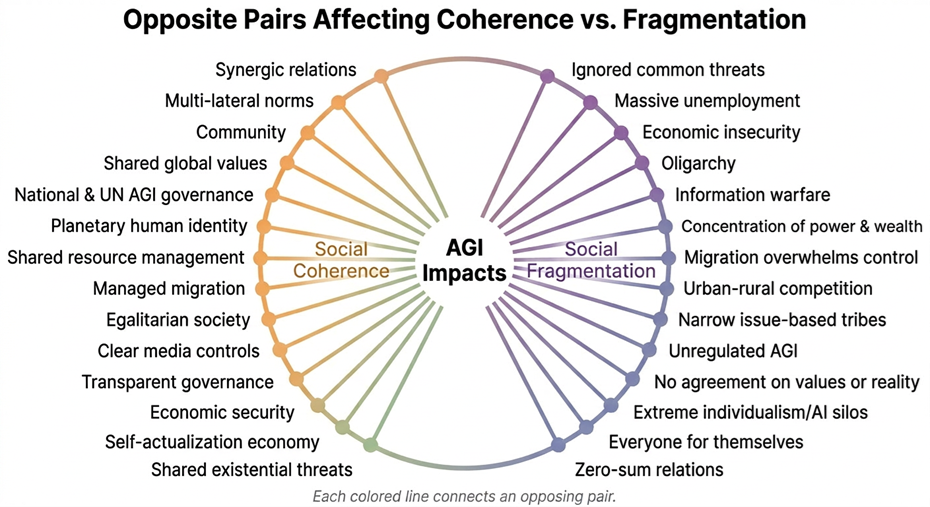
The Millennium Project is exploring how alternative futures for Artificial General Intelligence (AGI) could affect social coherence. This research is intended to provide clarity about AGI’s future possibilities and how national and international actions could improve humanity’s prospects with near-future AGI. Such clarity should reduce anxiety and confusion about options for the United Nations, governments, AGI-related businesses, academia, NGOs, and the arts to improve social coherence and explore new social structures made possible by AGI. The Millennium Project has conducted two three-year international studies that lay the foundation for this proposal. The first is Work/Technology 2050: Scenarios and Actions. The result were three detailed scenarios, 29 national workshops identifying actions to address the issues in the scenarios; distillation to 90 actions assessed by a global panel and organized into five categories of actions for: government; business and labor; education and learning; business and labor; arts and media; and science and technology communities. The second is Transition from Artificial Narrow (ANI) to Artificial General Intelligence (AGI) Governance. The results were: answers to 22 questions by 55 experts on AGI; international assessment of 40 potential regulations and guidelines for governance of AGI and 5 global governance models by 335 futurists, diplomats, and a range of AGI experts from 65 countries; and five global governance models of AGI by 2035.
Building on this research, The Millennium Project found there was little in-depth research on the impact of AGI on social coherence, beyond unemployment. There are also various possibilities for changing social coherence and social structure such as the paired opposites illustrated above. The Millennium Project is preparing to identify and evaluate these possibilities and future actions on a national and international basis.