Millennium Project -- Press Room

  Google
all www  millennium-project.org 
For Press Information, contact:
Jerome Glenn, Millennium Project, millennium-project@igc.org, Tel: 202-686-5179

FAQ

About the Millennium Project

Fact Sheet

Press Releases and News:


KHDA joins the WFUNA Millennium Project
Mon 12 November 2007

original Press Release: http://www.khda.gov.ae/en/news/display.asp?id=1756

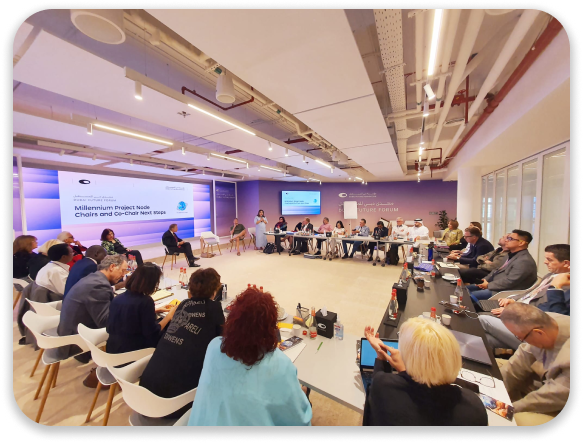
Hind Al Mualla (left), Head of Innovation,
Knowledge and Human Development Authority,
Dr Abdulla Al Karam (center), Chairman of the
Board of Directors and Director General of KHDA,
and Jerome Glenn, Millennium Project Director,
sign the Memorandum of Undesratnding establishing
the Dubai Node
November 11, 2007

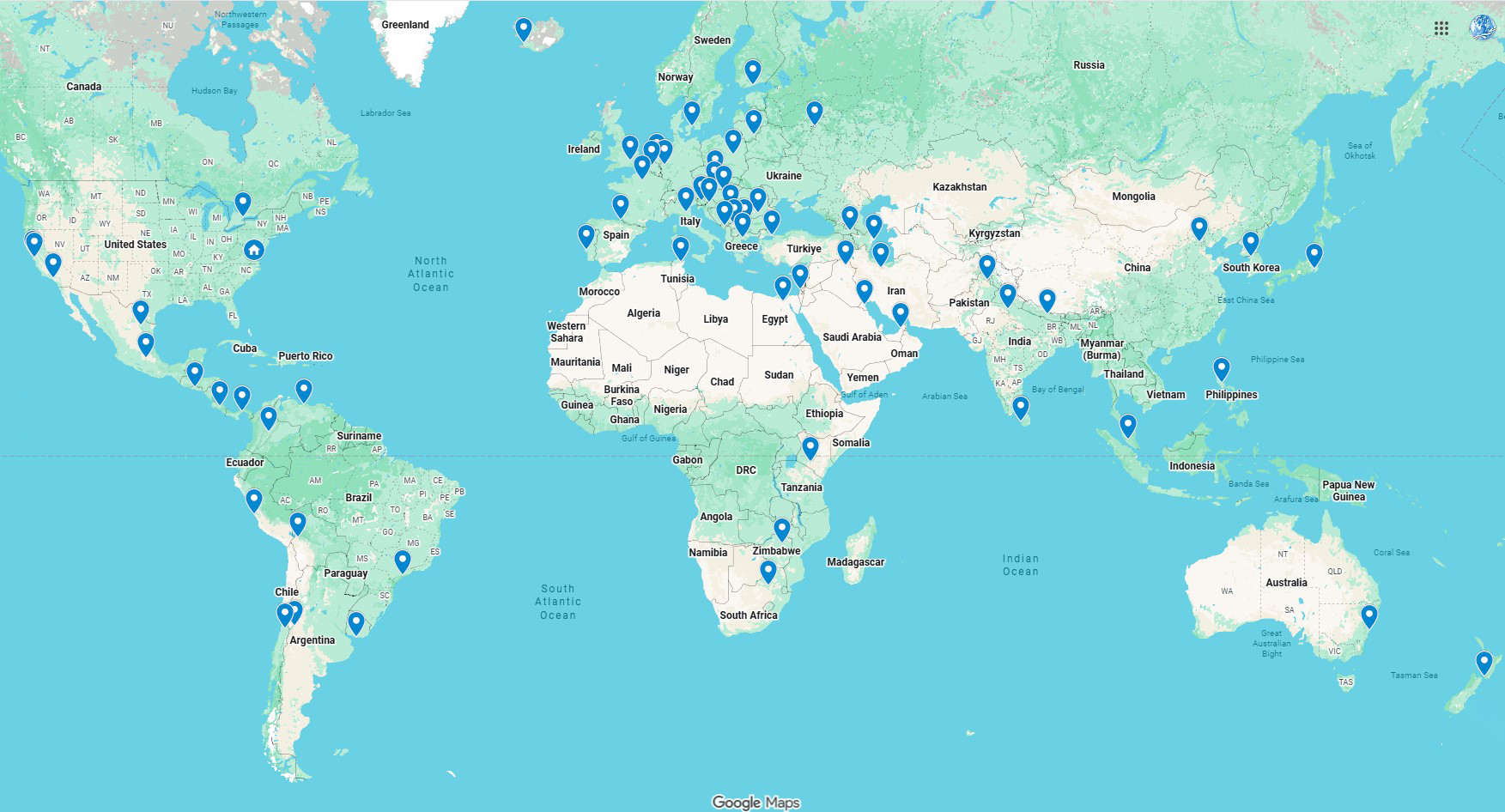
Dubai, UAE, November 12, 2007 – The Innovation Unit of the Knowledge and Human Development Authority (KHDA) yesterday joined the Millennium Project as the Dubai node. The Millennium Project is a global participatory futures research think tank of World Federation of United Nations Associations (WFUNA). Its nodes are the Project’s 30 global partners who ensure that the latest and most diverse research and information is fed into its work.

KHDA’s mandate is to ensure that Dubai’s learning and human development sectors attain world class standards. With this as its primary goal, the Authority recently launched its Innovation Unit that will engage in Futures Studies and help ensure that the Authority’s efforts are ahead of the curve. The most well known futures research method in the region is building futures scenarios.

Dr. Abdulla Al Karam, Chairman of the Board of Directors and Director General of KHDA said, “Being a future oriented organization, KHDA is taking practical steps by partnering with the world’s pre-eminent futures research think tank. We are in an era where change is not only inevitable but also quick and decisive. Preparing and coping with these changes requires foresight and telescopic vision. While attending to our immediate challenges, we must simultaneously prepare for the future. The project is not a one-time study of the future, but provides an on-going capacity as a geographically and institutionally dispersed think tank.”

Jerome Clayton Glenn the Director of the Millennium Project said, “The Millennium Project is a global think tank with 30 Nodes - groups of institutions and individuals that connect global and local perspectives - around the world to produce the annual State of the Future reports over the past 11 years. On behalf of the Millennium Project, it is a great honor to sign a MOU with the Knowledge and Human Development Authority in Dubai to establish a Millennium Project Node in Dubai. It (Dubai) is becoming one of the great centers for creativity, innovation, and futuristic projects in history.”

A lecture presentation on ‘Education in the year 2030’ will be delivered tomorrow (November 13) by Glenn at the KHDA premises in Dubai Academic City. The lecture is open to members of the public and those interested in Futures Studies.


FOR IMMEDIATE RELEASE

PRESS RELEASE
(see pdf file of the press release)

2007 State of the Future
11th Annual Edition

Contacts: Nils Hoffman 703 533-3535; 703 967-1490 cell
Marshall Hoffman: 703-533-3535:703-801-8602 cell

Release: Monday Sept 10th at 1:00 p.m.


A Global Agenda: Urgent Questions and Necessary Choices

In many areas the world is getting better. Life expectancy is increasing; infant mortality is decreasing; literacy, gross domestic products per capita and the number of global Internet users are increasing; and—despite Darfur and Iraq—there are fewer global conflicts.

But the picture is not entirely rosy, according to 2007 State of the Future’s track of global progress. CO2 emissions, terrorism, corruption, global warming, and unemployment are increasing as the percentage of voting populations decreases.

The new report, a slim print volume and a 6000-page companion CD, provides a view of the world as it is, and what it might become without a collective worldwide effort to resolve what the report identifies as the top 15 global challenges.

These include the obvious—water, energy, global warming, health, sustainable development, terrorism—and some not always considered global problems, such as organized crime, which on a global basis makes more money than the world’s military budgets combined, improving the capacity to decide as the nature of work and institutions change, and the need to accelerate scientific and technological breakthroughs.

Unless the challenges are met, the future could be bleak, marred by lack of water and arable land, mass migrations, turbulent climates, economic chaos, conflagrations and other disasters that could engulf global humanity.

2007 State of the Future offers answers along with questions. Proposed solutions sprinkled throughout the report include an Apollo-like global energy development program led by China and the United States, breakthroughs in water desalination, and the restructuring of educational systems to boost both individual and collective intelligence.

A cross-section of global thinking

Information in the report reflects the thinking of a cross section of leading global players, not a group who wrote a book. “Done on a global basis on behalf of the globe, it offers collective intelligence for the planet,” said Jerome Glenn, director of the Millennium Project, which each year updates and expands the State of the Future. “We deliberately seek a diversity of opinions, which means some of the issues raised and recommended actions seem contradictory.”

A planning committee of future-oriented individuals from 29 different countries oversees the overall direction of the project. The 32 Millennium Project “Nodes,” groups of future-oriented people and institutions—from business, government, academia, non-profit organizations, UN and other international agencies—have lead responsibility for a specific region. Their tasks include identifying and studying emerging issues, translating questionnaires, conducting interviews, identifying different participants each year to contribute their expertise and analyses to the project’s studies, and disseminating the results and findings.

“The Nodes are unique,” said Glenn. “Each is an intersection of networks, a new management response to global-local needs. This is probably the first globalized think tank,” he added. “The research has a richness that goes beyond more traditional think tanks.” Each year the State of the Future report is written and compiled by a staff of four, with assistance from interns, and operates on a shoestring budget of about $300,000 each year.

Designed to meet the needs of both decision makers and academics, the combination of a short print volume and expanded CD resolves the age-old contradiction between a small amount of information to help decision makers think through options and the detailed information required by academics to be sure the work is “honorable.”

To suit both audiences, the print document is brief and “sensitive to information overload,” said Glenn, but the detail is there—on the CD—for those who want it. The interactive version available on the website (www.stateofthefuture.org) permits others to add ideas and comments.

The report is laced with facts. For example:
• In 2006 the global economy grew 5.4 percent to $66 trillion while the population grew by 1.1 percent, increasing the average world per capita income by 4.3 percent;
• 2 percent of people own 50 percent of the world’s wealth while the poorest 50 percent own only 1 percent;
• The income of the 225 richest people in the world equals that of the poorest 2.7 billion, or 40 percent of the global population;
• More than half the world’s 6.6 billion people live in urban areas.
• The prevalence of HIV/AIDS has begun to level off in Africa but it continues to spread rapidly in Eastern Europe and in Central and South Asia.

An abundance of detail

The abundance of detail is deliberate. “When people try to understand a lot of information, they try to simplify it and reduce it to the top two or three issues, but that is not doing the world a favor,” said Glenn. “That’s like saying the brain is more important than the respiratory system. Everything is interconnected and inter-related.”

And while people may argue one issue is more important than another, “the fact is that all are important,” said Glenn. “What we are providing is utility. Most futurists consider single issues, like the World Bank looks at economics and the World Health Organization at health, but we provide a full range of issues and options.”

The report is not a consensus document, but rather a distillation of input from the more than 2,400 policy makers, academics, futurists, and creative thinkers from all parts of the globe who have contributed to State of the Future reports over the past 11 years.

As an agenda for the future, the work explores issues confronting the globe but it also shows solutions, said Glenn, updating information where necessary and adding new topics as research is completed. The Millennium Project conducts research under the auspices of the non-profit World Federation of United Nations Associations.

“This is the most vetted, longest lasting, cumulative integrated futures research project in history,” said Glenn, “It is a mechanism for cumulative learning about future possibilities and what can be done, more like sculpting than writing for it changes all the time.”

New for 2007

The 2007 version adds a futurist look at the possibilities for education and improving collective intelligence by 2030. It also updates the current status of the 15 global challenges and suggests ways these challenges can be met, both globally and in each region.

Another section, the State of the Future Index, SOFI, identifies where global humanity is winning and where it is losing, in effect providing a guide to where resources should be focused to improve prospects for the future.

Winners in 2007 include increases in life expectancy, decreasing infant mortality, increased literacy, fewer global conflicts, and increases in gross domestic products per capita and the number of global Internet users. The loss column cites increases in CO2 emissions, terrorism, corruption, global warming, and unemployment, and a decrease in percentage of voting populations.

Introduced in 2001, the SOFI and its indicators have been refined each year, and now include a matrix and guidance to help individual countries develop their own SOFIs.

Special Research Projects

Over the years, a number of special research projects have been added. This year’s addition, a study requested and supported by the Republic of Korea, explores possibilities for learning and education by 2030. Compiled by more than 200 participants, suggestions include greater use of individualized education, just-in-time knowledge and learning, use of simulations, improved individual nutrition, finding ways to keep adult brains healthier, E-Teaching, and integrated life-long learning systems.

Environmental security is another category. Using the Millennium Project definition of “environmental viability for life support with three sub-elements: preventing or repairing military damage to the environment, preventing or responding to environmentally caused conflicts, and protecting the environment due to its inherent moral value,” contributors have identified more than 200 emerging international environmental security issues and suggested ways to address them.

The potential audience is diverse and immense. “State of the Future provides a landscape from which people can draw information and ideas to suit and adapt to their unique needs,” said Glenn. Public and private policy makers can use the information to improve strategic decision making and global understanding, corporations and business executives can use it for planning, professors and consultants find it useful for teaching and research.

What are the global challenges?

The report defines the 15 global challenges as “transnational in nature and trans-institutional in solution. Any government or institution acting alone cannot address them.” Further, it states, “All require collaborative action by governments, international organizations, corporations, universities, NGOs and creative individuals.”

Despite the order, none is more or less important than any other, added Glenn, and they are interdependent. Progress toward one will affect others. So will deterioration.

1. How can sustainable development be achieved by all?
2. How can everyone have sufficient clean water without conflict?
3. How can population growth and resources be brought into balance?
4. How can genuine democracy emerge from authoritarian regimes?
5. How can policymaking be made more sensitive to global long-term perspectives?
6. How can the global convergence of information and communication technologies work for everyone?
7. How can ethical market economies be encouraged to help reduce the gap between rich and poor?
8. How can the threat of new and reemerging diseases and immune microorganisms be reduced?
9. How can the capacity to decide be improved as the nature of work and institutions change?
10. How can shared values and new security strategies reduce ethnic conflicts, terrorism and the use of weapons of mass destruction?
11. How can the changing status of women help improve t he human condition?
12. How can transnational organized crime networks be stopped from becoming more powerful and sophisticated global enterprises?
13. How can growing energy demand be met safely and efficiently?
14. How can scientific and technological breakthroughs be accelerated to improve the human condition?
15. How can ethical considerations become more routinely incorporated into global decisions?

“Contributors spent years arguing and debating the most significant challenges confronting the global future before whittling the list down to 15,” said Glenn. “We started with 280.”

Millennium Project sponsors include Applied Materials, Azerbaijan Ministry of Communications, Deloitte & Touche LLP, Foundation for the Future, Republic of Korea Ministry of Education, State of Kuwait, and the U.S. Army Environmental Policy Institute. CIM Engineering, Smithsonian Institution, UNESCO, and World Future Society provide in-kind support.


FOR IMMEDIATE RELEASE
Contact: Jerome C. Glenn, Director
202-686-5179

Launch of the
2007 State of the Future
11th Annual Edition
September 10th at 1 PM
UN Bookstore

Invaluable insights into the future for the UN, its Member States, and civil society.
-- Ban Ki-moon, UN Secretary-General

Best introduction by far to the key issues of the early 21st century.
-- Michael Marien, editor, Future Survey

The 2007 State of the Future by Jerome C. Glenn and Theodore J. Gordon, co-founders of the Millennium Project is an extraordinary resource for understanding global change and strategies to improve the human condition - as reported by a unique system of futurist networks around the world.

This “Report Card on the Future” distills the collective intelligence of over 2,000 leading scientists, business planners, futurists, scholars, and policy advisors who work for governments, corporations, non-governmental organizations, universities, and international organizations.

It calls for making increasing intelligence a national goal, establishing new institutional structures like transinstitutions, and creating a US-China-led Apollo-like global energy strategy, and brings to our attention startling facts: there are more slaves today than at the height of the African slave trade, organized crime gets more money than all the military budgets of the world combined, and single individuals may one day be able to make weapons of mass destruction.

The authors contend that humanity has the resources to address its global challenges, and that more wisdom, good will, and intelligence need to be focused on these challenges. We are overloaded with so much extraneous information that it is difficult to identify and concentrate on what is truly relevant. The 2007 State of the Future cuts through this clutter by presenting short, clear summaries in print, while giving the full details of the Millennium Project’s past 11 years of global futures research in the attached 6000-page CD.

- 15 Global Challenges––prospects, strategies, insights
- Education & Learning 2030
- 700 Annotated Scenario Sets
- State of the Future Index
- Environmental Security and much more futures intelligence

The executive summary can be downloaded at http://www.millennium-project.org/millennium/new.html
2007 State of the Future
99-page book, 6,000-page CD ISBN: 0-9722051-6-0


FOR IMMEDIATE RELEASE
Contact: Jerome C. Glenn, Director
202-686-5179

MILLENNIUM PROJECT MEETING IDENTIFIES ACTIONS FOR GLOBAL CHALLENGES
(see PDF of the press release)

August 2, 2007, Minneapolis, MN: The Millennium Project of the World Federation of United Nations Associations met in Minneapolis July 27-29 to discuss progress made in 2006 on 15 major global challenges, discuss the findings of the forthcoming 2007 State of the Future, and develop the 2008 work program. Seventeen of the 30 Node Chairs were present, representing all of the continents of the world, with the exception of Antarctica. They presented and responded to questions related to their country's individual progress. The Millennium Project was established in 1996 as a global participatory think tank in response to the increasingly transnational, trans-institutional, and trans-disciplinary nature of the enormous challenges facing the future of the world.

The 2007 State of the Future assemblage represents the 11th year of the think tank deliberations. Some of the 2006 accomplishments included international assessments of future education and learning possibilities, environmental security issues and options, and the State of the Future Index for countries and the world. People have always wanted to know if the future is getting better or worse, where we are winning and losing, and where resources should be focused to ensure a better future.

Prior to the creation of the Millennium Project State of the Future Index, major world indexes provided individual measures for economics, health, and energy, for example. However, no one organization attempted to bring it all together to see the prospects for humanity as a whole. The Millennium Project's State of the Future Index measures the 10-year outlook for the global future in general. It is constructed with key variables and forecasts related to the global opportunities and challenges that have emerged from the largest on-going global participatory futures process in history.

The "where we are winning" findings of this year's survey are that people around the world are becoming healthier, wealthier, better educated, more peaceful, increasingly connected, and they are living longer. But, at the same time, "where we are losing" findings are that the world is more corrupt, congested, warmer, and increasingly dangerous. On balance, however, world futures are improving.

The think tank assessed issues that ranged from life expectancy and infant mortality, to sex slavery, the global economy, energy and environmental issues, and the imminent changes in education and learning. Slavery, long declared as "no longer part of the human condition," continues in greater numbers today, with the growth of youth sex slavery, than it was at its highest point of the African slave trade.

The group also explored the opportunity for the United States and China to develop a joint energy-environment strategy that might be announced before the 2008 Olympics, and the likely impact of the 800 to 1,000 coal-fired plants currently in planning or under construction around the world. If these go into operations with a 40 year production life, the reduction of GHG emissions is unlikely. The group anticipates that an environmental movement similar to the 1970 movement against nuclear energy will likely occur.

The Millennium Project tracks some of the most challenging conditions while also identifying opportunities that would mitigate these threats. The group's conclusion is that answers have been identified for each of the 15 global challenges. The group's position is that the real challenge is connecting the answers with the decision makers. For example, solar-powered satellites could supply enough electrical energy to run all of the cars on the earth forever, and sea water agriculture could provide a viable alternative to address ever-growing water shortages, new sources for food, biofuels, and carbon sequestration. More than 1 billion people do not have access to safe drinking water, and water tables are falling on every continent. Forty percent of the water consumed is controlled by 2 or more countries, providing the new opportunities for conflicts. However, because agriculture accounts for 70% of human usage of fresh water, seawater agriculture on desert coastlines could significantly reduce freshwater agriculture demand. Research shows that there are 100,000 plants that can adapt to salt water. One hundred are currently in commercial trials in the U.S., China, and other countries. If we planted otherwise uninhabitable beaches with algae and other vegetation, we would have more food for humans and animals.

Glenn explained the group's strong conviction that all of the challenges facing the world have identified solutions. According to Millennium Project Director Jerome Glenn, "The Global Millennium Project has proven that Global Futures research is possible, and is enhanced by the international, inter-institutional, multi-ideological nature of the coalition. The emerging global threats are bigger than the political, religious, and cultural differences among the individuals involved. These are people who would never ordinarily work together, but have demonstrated an extraordinary commitment to the joint resolution of the global challenges facing us all." Blaz Golob, Node Chair for Ljubljana, Slovenia, expressed his conviction that "The future is what we as individuals chose to make of it."

The above information is among the findings of the group's research which are distilled in its forthcoming 99-page book, 2007 State of the Future. For those who want greater detail, a 6,000-page CD is part of the global report card on the future. According to Michael Marien, Editor, Future Survey, "The 15 Global Challenges updated annually continues to be the best introduction by far to the key issues of the early 21st century."


Senat, Republic of Chile

Jerome Glenn, Director of the Milleniumm Project, headed the delegation that met with the President of the Chile Senate, Eduardo Frei Ruiz-Tagle, for discussing the formation of a Commissions of the Future dedicated to help the Parliament to carry out political analyses to improve the management of the future. Glenn was accompanied by Miguel Gutiérrez Angel, Argentina, Director of the Center of Globalización and Prospectiva; Jose Cordeiro, Director of the Venezuela Society of the Future; Luis Ragno, Director of the Training center Prospectivos of the Universidad Nacional de Cuyo; Héctor Casanueva, Academic Vicerector of the University Miguel de Cervantes of Chile, and Marcela Palaces, Director of Continuous Education of the same university.

Jerome Glenn, Director General del Milleniumm Project de la Universidad de Naciones Unidas encabezó la delegación que se entrevistó con el Presidente del Senado Eduardo Frei Ruiz-Tagle para informarfle respecto de las Comisiones de Futuro que se están formando en los Parlamentos dedicadas a efectuar análisis políticos para mejorar la gestión del futuro. Glenn estuvo acompañado de Miguel Angel Gutiérrez, argentino, Director del Centro de Globalización y Prospectiva; José Cordeiro, Director de la Sociedad venezzolana del Futuro; Luis Ragno, Director del Centro de Estudios Prospectivos de la Universidad Nacional de Cuyo; Héctor Casanueva, Vicerrector Académico de la Universidad Miguel de Cervantes de Chile y Marcela Palacios, Directora de Educación Continua de la misma casa de estudios

http://www.senado.cl/prontus_senado/site/artic/20070516/pags/20070516145556.html


FOR IMMEDIATE RELEASE

Winners of the Global Millennium Prize Announced
(see Press Release PDF)

Statement by Jerome Glenn, Director of the Millennium Project

CONTACTS --see below contacts by country/region
General contacts:
Mexico
: Concepción Olavarrieta olav@prodigy.net.mx Tel:+55 (55) 5540-2746
General background: Jerome C. Glenn, jglenn@igc.org, Tel: 202-686-5179

Washington, DC––February 23, 2007 -The 15 winners of the Global Millennium Prize are represented by seven different countries which include Brazil, China, India, Mexico, South Korea, USA, and Venezuela.

The Global Millennium Prize sponsored by the Millennium Project of the American Council for the United Nations University is the first ever worldwide competition for high school students to address the 15 Global Challenges facing humanity .

Interestingly the Mexican students, representing the wealthiest to the poorest states, come from Baja, Distrito Federal, Guerrero, Mexico, Queretaro, and Tlaxcala.

The competition invited students to write an essay on one of the Millennium Project’s 15 Global Challenges which cover sustainable development, water, democratization, information technology, population and resources, the status of women, energy, transnational crime, health, the rich-poor gap, decision making, science and technology, peace and conflict, long-term policy making, and global ethics.

Winners were chosen for each of the 15 challenges and will receive an International Certificate of Recognition, a trophy, an all expense paid trip to Mexico City for the awards ceremony and a Hewlett Packard Laptop computer.

The Winners by the respective challenges are:
1. Sustainable development: Aline Mazeto Roldan, Brazil
2. Water without conflict: Chinwe Madubata, United States of America
3. Population and Resources: Teotl Rosas Lozano, México
4. Democratization: Yolanda Belén Zavala Gómez, México
5. Global, Long-Term Policymaking: Mario Urióstegui Hernández, México
6. Globalization of Information Technology: S. Laxmipriya, India
7. Rich-Poor Gap: Alberto Jaime Plancarte, México
8. Health: Elías David León, Venezuela
9. Decisionmaking Capacities: Maria do Rosario da Silva Gomes, Brazil
10. Conflict Resolution: Luz María Resendiz Montoya, México
11. Improving the Status of Women: Anayeli Muñoz Vázquez, México
12. Transnational Crime: Yunshin Cho, Korea
13. Energy: Min Yixiao, China
14. Science and Technology: Sai Sidhardh, India
15. Global Ethics: Nely Karina Santillán Silva, México

Statement by Jerome Glenn, Director of the Millennium Project
(see PDF of the Statement)

Congratulations to all the winners, the judges, the sponsors, and Concepción Olavarrieta with her Millennium Project Node in Mexico.

Theses prizes are part of a new human awaking around the world. We are wakening to the realization that anyone can contribute their ideas to improve people's lives. For the first time in history it is possible to connect people with good ideas with people who need them, and connect to the resources that can implement the ideas that can improve the human condition anywhere in the world.

The 15 Global Challenges have been identified and updated by over 2000 participants in the Millennium Project. And now you too are part of this international participation.

The Millennium Project will join forces with the World Federation of United Nations Associations to expand the participation in the Global Millennium Prize. I hope that the winners over years in the future will form a network for connecting people, ideas, and resources to build a better future.

In addition to the Global Millennium Prize for secondary school students, we are also planning to have a prize for university students around the world. Maybe one day we can connect the many prize programs around the world into a global system that can help connect people, ideas, and resources that will answer all the 15 Global Challenges.

About the Millennium Project: The Millennium Project is a worldwide think tank, acting under the auspices of the American Council for the United Nations University, comprising more than 2,000 futurists, scholars, business leaders, scientists, and policy makers from more than 50 countries, who volunteer their time to the Project. The Project explores global futures, by interviewing individuals who work for corporations, universities, Non-Government Organizations, UN organizations, and governments around the world. The Millennium Project is organized into regional and national “Nodes”, groups of individuals and institutions that identify key in-country futurists, and political, business, science, technology, and academic leaders, to participate in Millennium Project studies. Presently the Project has 27 Nodes around the world that connect global and local views. For more information about the Millennium Project see http://www.millennium-project.org/millennium/overview.html

The Global Millennium Prize: The Global Millennium Prize, based on the 15 Global Challenges, emulates on the successful national “Premio del Milenio” launched in 2005 under the guidance of Ms. Concepcion Olavarrieta, President, Nodo Mexicano, El Proyecto del Milenio. “Premio del Milenio” that invited grade 5 school children from Mexico to choose one of the 15 Global Challenges and to research creative solutions to address that Challenge. The program was such a success and incited such an interest from the other Millennium Project Nodes, that it was expanded to include teenagers worldwide. More
information about the Global Millennium Prize can be found at http://www.globalmillenniumprize.org

CONTACTS by country/region
Argentina:
Miguel Angel Gutierrez, alterfutures@hotmail.com
Brazil: Rosa Alegria rosa.alegria@terra.com.br
Canada: Elizabeth Florescu acunu@igc.org
Brussels Area: Marie-Anne Delahaut delahaut.amarie-anne@institut-destree.eu
Finland: Heinonen Sirkka Sirkka.Heinonen@vtt.fi
France: Saphia Richou saphia.richou@cnam.fr
Germany: Cornelia Daheim daheim@z-punkt.de
India: Anandhavali Mahadevan <anandd_2k@rediffmail.com> or Mohan Tikku <mohan_tikku@yahoo.co.in>
Mexico: Concepción Olavarrieta olav@prodigy.net.mx
South Korea: Youngsook Park harmsen@korea.com
Russia: Nadezhda Gaponenko foresightr@mail.ru
U.S: John J. Gottsman, Phone: 650-329-9818, gottsman@msn.com
Venezuela: Jose Cordeiro jose_cordeiro@yahoo.com , Eileen Cárdenas eileen.cardenas@gmail.com


FOR IMMEDIATE RELEASE

WORLD COMPETITION FOR SECONDARY SCHOOL STUDENTS ADDRESSING THE GLOBAL FUTURE
(see Press Release PDF)

CONTACTS --see below contacts by country/region
General contacts:
English:
John J. Gottsman, gottsman@msn.com Tel: 650-329-9818
Spanish: Concepción Olavarrieta olav@prodigy.net.mx Tel:+55 (55) 5540-2746
General background: Jerome C. Glenn, jglenn@igc.org, Tel: 202-686-5179

Washington, DC––September 15, 2006: the Millennium Project of the American Council for the United Nations University launches the GLOBAL MILLENNIUM PRIZE, the first ever worldwide competition for high school (secondary school) students to address the 15 Global Challenges facing humanity http://www.globalmillenniumprize.org

Following a highly successful national competition in Mexico in 2005, the Millennium Project expanded the contest for teenagers in other Millennium Project Nodes, although children from around the world are welcome to participate as well.

The Competition invites students (age 15-19) to choose one of the Millennium Project’s 15 Global Challenges and to research and write an essay (scenario) on how they think one of the Global Challenges could be addressed between now and the year 2015. The 15 Global Challenges cover issues and opportunities in sustainable development, water, population & resources, democratization, long-term policymaking, information technology, the rich-poor gap, health, decision making, peace & conflict, changing roles of women, transnational crime, energy, innovations in science & technology, and global ethics. For a brief overview of the 15 Global Challenges, see: http://www.millennium-project.org/millennium/challeng.html.

The competition opens on September 15, 2006, with a November 15, 2006 deadline for submission. Three awardees will be selected in each of the 15 Global Challenges categories. Acknowledgement will include an International Certificate of Recognition, a trophy, and all expenses while in Mexico City for the Award Ceremony (round trip airfare to Mexico might also be supplied pending resources.) The winner in each of the 15 challenges will receive a HP laptop.

All participants will receive a Certificate of Recognition. They may also receive the registration fee to the World Future Society Annual Conference to be held in Minneapolis, Minnesota, July 29–31, 2007, pending resources.

About the Millennium Project: The Millennium Project is a worldwide think tank, acting under the auspices of the American Council for the United Nations University, comprising more than 2,000 futurists, scholars, business leaders, scientists, and policy makers from more than 50 countries, who volunteer their time to the Project. The Project explores global futures, by interviewing individuals who work for corporations, universities, Non-Government Organizations, UN organizations, and governments around the world. The Millennium Project is organized into regional and national “Nodes”, groups of individuals and institutions that identify key in-country futurists, and political, business, science, technology, and academic leaders, to participate in Millennium Project studies. Presently the Project has 27 Nodes around the world that connect global and local views; see http://www.millennium-project.org/millennium/nodes.html

The Global Millennium Prize: The Global Millennium Prize, based on the 15 Global Challenges, emulates on the successful national “Premio del Milenio” launched in 2005 under the guidance of Ms. Concepcion Olavarrieta, President, Nodo Mexicano, El Proyecto del Milenio. “Premio del Milenio” that invited grade 5 school children from Mexico to choose one of the 15 Global Challenges and to research creative solutions to address that Challenge. The program was such a success and incited such an interest from the other Millennium Project Nodes, that it was expanded to include teenagers worldwide.

CONTACTS by country/region
Argentina:
Miguel Angel Gutierrez, alterfutures@hotmail.com
Brazil: Rosa Alegria rosa.alegria@terra.com.br
Canada: Elizabeth Florescu acunu@igc.org
Brussels Area: Marie-Anne Delahaut delahaut.amarie-anne@institut-destree.eu
Finland: Heinonen Sirkka Sirkka.Heinonen@vtt.fi
France: Saphia Richou saphia.richou@cnam.fr
Germany: Cornelia Daheim daheim@z-punkt.de
India: Anandhavali Mahadevan <anandd_2k@rediffmail.com> or Mohan Tikku <mohan_tikku@yahoo.co.in>
Mexico: Concepción Olavarrieta olav@prodigy.net.mx
South Korea: Youngsook Park harmsen@korea.com
Russia: Nadezhda Gaponenko foresightr@mail.ru
U.S: John J. Gottsman, Phone: 650-329-9818, gottsman@msn.com
Venezuela: Jose Cordeiro jose_cordeiro@yahoo.com , Eileen Cárdenas eileen.cardenas@gmail.com


FOR IMMEDIATE RELEASE

Washington, DC, August 15, 2006

The Millennium Project Releases “2006 State of the Future” Report

Extraordinary overview documents global prospects for humanity

No. 1 Best Selling Book on the Future at the World Future Society Conference
See the PDF file of the Press Release

2006 State of the Future
presentation and Executive Summary


Washington, DC–The Millennium Project––a global participatory think tank–– released its 10th annual State of the Future report today. Its pre-released copies were the top seller at the July 28-31 World Future Society conference held in Toronto, Canada.

This “Report Card on the Future” distills the collective intelligence of over 2,000 leading scientists, futurists, scholars, and policy advisors who work for governments, corporations, NGOs, universities, and international organizations. The 2006 State of the Future comes in two parts: a 125-page print executive summary and a 5,400-page CD. The CD contains all the research behind the print edition, plus the Millennium Project’s 10 years of cumulative research and methods. Some unique features not available in other global assessments:

• 15 Global Challenges – Prospects, Strategies, Insights
• 4 Global Energy Scenarios for 2020 - rich in detail
• 650 Annotated Scenario Sets
• State of the Future Index
• Reflections on 10 years of Global Futures Research
• And much more futures intelligence on technology, environment, governance, the human condition

A must in foresight, an excellent tool for policymakers.
                 Maria João Rodrigues, Special Advisor to the European Commission

Shows us the importance of future thinking.
                 Reyes Tamez, Minister of Education, Mexico

Best money I ever spent at Ford.
                 Ed Martin, former Director, Global Market Research, Ford Motor Company

Exceedingly valuable resource for corporate strategic planning.
                 Michael Stoneking, Partner, Deloitte & Touche LLP

“There is so much extraneous information that it is difficult to identify and concentrate on what is truly relevant,” says co-author Jerome C. Glenn, director of the Millennium Project of the American Council for the UN University. “Our report cuts through this clutter by presenting short, clear summaries in print, while giving the full details in the attached CD.” For example:

• Just as computer code is written to create many kinds of software, genetic code will be written to create many varieties of life, including those that make hydrogen from plants.

• $1 trillion was paid in political bribes last year and organized crime’s annual income is over $2 trillion. By comparison, all military budgets combined worldwide are $1 trillion.

• The worldwide race to connect everything not yet connected is just beginning.

• Sales of nanotech-related products exceed $20 billion a year, while the health and environmental impact studies proliferate that may knock out some of the nano-producers.

• Buffett/Gates will have more implementation power in the developing world’s health policies than the United State or the World Health Organization––showing the evolution of power from nations, to corporations, to individuals.

• The Chernobyl plant is still leaking radioactivity 20 years after the accident––Ukraine’s President has asked for $1 billion for better containment, 27,000 nuclear warheads still exist, smuggling of nuclear waste is up again; hence, we are still out to lunch on nuclear management.

• 25 million are likely to die if avian flu mutates for human-to-human transmission.

• While electoral democracies increase, press freedoms are actually falling worldwide.

• In the best case scenario, China’s water situation does not start to improve for another 10 to 15 years, which could lead to future mass migrations.

• Dramatic increases in collective human-machine intelligence are possible within 25 years. It is also possible that within the same time frame single individuals acting alone might create and use weapons of mass destruction.

• Conducting regional water negotiations in the Middle East may be the best way to build confidence that peace is possible in the region.

• Using a State of the Future Index can improve decision making and setting priorities.

After 10 years of Millennium Project research, it has become increasingly clear that humanity has the resources to address its global challenges; what is less clear is how much wisdom, good will, and intelligence will be focused on these challenges.

The authors:
Jerome C. Glenn and Theodore J. Gordon co-founded the Millennium Project of the American Council for the United Nations University () in 1996. Glenn has been the executive director of the since 1988 as liaison between the U.S. and the UNU, the primary academic research system of the United Nations. He has 35 years experience in futures research for various think tanks and was deputy director for PfP International in micro-enterprise development, where he introduced e-mail to thirty developing countries in the early 1980s. Gordon was a space scientist in the Apollo program, has 45 years experience in futures research, founded The Futures Group, co-founded the Institute for the Future, and was an early pioneer with the RAND Corporation’s Delphi studies.

About the Millennium Project:
The Millennium Project is a unique think tank with 26 Nodes––groups of institutions and individuals who connect global and local perspectives––around the world, plus 2,000+ volunteer futurists, scholars, business leaders, scientists, and policymakers from more than 50 countries, acting under the auspices of the American Council for the United Nations University. It is dedicated to exploring global futures by interviewing and surveying individuals at corporations, universities, NGO's, UN organizations, and governments to understand world change and to identify actions to improve humanity’s prospects for the future. In addition to its annual State of the Future reports, the Millennium Project also produces the Futures Research Methodology series, and special studies. Current sponsors of the Millennium Project are Applied Materials, Deloitte & Touche LLP, Ford Motor Company, Kuwait Petroleum Corporation, and the U.S. Army Environmental Policy Institute, and (in-kind) the Smithsonian Institution, World Future Society, and World Federation of United Nations Associations.

NOTE TO EDITORS: For additional information, visit The Millennium Project’s website www.millennium-project.org and/or download the project’s flyer at: http://www.millennium-project.org/millennium/mpflyer-2006.html


Future of Livestock in Developing Countries to 2030

First Meeting of the Future of Livestock in Developing Countries to 2030 Held in Nairobi
Group of 25 experts enters 'uncharted waters' in building futuristic livestock scenarios that force new thinking and new decisions

The International Livestock Research Institute (ILRI) and the Food and Agriculture Organization of the United Nations (FAO) hosted a group of 25 livestock and futures experts from around the world for two and a half days 13-15 February 2006 to do some non-crystal-ball-gazing. The experts constructed alternative scenarios of likely futures of livestock development in developing countries paying particular attention to what will happen to poor people.

They got help from Jerome Glenn (jglenn@igc.org), who is an expert in 'futures research' and director of a think tank called the Millennium Project, which has been running under the aegis of the American Council for the United Nations University since 1991.

Decisionmakers in ILRI and FAO and other livestock research and development institutions are the target of the products of this meeting. The idea behind this work is to force serious, flexible thinking about alternative possibilities for the future and begin to come up with the right mix of strategic decisions that will allow people to adapt to the future. The process of doing this work can alter the way decision makers think about the future. That, says Glenn, may be the most important outcome of the meeting.

'The germ of a future-oriented collective intelligence on livestock development for the poor was created here,' Glenn said at the close of the meeting. 'What we believe is possible for livestock development is "pretty poultry"', he laughed. 'Here, for example, are just a few of the things that were not yet in the world in 1980: personal computers, the World Wide Web, cellular phones, AIDs, the European Union and the World Trade Organisation. The world has changed dramatically in the last 25 years. What is guaranteed is that we will have even more and faster changes in the future. This meeting was held to enlarge the capacity of stakeholders in livestock development to respond to good and bad events in future, including major shocks such as another tsunami, a war and or disease pandemics.'

Click here to read Jerome Glenn's paper, Global Scenarios and Implications for Constructing Future Livestock Scenarios, January 2006, 68 pages.

'We are entering uncharted waters', said FAO's Henning Steinfeld (henning.steinfeld@fao.org) to develop a platform for creating a better understanding of livestock futures.'

ILRI's director general, Carlo Seré (c.sere@cgiar.org), said ILRI and FAO share concerns about finding the best ways to position livestock in a dynamic world for the benefit of the poor.

The products of this meeting include a wealth of information embedded in four plausible 'storylines' that the participants constructed for the future. The participants adapted the Millennium Ecosystem Assessment scenarios for the livestock sector. These ranged from a 'Techno-Garden' scenario, where technology is largely a good, benefiting many and bringing people together, to a 'Global Orchestration' scenario where consumers rule---but which consumers?, to an 'Adaptive Mosaic' scenario in which novel uses of IT connect livestock communities, to a 'Order from Strength; Weakness from Chaos' scenario where today's international organizations are largely ineffective or have disappeared altogether, the world is fragmented and reactionary, and its every country for itself.

Summaries of the storylines will be produced by the end of February 2006. A longer report will be produced subsequently by ILRI and FAO. To receive a copy of the summaries or report, contact the meeting's organizers, ILRI's Ade Freeman (a.freeman@cgiar.org) or FAO's Anni McLeod (anni.mcleod@fao.org).

This livestock expert opinion is needed to feed into the Millennium Ecosystem Assessment and another major inter-governmental and consultative 3-year effort initiated by the World Bank called the International Assessment of Agricultural Science and Technology for Development (http://www.agassessment.org/). Involving 900 participants and 110 countries, the IAASTD is now collecting global and regional assessments of the state and needs of science and technology and is at the stage of preparing first drafts of results. Results of the ILRI-FAO meeting will also be used to inform annual program meetings of ILRI and the Animal Production and Health Division of FAO, where feedback from wider circles of livestock experts will be sought.

The aim of all this work, says ILRI livestock systems analyst Philip Thornton (p.thornton@cgiar.org), is to 'help build and drive a bandwagon rather than jumping on whatever bandwagon happens along. We need to be changing mindsets in a world where ten percent of the world's population consumes ninety percent of the world's resources. It is surely not impossible to have a more equitable world. We need to show people that livestock are a great development tool with which to do that.'

If the world does not view livestock experts as long-term global visionaries, maybe it should take another look.


2005 State of the Future Book Launch

November 14, 2005: 2005 State of the Future Book Launch. Jerome C. Glenn, co-author of 2005 State of the Future will provide his insights into the collective intelligence of nearly 2,000 leading minds in more than 50 countries.Woodrow Wilson International Center for Scholars, 5th Floor Conference Room, 12pm-1:30pm

See the archived video from the webcast of the meeting, at: Live Webcast: 2005 State of the Future. An Extraordinary Overview of the Global Situation and Prospects for the Future

See the power point presentation 2005 State of the Future Book Launch by Jerome C. Glenn, co-author, presented at the launch.


USACOR Awards

Jerome C. Glenn, Director of the Millennium Project, receives the Donnella Meadows Futures Award
and Hazel Henderson, member of the Millennium Project Planning Committee, receives USACOR Lifetime Achievement Award

US Association for the Club of Rome (USACOR)
AWARD MEETING and 30th ANNIVERSARY

at a meeting on Friday, September 30, 2005, 3 PM to 6 PM at Old Dominion University
To be held in the Rector's Room at the Webb University Center

The Donnella Meadows Futures Award
Presented by Dr. Prof. Dennis Meadows, author of Limits to Growth ...a Thirty Year Update
To Jerome Clayton Glenn (ACUNU/Millennium Project)
Followed by a presentation by Jerry Glenn

The USACOR LIFETIME ACHIEVEMENT AWARD
presented by Dr. Anitra Thorhaug, the president of USACoR
To Hazel Henderson
With talk by Hazel Henderson,
A presentation of Hazel's most recent works and a signing of her most recent book.

Jerome C. Glenn receives the Donnella Meadows Futures Award presented by Dr. Prof. Dennis Meadows

Hazel Henderson, a well known, independent, futurist and economist is the author of many outstanding books and articles including: The Politics of the Solar Age; Ecocities: Building Cities in Balance with Nature; New World Trends and the Future of Oil and Energy; Beyond Globalization: Shaping a Sustainable Global Economy; Building a Win-Win World: Life Beyond Global Economic Warfare; Creating Alternative Futures, the end of economics.
She has participated in the development of the Calvert-Henderson Quality of life Indicators.
Most recently she has worked to create and to moderate a TV series that reaches 44 million homes, called Ethical Markets, which can be viewed at http://www.ethicalmarkets.com/
In the past few days, she has brilliantly proposed Vouchers for Resettling Katrina’s Victims, which would Stimulate US Economy. An article by her on this topic can be read at the above website.
We are honored to have her with us at the COR annual meeting and we hope that many of you will be at her talk on Friday September 30th 2005, at USACOR Awards Ceremony at Old Dominion University in Norfolk Virginia.

Jerome Clayton Glenn is the Executive Director of the American Council / United Nations University and the Director of the UN Millennium Project. He also serves on Editorial Board of the World Future Society’s “Future Research Quarterly.” He is the author of numerous books and articles including: Future Mind: Artificial Intelligence: The Merging of the Mystical and the Technological in the 21st Century; Spacetrek: The endless migration; 1999 State of the Future: Challenges we Face at the Millennium; Defining Environmental Security: Implications for the US Army; and Linking the Future: Findhorn, Auroville, Arcosanti.


FOR IMMEDIATE RELEASE

The Millennium Project Releases “2005 State of the Future” Report

Think Tank Explores the Global Challenges and Prospects for the Future


WASHINGTON, DC - August 4, 2005 - The Millennium Project--the global participatory think tank--released today its ninth annual "2005 State of the Future" report. This unique resource presents what is important to know about today and prospects for tomorrow. This "Report Card on the Future" distills the collective intelligence of nearly 2,000 leading experts from around the world who work for governments, corporations, NGOs, universities, and international organizations.

"There is so much extraneous information that it is difficult to identify and concentrate on what is truly relevant," says co-author Jerome C. Glenn, director of the Millennium Project of the American Council for the UN University. "Our report cuts through this clutter by presenting short, clear summaries in the paperback, while giving the full details of the research in an attached CD." For example:
· the annual gross income of organized crime is more than twice that of all military budgets worldwide
· views of women and men on future ethical issues are strikingly similar around the world
· the worldwide race to connect everything not yet connected is just beginning
· in the best case scenario, China's water situation does not start to improve for another 10 to 15 years, which is now the key impediment to its growth and could lead to future mass migrations
· dramatic increases in collective human-machine intelligence are possible within 25 years. It is also possible that within the same time frame single individuals acting alone might create and use weapons of mass destruction (WMD)
· conducting regional water negotiations in the Middle East may be the best way to build confidence that peace is possible in the region

Some early reactions:
"This extraordinary overview reminds policymakers of their long-term responsibilities."
Barbara Haering, V.P., OSCE Parliamentary Assembly

" Exceedingly valuable resource for corporate strategic planning."
Michael Stoneking, Partner, Deloitte & Touche

"Very important for Korea and the future of our planet."
Lee Kang-chul, Chief of Staff for the President of South Korea

The new "State of the Future Index" (SOFI) shows that the outlook for the future is getting better due to the past 20 years of improvement in the infant mortality rate, food availability in low-income countries, and other factors. However, plausible and significant drops in the index could occur due to proliferation of various forms of weapons of mass destruction, terrorism, the rich-poor gap, and increasing global climate changes.

After nine years of Millennium Project research, it has become increasingly clear that humanity has the resources to address its global challenges; what is less clear is how much wisdom, good will, and intelligence will be focused on these challenges.

The 2005 State of the Future consists of a series of executive summaries accompanied by a CD-ROM of approximately 3,800 pages with complete details of the Millennium Project's cumulative work since 1996 and an annotated bibliography of over 600 scenarios.

The authors:
Jerome C. Glenn and Theodore J. Gordon have been co-directors of the Millennium Project of the American Council for the United Nations University () since 1995. Glenn has been the executive director of the since 1988 as liaison between the US and the UNU, the primary academic research system of the United Nations. He has 35 years experience in futures research for various think tanks and was deputy director for PfP International in micro-enterprise development where he introduced e-mail to thirty developing countries in the early 1980s. Gordon was a space scientist in the Apollo program, has 45 years experience in futures research, founded The Futures Group, co-founded the Institute for the Future, and was an early pioneer with the RAND Corporation's Delphi studies.

About the Millennium Project:
The Millennium Project is a unique think tank with 25 Nodes-groups of institutions and individuals who connect global and local perspectives-around the world plus 2,000 volunteer futurists, scholars, business leaders, scientists, and policymakers from more than 50 countries, acting under the auspices of the American Council for the United Nations University. It is dedicated to exploring global futures by interviewing and surveying individuals at corporations, universities, NGO's, UN organizations, and governments to understand world change and to identify actions to reach the best possible future for humanity. In addition to its annual State of the Future reports, the Millennium Project also produces the Futures Research Methodology series, and special studies such as nanotechnology impacts, Middle East peace scenarios, environmental security, 2025 global science and technology scenarios, early warning and decisionmaking systems. The Millennium Project's work has been recognized by leading organizations, has been named one of the best foresight organizations by the US Department of Energy, is annually selected among "Top Picks" by Future Survey, and is recognized as one of the leading "Best Practices" by United Nations Habitat.

To order go to: http://www.millennium-project.org/millennium/sof2005.html
The Millennium Project, American Council for the UN University, 4421 Garrison Street, NW, Washington, D.C. 20016 USA 202-686-5179

Current Sponsors of the Millennium Project are Applied Materials, Dar Almashora (for Kuwait Petroleum Corporation), Deloitte & Touche LLP, and U.S. Army Environmental Policy Institute and inkind support from the Smithsonian Institution, World Future Society, and World Federation of United Nations Associations.


PRESS RELEASE
March 23, 2005 08:01 AM US Eastern Timezone

April 4 Nomination Deadline for 2005 Tech Museum Awards; Global Awards Program Recognizes Those Who Use Technology to Benefit Humanity

--(BUSINESS WIRE)--The Tech Museum of Innovation

WHAT
The deadline to nominate for the 2005 Tech Museum Awards is April 4. The Tech Museum Awards, presented by Applied Materials Inc., is a unique program, which recognizes pioneers who leverage technology to address the world's most pressing challenges.

Annually, The Tech Awards honor 25 laureates from around the world in the categories of Education, Equality, Environment, Economic Development, and Health. At a black-tie gala each November, five laureates share a $250,000 cash prize to further their work.

WHO
Nominate anyone who uses technology in any way to help make the world a better place. Any individuals, companies and non-profit organizations are eligible, and self-nominations are accepted.

HOW
Nominations for the 2005 Tech Museum Awards can be submitted online only at: http://techawards.thetech.org/nominations.cfm.

ABOUT THE TECH MUSEUM AWARDS
The concept for The Tech Awards and its five categories was inspired in part by The American Council for the United Nations University's "State of the Future" report, which recommends that award recognition is an effective way to accelerate scientific breakthroughs and technological applications to improve the human condition. The Tech Awards were inaugurated in 2001, and have since generated over 2,000 nominations across 80 countries.

An international team assembled by Santa Clara University's Center for Science, Technology, and Society independently conducts judging for The Tech Awards.

THE TECH MUSEUM AWARD PARTNERS
Key supporters of The Tech Awards include presenting sponsor Applied Materials, Inc., Santa Clara University's Center for Science, Technology, and Society, the United Nations Development Programme and The World Bank Institute. Category sponsors include Intel, Accenture, Microsoft and Agilent Technologies.

ABOUT THE TECH MUSEUM OF INNOVATION
Located in the heart of downtown San Jose, Silicon Valley, Calif., The Tech Museum of Innovation, a non-profit organization, engages people of all ages and backgrounds in exploring and experiencing the technologies affecting their lives and aims to inspire the young to become innovators in the technologies of the future. For more information, visit http://www.thetech.org/ or call 408-294-TECH.

Contacts
The Tech Museum of Innovation
Tony Santos, 408-795-6226
tsantos@thetech.org


ARTICLE
Daily Environment
No. 228 Monday, November 29, 2004. News, Page A-7
ISSN 1521-9402

Toxic SubstancesQuestionnaire Seeks More Views on Problems Related to Military's Use of Nanotechnologies

Individuals or organizations with an expertise in nanotechnologies are invited to participate in the second round of a study to identify and rank environmental pollution and health hazards that could result from military uses of nanotechnologies, the director of the study told BNA Nov. 26.

Jerome Clayton Glenn, director of the Millennium Project, was discussing the status of a study his organization is conducting to identify potential problems that could stem from the military's use of nanotechnologies and research that might reduce or eliminate these problems.
The study is being conducted with the support of the Army Environmental Policy Institute.
The American Council for the United Nations University, a nonprofit organization, runs the Millennium project which conducts "future research," studies to forecast and analyze global change.
In September, the Millennium Project invited individuals and organizations to answer a variety of questions about potential environmental pollution and human health hazards from military applications of nanotechnologies (186 DEN A-13, 9/27/04 ).
For example, by 2010 to 2025 the military could be using nanoscale sensors for many purposes. These sensors might litter the environment, concentrating in water and soil and eventually linking with natural organisms, causing unknown environmental changes, according to the first round of the questionnaire.

Replies Sought by Dec. 15

"Environmental Pollution and Health Hazards Resulting From Military Uses of Nanotechnology-Round 2" asks additional questions and requests replies by Dec. 15 from people with expertise in the issues being discussed, Glenn said.
The second questionnaire provides a three-page list of potentially relevant reports and articles and invites interested parties to submit information about other ongoing or planned studies that could help to address potential problems of the military application of nanotechnologies.
In addition, the second questionnaire describes the ranking given to various issues described in the first questionnaire. For example, research to determine how nanoparticles may be absorbed into the body was ranked as "very likely" to help understand health hazards.
Research on whether nanoparticles might get into plants and other organisms was also ranked as "very likely" to help understand whether military applications of nanotechnologies would create environmental pollution.
Results from both surveys are being analyzed by an expert group convened by the Millennium Project, Glenn said.

'Heads Up' on Research Needs

A report summarizing people's concerns and research that could address those concerns will be submitted to the Army in February or March 2005, Glenn said.
The information will also be included in the 2005 State of the Future report that the Millennium Project expects to publish in August, he said.
Chemical companies and other organizations conducting research into potential applications of nanotechnologies may find the survey results of interest because the information will serve as a "heads up" on the types of research the Army may fund to answer key concerns, Glenn told BNA.
Several links to Environmental Pollution and Health Hazards Resulting From Military Uses of Nanotechnology-Round 2 can be found at http://www.millennium-project.org/millennium/hot.html on the World Wide Web.

By Pat Phibbs


NEWS RELEASE
Contact: Judy Conner
650.917.1122
Judy@foresight.org
www.foresight.org

FORESIGHT INSTITUTE TO FOCUS ON MILLENNIUM CHALLENGES
NANOTECHNOLOGY THINK TANK TO WORK WITH THE MILLENNIUM PROJECT ON CRITICAL ISSUES FACING HUMANITY

Palo Alto, CA - October 22, 2004 - Foresight Institute, a nanotechnology education and public policy think tank, will align its future efforts with The Millennium Project, sponsored by the American Council for United Nation University, to guide the use of nanotechnology towards solving global challenges faced by human kind. Over the past eight years, The Millennium Project has identified 15 Global Challenges and has assembled over 1650 experts worldwide. The Global Challenges are transnational in nature and transinstitutional in solution.

"Too many believe that technology and social concerns are somehow in conflicts," said Jerome C. Glenn, Executive Director of The Millennium Project, "Humanity faces enormous challenges and unprecedented opportunities. It is very important for the world to know that nanotechnology can make substantial contributions to addressing these challenges."

Foresight Institute has 18 years of experience in promoting open dialog about nanotechnology. Its track record of educating the public about the potential benefits and downsides of nanotechnology makes it a natural fit to support and explore how nanotechnology can help solve the Global Challenges.

"Nanotechnology will be a critical component in solving some of these serious challenge facing our society, "said Scot Mize, President of Foresight institute. "Now is the time to accelerate the pace of scientific and technological breakthroughs on the nanoscale to meet these challenges in time to avoid negative consequences."

Several of the challenges that can be addressed by nanotechnology include achieving sustainable development, providing clean water to everyone, meeting global energy needs, balancing population and resources, making powerful information technology available to everyone, combat infectious diseases, and reducing the threat of terrorism.


About the Millennium Project
The Millennium Project is a worldwide think tank comprising more than 1,500 futurists, scholars, business leaders, scientists and policymakers from more than 50 countries, acting under the auspices of the American Council for the United Nations University. It is dedicated to exploring global futures by interviewing and surveying individuals at corporations, universities, NGO's, UN organizations, and governments to understand world change and to identify actions to reach the best possible future for humanity as a whole. In addition to its flagship "State of the Future" reports, the Millennium Project also produces studies in other specialized areas, including counter-terrorism strategies, future issues of science and technology, environmental security, United Nations Millennium Summit analysis, early warning and decision making, long-range goals for governance, and "Future Research Methodology."
http://www.millennium-project.org

About Foresight Institute
Foresight Institute is the leading think tank and public interest organization focused on nanotechnology. Foresight dedicates itself to providing education, policy development, and networking to ensure the beneficial implementation of molecular manufacturing.
For more information about Foresight Institute: http://www.foresight.org


FOR IMMEDIATE RELEASE

The Millennium Project Releases “2004 State of the Future” Report

Think Tank Explores the Global Challenges and Prospects for the Future

WASHINGTON, DC - August 3, 2004 - The Millennium Project, an international think tank with more than 1,500 futurists, scholars, business leaders, scientists and policymakers from over 50 countries, acting under the auspices of the American Council for the United Nations University, announces the release of its "2004 State of the Future" report, an informed global view on the challenges facing humanity today.

For those who want a heads up on what's next, this comprehensive annual report provides an assessment of the human situation as a whole, addressing the international situation on the global challenges with sensitivity to regional perspectives, prospects for the future and actions for today. Policymakers, strategic planners and educators around the world use the report to add focus to important issues, clarify choices and improve the quality of decisions.

"Decisionmaking is increasingly affected by globalization; hence, global futures research will be needed to inform decisions made by individuals, groups, and institutions" says Jerome C. Glenn, director, The Millennium Project. "While there are many answers to many problems, there is so much extraneous information that it is difficult to identify and concentrate on what is truly relevant. Our report is designed to cut through this clutter by presenting clear summaries, with supporting materials, that capture the current informed global view of humanity's challenges."

The "2004 State of the Future" report consists of a series of executive summaries in 98 pages accompanied by a CD-ROM of over 3,000 pages with complete details of the Millennium Project's cumulative work since 1996 and an annotated bibliography of about 550 scenarios. The cost of the report is $49.95.

Highlights of the "2004 State of the Future" Report

Call to Global Collaborative Action

The most important global challenges are transnational in nature and transinstitutional in solution; they cannot be addressed by any government or institution acting alone. They require collaborative action among governments, international organizations, corporations, universities and NGOs.

"My colleagues and I at the United Nations find the State of the Future's insights, research and lucid presentation immensely useful sources of inspiration for our own annual reports on the UN's Millennium Declaration," stated Michael Doyle, former UN Assistant Secretary-General and Special Advisor to UN Secretary-General Kofi Annan

"The '2003 State of the Future' Report is an exceedingly valuable and unique resource for corporate strategic planning," commented Michael Stoneking, partner, Deloitte & Touche.

About the Millennium Project
The Millennium Project is a worldwide think tank comprising more than 1,500 futurists, scholars, business leaders, scientists and policymakers from more than 50 countries, acting under the auspices of the American Council for the United Nations University. It is dedicated to exploring global futures by interviewing and surveying individuals at corporations, universities, NGO's, UN organizations, and governments to understand world change and to identify actions to reach the best possible future for humanity as a whole. In addition to its flagship "State of the Future" reports, the Millennium Project also produces studies in other specialized areas, including counter-terrorism strategies, future issues of science and technology, environmental security, United Nations Millennium Summit analysis, early warning and decision making, long-range goals for governance, and "Future Research Methodology." The Millennium Project's work has been recognized by leading organizations and has been named one of the best foresight organizations by the US Department of Energy, is annually selected among "Top Picks" by the Future Survey, and is recognized as one of the leading "Best Practices" by United Nations Habitat. For further information, call +01-202-686-5179; email acunu@igc.org or visit www.StateOfTheFuture.org.


FOR IMMEDIATE RELEASE

MILLENNIUM PROJECT TO RELEASE MIDDLE EAST PEACE SCENARIOS

Washington, DC – February 10, 2004 – Instead of cursing the darkness of events in the Middle East, an international team is lighting candles for Israeli-Palestinian peace by writing scenarios to show what is possible.  After finding no plausible scenarios for peace in the Middle East, they sent out two-rounds of questionnaires to poll 200 experts around the world to generate and rate 108 actions to address 7 preconditions.  The results have been folded into three draft "normative" scenarios, which have just been distributed around the globe for critique.

The Millennium Project, an international think tank comprising more than 1,500 volunteer futurists, scholars, business leaders, scientists and policymakers from more than 50 countries, acting under the auspices of the American Council for the United Nations University (), today announced the release of its draft Middle East Peace scenarios for critical review, the results of which will be available in the forthcoming 2004 State of the Future.

Undertaken in response to a request by its Cairo Node (one of 20 around the world), the Millennium Project’s Middle East Peace scenarios address the void of “stories with causal links connecting a peaceful future condition and the present for the Middle East”.  The impetus being: “Why should people cooperate if no peace scenario could be imagined that is plausible to most people on all sides?”  Three years in the making, these scenarios represent the combined insights of more than 180 futurists, social scientists, and representatives of involved institutions, and decision-makers in the Middle East and around the globe.

Through the course of this research, the Millennium Project has identified seven preconditions for peace in the Middle East:

A list of actions for achieving these preconditions, including their importance, likelihood, and potential for backfiring, were explored; in all, a total of 108 actions were compiled and rated by the panel.

The three draft Middle East Peace Scenarios:  Water Works, Open City, and Dove are available at: http://www.millennium-project.org/millennium/MEPS-rd3.html.  For further information contact: Jerome C. Glenn at jglenn@igc.org or Elizabeth Florescu at acunu@igc.org, Tel: 202-686-5179.

2004 State of the Future Report
The Executive Summary of the first two rounds of the Middle East Peace scenarios is currently available at http://www.millennium-project.org/millennium/MEPS.html.  The full scenarios and accompanying data will be available in July in the 2004 State of the Future Report.  This annual report provides an assessment of the 15 Global Challenges identified by the Millennium Project, their trends, and actions to address each.  The report also includes a State of the Future Index based on changes in these challenges over the next 10 years., a CD-ROM of more than 2,500 pages of details behind the research, plus an annotated bibliography of hundreds of scenarios. Interested people can pre-order the report by sending an email to acunu@igc.org.

About the Millennium Project
The Millennium Project is a worldwide think tank comprising more than 1,500 futurists, scholars, business leaders, scientists and policymakers from more than 50 countries, acting under the auspices of the American Council for the United Nations University. It is dedicated to exploring global futures by interviewing and surveying individuals at corporations, universities, NGO's, UN organizations, and governments to understand world change and to identify actions to reach the best possible future for humanity as a whole. In addition to its flagship “State of the Future” reports, the Millennium Project also produces studies in other specialized areas, including counter-terrorism strategies, future issues of science and technology, environmental security, United Nations Millennium Summit analysis, early warning and decision making, long-range goals for governance, and “Future Research Methodology.” The Millennium Project's work has been recognized by leading organizations and has been named one of the best foresight organizations by the US Department of Energy, is annually selected among “Top Picks” by the Future Survey, and is recognized as one of the leading “Best Practices” by United Nations Habitat. For further information, call +01-202-686-5179; email acunu@igc.org or visit www.StateOfTheFuture.org.


FOR IMMEDIATE RELEASE

EL PROYECTO MILLENNIUM PROJECT DIO A CONOCER ESCENARIOS DE PAZ EN EL MEDIO ORIENTE

Washington, DC – Febrero 10 de 2004 En vez de maldecir la oscuridad de los eventos en el Medio Oriente un equipo internacional está encendiendo cirios por la paz Israelí-Palestina hoy, diseñando escenarios que sirvan para mostrar que eso es posible. Después de hallar escenarios no- pausibles para la paz en el Medio Oriente esos equipos enviaron una segunda ronda de encuestas a más de 200 expertos de todo el mundo para generar y jerarquizar 108 acciones que servirían para concretar 7 precondiciones para la paz. El resultado se volcó en tres s de escenarios normativos en borrador, los que han sido presentados alrededor del mundo para su crítica.

El Proyecto Millennium, un grupo de pensamiento para la investigación del futuro mundial, constituido por más de 1500 voluntarios: expertos en estudios de futuros, académicos, hombres de negocios y dirigentes políticos en más de 50 países, actuando bajo los auspicios del Consejo Americano para la Universidad de Naciones Unidas, anunció hoy que dio a conocer sus borradores de escenarios de paz en Medio Oriente, para su revisión crítica de los resultados, lo que estará disponible el venidero informe Estado del Futuro 2004.

Emprendido como respuesta a un requerimiento del nodo de El Cairo (uno de los 20 nodos del proyecto en todo el mundo) Los Escenarios de Paz en el Medio Oriente del Proyecto Millennium están orientados a evitar historias con vinculaciones causales, conectando las condiciones para un futuro pacífico para el Medio Oriente con el presente. El impulso es un interrogante ¿Por qué podría la gente cooperar si un escenario de no- paz puede ser imaginado como pausible por la mayoría de la gente en todas partes? Esos escenario realizado durante tres años, representan la perspicacia articulada de más de 180 expertos en futuros, científicos sociales y representantes de instituciones y decisores político de todo el mundos involucrados en el Medio Oriente.

Durante el curso de esta investigación el Proyecto Millennium ha identificado siete precondiciones para la paz en el Medio Oriente:

Una lista de acciones para obtener esas precondiciones, incluyendo su importancia, probabilidad y potencial resultados negativos fueron explorado en un total de 108 acciones compiladas y ordenadas por el panel de expertos.

Borradores de Tres Escenarios de Paz en Medio Oriente: Trabajos de Agua, Ciudad Abierta y Paloma están disponibles en la Web en el sitio: http://www.millennium-project.org/millennium/MEPS-rd3.html. Para mayor información contactar a Jerome Glenn en jglenn@igc.org o Elizabeth Florescu en acunu@igc.org, TEL: 001 202-686-5179. En Buenos Aires al director del nodo latinoamericano: Centro Latinoamericano de Globalización y Prospectiva Dr. Miguel Angel Gutierrez alterfutures@hotmail.com o alterfutures@yahoo.com.ar TEL 11 47842860.


FOR IMMEDIATE RELEASE

The Millennium Project Releases “2003 State of the Future” Report
Think Tank Explores 15 Global Challenges

WASHINGTON, DC – July 18, 2003 – The Millennium Project, an international think tank with more than 1,500 futurists, scholars, business leaders, scientists and policymakers from more than 50 countries who participate on a voluntary basis, acting under the auspices of the American Council for the United Nations University, today announced the release of its “2003 State of the Future” report, an informed global view on the challenges facing humanity today.

This comprehensive annual report provides an assessment of the human situation as a whole, addressing the international situation on 15 global challenges with sensitivity to regional perspectives, prospects for the future and actions for today.  Policymakers, strategic planners and educators around the world use the report to add focus to important issues, clarify choices and improve the quality of decisions.

“International responses to SARS, the September 11th attacks and the Space Shuttle Columbia explosion have increased global long-term thinking, but their impacts seem short-lived,” said Jerome C. Glenn, director, The Millennium Project.  “One of the reasons is that while there are many answers to many problems, there is so much extraneous information that it is difficult to identify and concentrate on what is truly relevant.  Our report is designed to cut through this clutter by presenting clear summaries, with supporting materials, that capture the current informed global view of humanity’s challenges.”

The “2003 State of the Future” report consists of a series of executive summaries in 90 pages accompanied by a CD-ROM of approximately 2,500 pages with complete details of the Millennium Project’s cumulative work since 1996 and an annotated bibliography of 500 scenarios.  The cost of the report is $49.95.

Highlights of the “2003 State of the Future” Report

· Mid-term report of international study to produce Middle East peace scenarios
Key Finding:  Conducting regional water negotiations in the Middle East is the best way to build confidence that peace is possible in the region.

· Four science and technology global scenarios for 2050 complete three-year study
Key Findings:  Dramatic increases in collective human-machine intelligence are possible within 25 years.  It is also possible that within the same timeframe single individuals acting alone might create and use weapons of mass destruction (WMD).

· 15 Global challenges updated and improved
Key Finding:  It has become increasingly clear that humanity has the resources to address its global challenges; what is less clear is how much wisdom, good will and intelligence will be focused on these challenges.

· State of the Future Index (SOFI) improved
Key Finding:  The outlook for the future is getting better due to the past 20 years of improvement in the infant mortality rate, food availability in low-income countries and other factors.  However, a plausible and significant drop in the future SOFI due to WMDs and nuclear proliferation, among other items, suggest an agenda for global attention.

Call to Global Collaborative Action

The most important global challenges are transnational in nature and transinstitutional in solution; they cannot be addressed by any government or institution acting alone. They require collaborative action among governments, international organizations, corporations, universities and NGOs.

“I and my colleagues at the United Nations find the ‘State of the Future’s’ annual guidance invaluable,” stated Michael Doyle, UN assistant secretary-general and special advisor to UN secretary-general Kofi Annan.

“The ‘2003 State of the Future’ Report is an exceedingly valuable and unique resource for corporate strategic planning,” commented Michael Stoneking, partner, Deloitte & Touche.

About the Millennium Project

The Millennium Project is a worldwide think tank comprising more than 1,500 futurists, scholars, business leaders, scientists and policymakers from more than 50 countries, acting under the auspices of the American Council for the United Nations University. It is dedicated to exploring global futures by interviewing and surveying individuals at corporations, universities, NGO's, UN organizations, and governments to understand world change and to identify actions to reach the best possible future for humanity as a whole. In addition to its flagship “State of the Future” reports, the Millennium Project also produces studies in other specialized areas, including counter-terrorism strategies, future issues of science and technology, environmental security, United Nations Millennium Summit analysis, early warning and decision making, long-range goals for governance, and “Future Research Methodology.” The Millennium Project's work has been recognized by leading organizations and has been named one of the best foresight organizations by the US Department of Energy, is annually selected among “Top Picks” by the Future Survey, and is recognized as one of the leading “Best Practices” by United Nations Habitat. For further information, call  +01-202-686-5179; email acunu@igc.org or visit www.StateOfTheFuture.org.


FOR IMMEDIATE RELEASE

MILLENNIUM PROJECT CAPTURES BROAD RANGE OF INTERNATIONAL PERSPECTIVES ON FUTURE OFSCIENCE AND TECHNOLOGY
Upcoming Report Explores Important Questions, Including
“How To Prevent Dangerous Uses of Science and Technology While Protecting Free Inquiry and Human Rights?”

Washington, DC – June 10, 2003 – The Millennium Project, an international think tank comprising more than 1,000 futurists, scholars, business leaders, scientists and policymakers from more than 50 countries, acting under the auspices of the American Council for the United Nations University (), today offers preliminary results of its three-year study into the future management and practice of science and technology.  Looking ahead to the year 2025, the majority of respondents believe that the science disciplines cannot effectively self-regulate, but most participants in the study believe that it is plausible that international systems, such as the International Atomic Energy Association (IAEA), will be established to monitor and regulate biotechnology, nanotechnology and other areas of scientific research and development with enforcement powers.  However, they are not confident that such regulatory systems can keep up with the pace of change.

Just 25 years ago, there was no widespread, public use of the Internet; no European Union, space shuttles orbiting the earth, talk of globalization, or AIDS; and many people believed that nuclear war between the USSR and the USA was inevitable.  Since the factors that accelerated change over the past 25 years are themselves accelerating, then the rate of change over the next 25 years should be much faster.  In the face of all of this, the Millennium Project embarked on a study designed to help shed light on what the future may bring.   Global themes that emerged for discussion included the: