Our World of Futures Studies as a Mosaic II is out
- On 15 June 2026
- 0 Comments
- foresight europe network, futures conference, Helsinki Node, Italy Node, Mendoza sub-node, Mexico Node, Philippines Node, publication, RIBER, South Korea Node
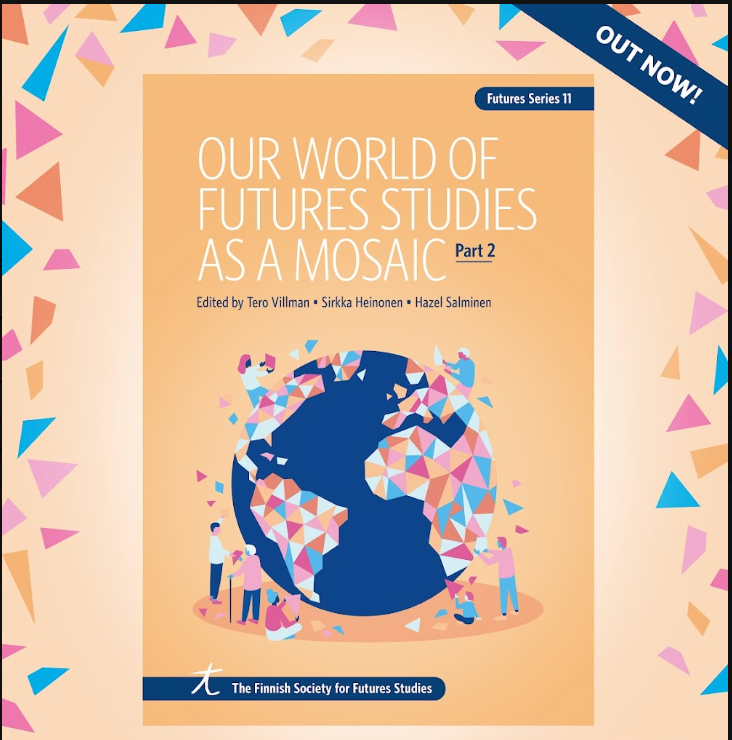
The eleventh volume f the prestigious Futures Series, published by the Finnish Society for Futures Studies, is officially out. Titled “Our World of Futures Studies as a Mosaic 2 (Futures Series 11)“ and edited by Tero Villman, Sirkka Heinonen, and Hazel Salminen, this volume continues the evocative mosaic metaphor introduced in 2024 and was officially launched and presented during the recent Futures Conference 2026 in Turku
By bringing together twelve chapters from five continents and two international networks, the publication highlights how regional, cultural, and linguistic contexts shape the evolution of foresight. Notably, the volume features an extraordinary footprint from The Millennium Project, with a vast majority of the research, leadership, and insights driven directly by our global network of Chairs, Co-Chairs, and Node members.
This collaborative connection begins at the editorial level, with Sirkka Heinonen, Co-Chair of the Helsinki Node, serving as one of the volume’s key editors. The deep dive into regional foresight continues in Latin America, where Guillermo Gándara Fierro—Co-Chair of the Mexico Node and President of RIBER, contributes two pivotal pieces. He solo-authors a study titled “Mexico 2050: A National Foresight Mosaic in Collective Construction and the Application of Global Challenges at Country Scale”, and co-authored a retrospective with Karelys Abarca titled “A Decade of RIBER in Strategic Foresight for Regional Challenges, Scenarios and Transformative Actions: Towards Latin America 2050”. Further south, Paola Aceituno O., Co-Chair of the Mendoza Node, addresses structural challenges in Chile with her piece, “From the Planning State to the Anticipatory State: The challenge of institutionalizing futures studies in Chile”.
Moving across the globe to Asia and Oceania, the volume highlights the critical role of decolonial thinking and institutional history. Shermon Cruz, Chair of the Philippines Node, explores local roots and evolution in “From Probing Our Futures to Decolonial Foresight: The Origins and Evolution of Futures Studies and Foresight in the Philippines”. Meanwhile, Yuna Lee, a member of the South-Korea Node, brings an institutional lens to the collection with two distinct chapters: “US Congressional Foresight: Revisiting history and contemporary practice”, and a co-authored piece with Ian Miles titled “The UK National Foresight Programme—and Beyond”.
The European landscape is equally well-represented, addressing both geopolitical resilience and network governance. Mara di Berardo, Director of Communication of the Millennium Project and Co-chair of the Italy Node, provides a comprehensive overview of network structures in her chapter, “Foresight Europe Network: history, leadership, and future direction”, highlighting FEN’s role as a regional node of The Millennium Project. Additionally, Iryna Gerasymenko, a member of the Ukraine Node, collaborates with Olena Sushyi to map out practical applications in “Institutional Landscape and Practices of Futures Studies and Foresight in Ukraine”. Additionally,
Our World of Futures Studies as a Mosaic 2 stands as a powerful testament to the strength of international cooperation, inviting readers to view regional differences not as barriers, but as essential sources of inspiration and mutual learning.
The publication is openly accessible in digital format.